




Why is the Diels Alder reaction classified as a \[{\mathbf{4}} + {\mathbf{2}}\] cycloaddition?
Answer
 Verified
485.4k+ views
Hint: The coordinated joining together of two distinct pi-electron systems to generate a new ring of atoms is known as a cycloaddition reaction. Because the diene has four pi-electrons that shift position in the reaction and the dienophile has two, the Diels-Alder cycloaddition is classed as a $[4 + 2]$ process.
Complete step by step Answer:
The Diels-Alder reaction is an example of an organic chemical reaction that follows a pericyclic pathway rather than a polar or free radical pathway. The $[4 + 2]$ -cycload addition of a conjugated diene with a dienophile (an alkene or alkyne), an electrocyclic process involving the diene's $4$ and dienophile's $2$ electrons. The production of new -bonds, which are energetically more stable than the -bonds, is the reaction's driving force.
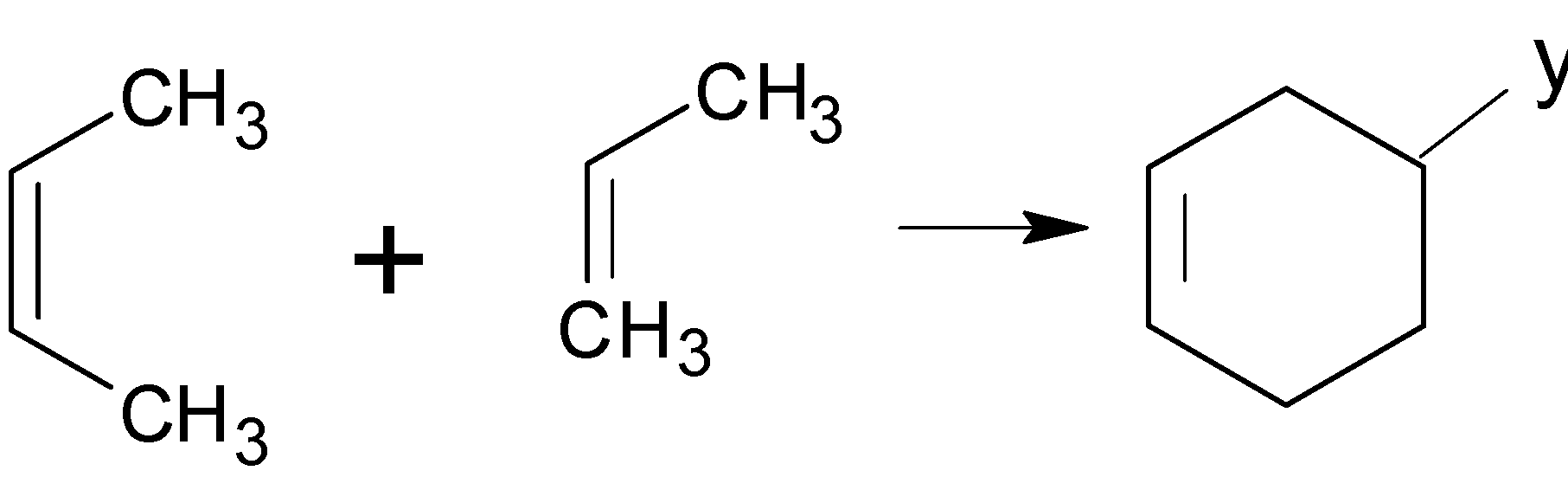
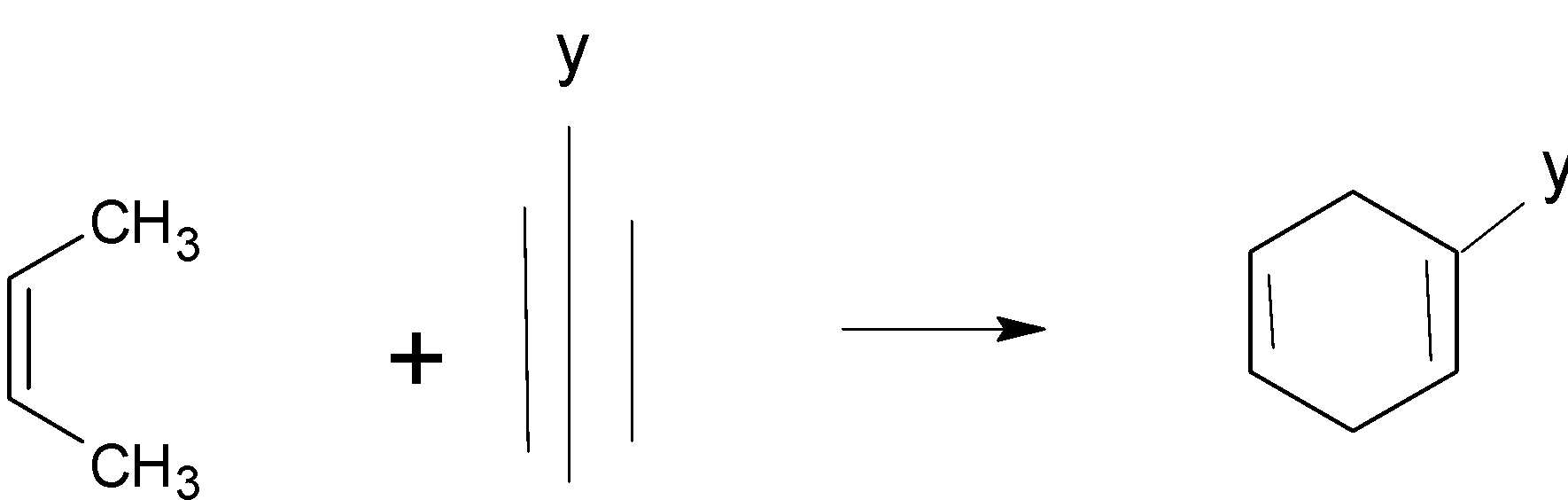
For a reaction to occur, the conjugated diene must be s-cis. Otherwise, the diene’s carbons $1$ and $4$ are too far apart to react in a coordinated manner. (Trans-$1,3$-butadiene, thus would not react) .When the reactants are symmetrical or don't have any electron-withdrawing/donating groups, they're pretty much all like that (with heat).
Mechanism:
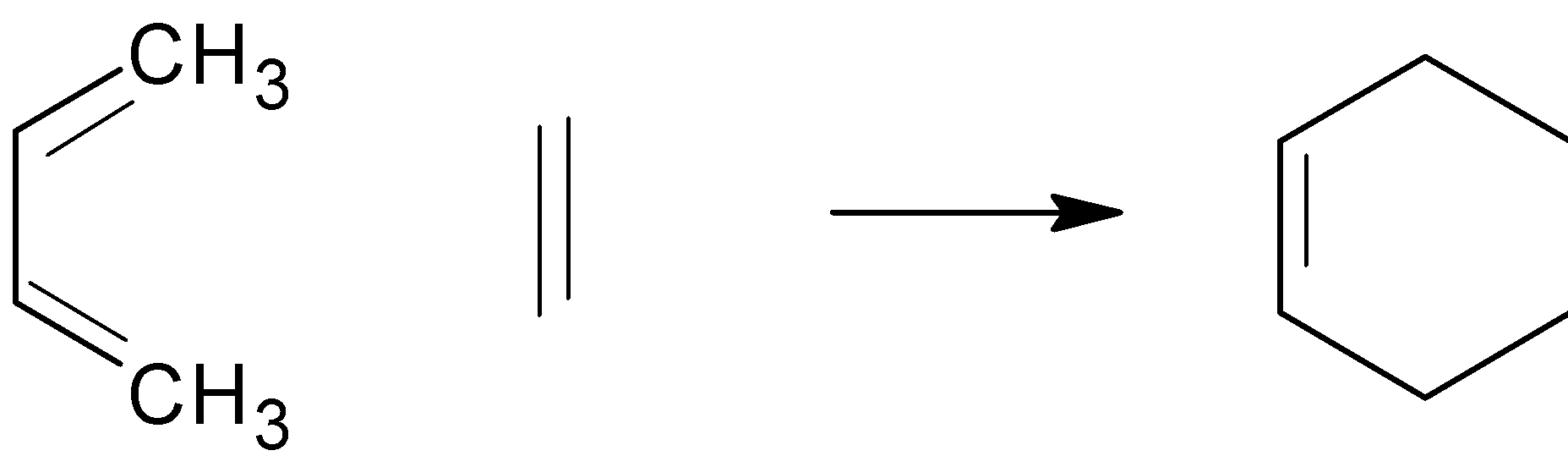
Conjugated Diene $ + $ Substituted $ \to $ Substituted Cyclohexane ($4 + 2$ cycloaddition)
Two pi bonds were changed into two sigma bonds in the above image. This is due to the coordinated bonding of two separate pi-electron systems. In addition, the Diels-Alder reaction requires the shift of four diene pi electrons and two dienophile pi electrons.
Note:
In the industrial synthesis of cyclopentadiene, the reverse Diels-Alder process is used. Many norbornane, which are common monomers, are produced from cyclopentadiene. In the manufacture of vitamin $B6$, the Diels-Alder process is also used. Vitamin \[B6\] is made via this process. On a large scale, the reverse reaction (also known as a retro-Diels-Alder reaction) is utilised to create cyclopentadiene.
Complete step by step Answer:
The Diels-Alder reaction is an example of an organic chemical reaction that follows a pericyclic pathway rather than a polar or free radical pathway. The $[4 + 2]$ -cycload addition of a conjugated diene with a dienophile (an alkene or alkyne), an electrocyclic process involving the diene's $4$ and dienophile's $2$ electrons. The production of new -bonds, which are energetically more stable than the -bonds, is the reaction's driving force.
For a reaction to occur, the conjugated diene must be s-cis. Otherwise, the diene’s carbons $1$ and $4$ are too far apart to react in a coordinated manner. (Trans-$1,3$-butadiene, thus would not react) .When the reactants are symmetrical or don't have any electron-withdrawing/donating groups, they're pretty much all like that (with heat).
Mechanism:
Conjugated Diene $ + $ Substituted $ \to $ Substituted Cyclohexane ($4 + 2$ cycloaddition)
Two pi bonds were changed into two sigma bonds in the above image. This is due to the coordinated bonding of two separate pi-electron systems. In addition, the Diels-Alder reaction requires the shift of four diene pi electrons and two dienophile pi electrons.
Note:
In the industrial synthesis of cyclopentadiene, the reverse Diels-Alder process is used. Many norbornane, which are common monomers, are produced from cyclopentadiene. In the manufacture of vitamin $B6$, the Diels-Alder process is also used. Vitamin \[B6\] is made via this process. On a large scale, the reverse reaction (also known as a retro-Diels-Alder reaction) is utilised to create cyclopentadiene.
Recently Updated Pages
Master Class 11 Social Science: Engaging Questions & Answers for Success

Master Class 11 Physics: Engaging Questions & Answers for Success
Master Class 11 Maths: Engaging Questions & Answers for Success
Master Class 11 Economics: Engaging Questions & Answers for Success
Master Class 11 Computer Science: Engaging Questions & Answers for Success
Master Class 11 Chemistry: Engaging Questions & Answers for Success
Trending doubts
One Metric ton is equal to kg A 10000 B 1000 C 100 class 11 physics CBSE
There are 720 permutations of the digits 1 2 3 4 5 class 11 maths CBSE
1 Quintal is equal to a 110 kg b 10 kg c 100kg d 1000 class 11 physics CBSE
State and prove Bernoullis theorem class 11 physics CBSE
Difference Between Prokaryotic Cells and Eukaryotic Cells
Discuss the various forms of bacteria class 11 biology CBSE