




What did Oersted do in the experiment?
(A) Placed a compass near an electromagnet and observed its deflection
(B) Placed a compass near a magnet and observed the deflection of compass needle
(C) Placed a compass near a current carrying wire and observed the deflection of compass needle
(D) Placed a compass near an electrolyte and observed the deflection of compass needle
Answer
 Verified
590.4k+ views
Hint: Oersted discovered the relationship between electricity and magnetism. In his experiment he noticed that when a magnetic compass is placed near a current carrying wire, it produces a magnetic field around it which deflects the compass needle.
Complete answer:
According to Oersted's experiment, a magnetic compass is placed near a current carrying wire as shown in the circuit below.
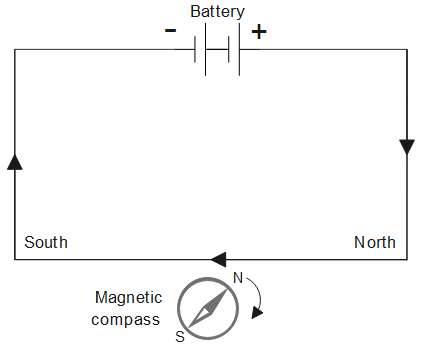
When current flows in the circuit, the electrons moving in the wire give rise to a magnetic field around it. By placing the magnetic compass, the north of the needle is deflected as shown in the figure above. The direction of the north of the compass needle points can be found by the current using the right hand rule. If the right hand is wrapped around the wire as that the thumb points in the direction of current in the wire, then the fingers will curl around the wire and point to the direction of the magnetic field produced by the wire.
The magnetic field lines produced by the current carrying wire are perpendicular to the plane of the wire. If the direction of the current in the wire is reversed by inverting the battery’s positive and negative terminal, then the direction of the magnetic field is also reversed and the needle of the magnetic compass deflects in the opposite direction as that in the first case.
Thus, the correct answer is option (C).
Note:
The method to determine the direction of magnetic field produced by a current carrying wire by using the right hand rule should be important to remember and the direction of the thumb should be the same as the direction of the current.
Complete answer:
According to Oersted's experiment, a magnetic compass is placed near a current carrying wire as shown in the circuit below.
When current flows in the circuit, the electrons moving in the wire give rise to a magnetic field around it. By placing the magnetic compass, the north of the needle is deflected as shown in the figure above. The direction of the north of the compass needle points can be found by the current using the right hand rule. If the right hand is wrapped around the wire as that the thumb points in the direction of current in the wire, then the fingers will curl around the wire and point to the direction of the magnetic field produced by the wire.
The magnetic field lines produced by the current carrying wire are perpendicular to the plane of the wire. If the direction of the current in the wire is reversed by inverting the battery’s positive and negative terminal, then the direction of the magnetic field is also reversed and the needle of the magnetic compass deflects in the opposite direction as that in the first case.
Thus, the correct answer is option (C).
Note:
The method to determine the direction of magnetic field produced by a current carrying wire by using the right hand rule should be important to remember and the direction of the thumb should be the same as the direction of the current.
Recently Updated Pages
Master Class 11 English: Engaging Questions & Answers for Success

Master Class 11 Social Science: Engaging Questions & Answers for Success
Master Class 11 Maths: Engaging Questions & Answers for Success
Master Class 11 Biology: Engaging Questions & Answers for Success
Master Class 11 Physics: Engaging Questions & Answers for Success
Master Class 11 Chemistry: Engaging Questions & Answers for Success
Trending doubts
Explain the Treaty of Vienna of 1815 class 10 social science CBSE
What is the full form of POSCO class 10 social science CBSE
Define Potential, Developed, Stock and Reserved resources
Why is Venus called Earths sister planet class 10 physics CBSE
10 examples of evaporation in daily life with explanations
Identify the plural form of the word child from the class 10 english CBSE