




Diameter of prokaryotic and eukaryotic cells are respectively:
A) \[0.2 - 10\mu {m^3}and{\text{ }}1000 - 10000\mu {m^3}\]
B) \[3.1 - 10\mu m3and{\text{ }}100 - 1000\mu m3\]
C) \[0.1 - 5.0\mu {m^3}3 - 30\mu {m^{3\;}}\]
D) \[{\text{ }}0.1 - 1.0\mu m3and{\text{ }}10 - 100\mu m3\]
Answer
 Verified
570.3k+ views
Hint: Cells that have membrane-bound nuclei are called eukaryotic whereas those that lack a membrane-bound nucleus are termed prokaryotic. In both prokaryotic and eukaryotic cells, a semi-fluid matrix exists.it is called cytoplasm.
Complete answer:
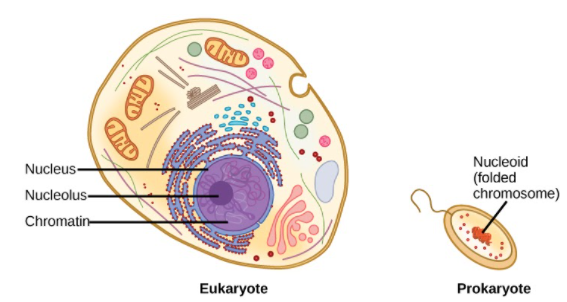
The prokaryotic cells are represented by bacteria, blue-green algae, mycoplasma and PPLO. They are generally smaller in size and multiply much faster than eukaryotic cells. They may vary greatly in shape and size but exhibit a similar basic cellular organisation.
Most prokaryotes have a cell wall surrounding the cell membrane. The fluid matrix filing the cell is the cytoplasm. There is no well-defined nucleus. The genetic material is basically naked, it is not enveloped by a nuclear membrane.
Eukaryotic cells are those which possess an organised nucleus with a nuclear envelope. Some of the important characteristics of eukaryotic cells are cytoskeletal structure, membrane-bound organelles and organisation of genetic material into chromosomes. These cells occur in Protists, fungi, plants and animals. Prokaryotic cells are very small and eukaryotic cells are comparatively larger. Hence, \[0.1 - 5.0\mu {m^3}3 - 30\mu {m^{3\;}}\] is the correct answer.
Therfore the correct answer is option ‘C’.
Note: Ribosomes are non-membrane bound organelles found in the cells of both eukaryotic and prokaryotes. Within the cell, ribosomes are found not only in the cytoplasm but also within the two organelles. In both prokaryotic and eukaryotic cells, a semi-fluid matrix exists.it is called cytoplasm.
Complete answer:
The prokaryotic cells are represented by bacteria, blue-green algae, mycoplasma and PPLO. They are generally smaller in size and multiply much faster than eukaryotic cells. They may vary greatly in shape and size but exhibit a similar basic cellular organisation.
Most prokaryotes have a cell wall surrounding the cell membrane. The fluid matrix filing the cell is the cytoplasm. There is no well-defined nucleus. The genetic material is basically naked, it is not enveloped by a nuclear membrane.
Eukaryotic cells are those which possess an organised nucleus with a nuclear envelope. Some of the important characteristics of eukaryotic cells are cytoskeletal structure, membrane-bound organelles and organisation of genetic material into chromosomes. These cells occur in Protists, fungi, plants and animals. Prokaryotic cells are very small and eukaryotic cells are comparatively larger. Hence, \[0.1 - 5.0\mu {m^3}3 - 30\mu {m^{3\;}}\] is the correct answer.
Therfore the correct answer is option ‘C’.
Note: Ribosomes are non-membrane bound organelles found in the cells of both eukaryotic and prokaryotes. Within the cell, ribosomes are found not only in the cytoplasm but also within the two organelles. In both prokaryotic and eukaryotic cells, a semi-fluid matrix exists.it is called cytoplasm.
Recently Updated Pages
Class 10 Question and Answer - Your Ultimate Solutions Guide

Master Class 10 Computer Science: Engaging Questions & Answers for Success
Master Class 10 General Knowledge: Engaging Questions & Answers for Success
Master Class 12 Economics: Engaging Questions & Answers for Success
Master Class 12 Social Science: Engaging Questions & Answers for Success
Master Class 12 English: Engaging Questions & Answers for Success
Trending doubts
Explain the Treaty of Vienna of 1815 class 10 social science CBSE
The slogan Jai Hind was given by A Lal Bahadur Shastri class 10 social science CBSE
10 examples of evaporation in daily life with explanations
What is the full form of POSCO class 10 social science CBSE
Five things I will do to build a great India class 10 english CBSE
Identify the feminine form of noun nephew a shenephew class 10 english CBSE