




Diameter of cylinder A is 7 cm, and the height is 14 cm. Diameter of cylinder B is 14 cm and height is 7 cm. Without doing any calculations can you suggest whose volume is greater? Verify it by finding the volume of both cylinders. Check whether the cylinder with greater volume also has greater surface area?
Answer
 Verified
578.7k+ views
Hint: The volume of a cylinder is given by the formula \[V = \pi {r^2}h\] and its surface area \[S = 2\pi r\left( {r + h} \right)\] . In this question the height and the diameter of the base of the two cylinders are given so by substituting the value of height and diameter we will check whether which cylinder has the greater volume and the greater surface area.
Complete step-by-step answer:
Given
The diameter of cylinder A is \[{d_A} = 7\;cm\]
The height of cylinder A is \[{h_A} = 14\;cm\]
The diameter of cylinder B is \[{d_B} = 14\;cm\]
The height of cylinder B is \[{h_B} = 14\;cm\]
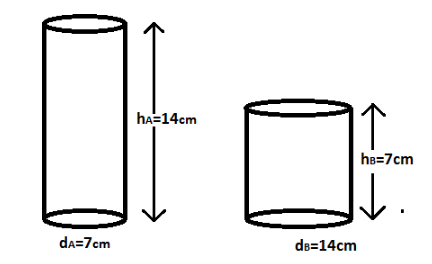
So we can see from the figure the diameter of cylinder A is less than the diameter of cylinder B \[{d_A} < {d_B}\] and the height of cylinder A is more than the height of cylinder B \[{d_A} > {d_B}\]
Now as we know the volume of the cylinder is given by the formula \[V = \pi {\left( {\dfrac{d}{2}} \right)^2}h\] , hence we can say the volume of cylinder B is greater than that of cylinder A
Now to find the volume of the cylinders A and cylinder B we will use the formula \[V = \pi {\left( {\dfrac{d}{2}} \right)^2}h\] , by substituting the given data in the formula
Hence the volume of the cylinders A,
\[
{V_A} = \pi {\left( {\dfrac{{{d_A}}}{2}} \right)^2}{h_A} \\
= \pi {\left( {\dfrac{7}{2}} \right)^2}14 \\
= \dfrac{{22}}{7} \times \left( {\dfrac{7}{2}} \right) \times \left( {\dfrac{7}{2}} \right) \times 14 \\
= 539\;c{m^3} \;
\]
Also the volume of the cylinders B,
\[
{V_B} = \pi {\left( {\dfrac{{{d_B}}}{2}} \right)^2}{h_B} \\
= \pi {\left( {\dfrac{{14}}{2}} \right)^2}7 \\
= \dfrac{{22}}{7} \times \left( {\dfrac{{14}}{2}} \right) \times \left( {\dfrac{{14}}{2}} \right) \times 7 \\
= 1078\;c{m^3} \;
\]
Hence verified \[{V_B} > {V_A}\]
So, the correct answer is “ \[{V_B} > {V_A}\]”.
Now we know the surface area of a cylinder is given by the formula \[S = 2\pi r\left( {r + h} \right)\] so by substituting the values in the surface area formula we can say
The surface area of the cylinders A,
\[
{S_A} = 2\pi \left( {\dfrac{{{d_A}}}{2}} \right)\left( {\dfrac{{{d_A}}}{2} + {h_A}} \right) \\
= 2 \times \dfrac{{22}}{7}\left( {\dfrac{7}{2}} \right)\left( {\dfrac{7}{2} + 14} \right) \\
= 2 \times \dfrac{{22}}{7} \times \left( {\dfrac{7}{2}} \right) \times \left( {\dfrac{{7 + 28}}{2}} \right) \\
= 2 \times \dfrac{{22}}{7} \times \left( {\dfrac{7}{2}} \right) \times \left( {\dfrac{{35}}{2}} \right) \\
= 385\;cm^2 \;
\]
And also the surface area of the cylinders B,
\[
{S_B} = 2\pi \left( {\dfrac{{{d_B}}}{2}} \right)\left( {\dfrac{{{d_B}}}{2} + {h_B}} \right) \\
= 2 \times \dfrac{{22}}{7}\left( {\dfrac{{14}}{2}} \right)\left( {\dfrac{{14}}{2} + 7} \right) \\
= 2 \times \dfrac{{22}}{7} \times \left( {\dfrac{{14}}{2}} \right) \times \left( {\dfrac{{14 + 14}}{2}} \right) \\
= 2 \times \dfrac{{22}}{7} \times \left( {\dfrac{14}{2}} \right) \times \left( {\dfrac{{28}}{2}} \right) \\
= 616\;cm^2 \;
\]
Hence we can say Cylinder B has greater surface area than Cylinder A.
So, the correct answer is “Cylinder B has greater surface area than Cylinder A”.
Note: Students can also find weather which cylinder has more volume just by filling water or the fluid substance in both the cylinder and the cylinder which take more intake of that fluid will have more volume since volume is also known as the capacity of a body.
Complete step-by-step answer:
Given
The diameter of cylinder A is \[{d_A} = 7\;cm\]
The height of cylinder A is \[{h_A} = 14\;cm\]
The diameter of cylinder B is \[{d_B} = 14\;cm\]
The height of cylinder B is \[{h_B} = 14\;cm\]
So we can see from the figure the diameter of cylinder A is less than the diameter of cylinder B \[{d_A} < {d_B}\] and the height of cylinder A is more than the height of cylinder B \[{d_A} > {d_B}\]
Now as we know the volume of the cylinder is given by the formula \[V = \pi {\left( {\dfrac{d}{2}} \right)^2}h\] , hence we can say the volume of cylinder B is greater than that of cylinder A
Now to find the volume of the cylinders A and cylinder B we will use the formula \[V = \pi {\left( {\dfrac{d}{2}} \right)^2}h\] , by substituting the given data in the formula
Hence the volume of the cylinders A,
\[
{V_A} = \pi {\left( {\dfrac{{{d_A}}}{2}} \right)^2}{h_A} \\
= \pi {\left( {\dfrac{7}{2}} \right)^2}14 \\
= \dfrac{{22}}{7} \times \left( {\dfrac{7}{2}} \right) \times \left( {\dfrac{7}{2}} \right) \times 14 \\
= 539\;c{m^3} \;
\]
Also the volume of the cylinders B,
\[
{V_B} = \pi {\left( {\dfrac{{{d_B}}}{2}} \right)^2}{h_B} \\
= \pi {\left( {\dfrac{{14}}{2}} \right)^2}7 \\
= \dfrac{{22}}{7} \times \left( {\dfrac{{14}}{2}} \right) \times \left( {\dfrac{{14}}{2}} \right) \times 7 \\
= 1078\;c{m^3} \;
\]
Hence verified \[{V_B} > {V_A}\]
So, the correct answer is “ \[{V_B} > {V_A}\]”.
Now we know the surface area of a cylinder is given by the formula \[S = 2\pi r\left( {r + h} \right)\] so by substituting the values in the surface area formula we can say
The surface area of the cylinders A,
\[
{S_A} = 2\pi \left( {\dfrac{{{d_A}}}{2}} \right)\left( {\dfrac{{{d_A}}}{2} + {h_A}} \right) \\
= 2 \times \dfrac{{22}}{7}\left( {\dfrac{7}{2}} \right)\left( {\dfrac{7}{2} + 14} \right) \\
= 2 \times \dfrac{{22}}{7} \times \left( {\dfrac{7}{2}} \right) \times \left( {\dfrac{{7 + 28}}{2}} \right) \\
= 2 \times \dfrac{{22}}{7} \times \left( {\dfrac{7}{2}} \right) \times \left( {\dfrac{{35}}{2}} \right) \\
= 385\;cm^2 \;
\]
And also the surface area of the cylinders B,
\[
{S_B} = 2\pi \left( {\dfrac{{{d_B}}}{2}} \right)\left( {\dfrac{{{d_B}}}{2} + {h_B}} \right) \\
= 2 \times \dfrac{{22}}{7}\left( {\dfrac{{14}}{2}} \right)\left( {\dfrac{{14}}{2} + 7} \right) \\
= 2 \times \dfrac{{22}}{7} \times \left( {\dfrac{{14}}{2}} \right) \times \left( {\dfrac{{14 + 14}}{2}} \right) \\
= 2 \times \dfrac{{22}}{7} \times \left( {\dfrac{14}{2}} \right) \times \left( {\dfrac{{28}}{2}} \right) \\
= 616\;cm^2 \;
\]
Hence we can say Cylinder B has greater surface area than Cylinder A.
So, the correct answer is “Cylinder B has greater surface area than Cylinder A”.
Note: Students can also find weather which cylinder has more volume just by filling water or the fluid substance in both the cylinder and the cylinder which take more intake of that fluid will have more volume since volume is also known as the capacity of a body.
Recently Updated Pages
Master Class 9 Social Science: Engaging Questions & Answers for Success

Master Class 9 Science: Engaging Questions & Answers for Success
Master Class 9 Maths: Engaging Questions & Answers for Success
Master Class 9 General Knowledge: Engaging Questions & Answers for Success
Class 9 Question and Answer - Your Ultimate Solutions Guide
Master Class 8 Social Science: Engaging Questions & Answers for Success
Trending doubts
Find the sum of series 1 + 2 + 3 + 4 + 5 + + 100 class 9 maths CBSE
What is the Full Form of ISI and RAW
Fill the blanks with the suitable prepositions 1 The class 9 english CBSE
Difference Between Plant Cell and Animal Cell
Who is eligible for RTE class 9 social science CBSE
What is pollution? How many types of pollution? Define it