




How many diagonals does a convex quadrilateral have?
[a] 1
[b] 2
[c] 3
[d] 4
Answer
 Verified
652.8k+ views
Hint: Recall that a diagonal is a line segment formed by two points of a polygon such that the points are not connected by the side of the polygon. Use the definition of a convex polygon and think how many diagonals can a convex quadrilateral have.
Complete step-by-step answer:
We know that a diagonal of a polygon is a line segment formed by joining two points of the polygon which are not connected by the side of the polygon.
A convex polygon is a polygon having the following property:
If any two points A and B are inside the polygon, then the whole line segment AB is inside the polygon. Hence a convex quadrilateral has all angles smaller than $180{}^\circ $.
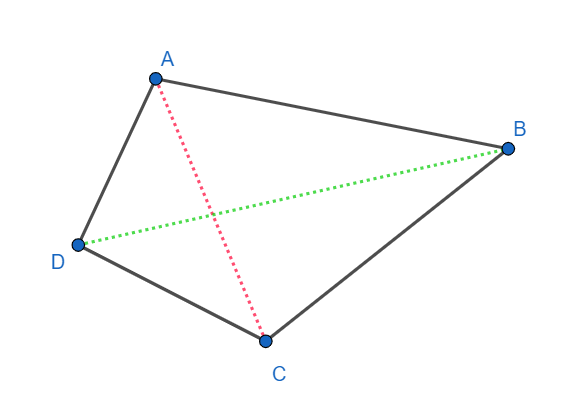
ABCD is an example of a convex quadrilateral. It is clear from the picture that only the pairs of point (A, C) and (B, D) are not connected by a side.
Hence ABCD has two diagonals AC and BD.
Hence a convex quadrilateral has 2 diagonals.
Hence option [b] is correct.
Note: Alternatively, we know that the number of diagonals in a polygon of n sides is given by
$\dfrac{\left( n \right)\left( n-3 \right)}{2}$.
Put n= 4, we get
The number of diagonals in a quadrilateral $=\dfrac{4\left( 1 \right)}{2}=2$
Hence option [b] is correct.
Complete step-by-step answer:
We know that a diagonal of a polygon is a line segment formed by joining two points of the polygon which are not connected by the side of the polygon.
A convex polygon is a polygon having the following property:
If any two points A and B are inside the polygon, then the whole line segment AB is inside the polygon. Hence a convex quadrilateral has all angles smaller than $180{}^\circ $.
ABCD is an example of a convex quadrilateral. It is clear from the picture that only the pairs of point (A, C) and (B, D) are not connected by a side.
Hence ABCD has two diagonals AC and BD.
Hence a convex quadrilateral has 2 diagonals.
Hence option [b] is correct.
Note: Alternatively, we know that the number of diagonals in a polygon of n sides is given by
$\dfrac{\left( n \right)\left( n-3 \right)}{2}$.
Put n= 4, we get
The number of diagonals in a quadrilateral $=\dfrac{4\left( 1 \right)}{2}=2$
Hence option [b] is correct.
Recently Updated Pages
Master Class 11 English: Engaging Questions & Answers for Success

Master Class 11 Social Science: Engaging Questions & Answers for Success
Master Class 11 Maths: Engaging Questions & Answers for Success
Master Class 11 Biology: Engaging Questions & Answers for Success
Master Class 11 Physics: Engaging Questions & Answers for Success
Master Class 11 Chemistry: Engaging Questions & Answers for Success
Trending doubts
Explain the Treaty of Vienna of 1815 class 10 social science CBSE
What is the full form of CNG A Complete Natural Gas class 10 social science CBSE
In cricket, what is a "Yorker" designed to do?
What is the full form of POSCO class 10 social science CBSE
Define Potential, Developed, Stock and Reserved resources
What were the majoritarian measures taken in Sri Lanka class 10 social science CBSE