




How many diagonals are there in a hexagon?
$
A.{\text{ 6}} \\
B.{\text{ 4}} \\
{\text{C}}{\text{. 11}} \\
{\text{D}}{\text{. 9}} \\
$
Answer
 Verified
652.2k+ views
Hint: Here in this question we go through the properties of polygon. We know many types of polygon. For this question we should have to use the properties of the hexagon to find the number of diagonals.
The formula for finding the number of diagonal from n sided polygon I.e. $\left[ {\dfrac{{n(n - 1)}}{2} - n} \right]$
Complete step-by-step answer:
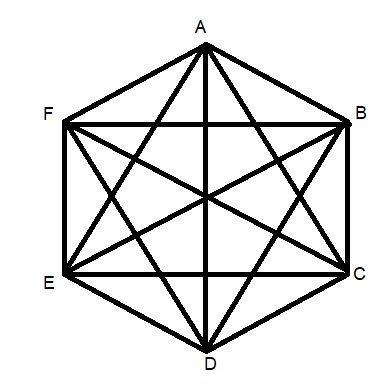
We have to find out the number of diagonals in a hexagon . For this we made the diagram of hexagon recoiling the definition of hexagon.
A hexagon is a polygon with 6 sides and 6 angles. When we join the vertices which are not adjacent we will find the number of diagonals in the hexagon. All the sides of a hexagon meet with each other end to end to form a shape.
By the help of diagrams we can also name the diagonals.
The diagonals are AE, AD, AC, BD, BE, BF, CE, CF and DF.
By counting we can say that, the number of diagonals in hexagon = 9.
So option D is the correct answer.
SECOND METHOD
We know that the formula for finding the number of diagonal from n sided polygon I.e. $\left[ {\dfrac{{n(n - 1)}}{2} - n} \right]$
And here it is a hexagon therefore the value of n is 6.
Now put the value of n in the formula we get,
$
= \left[ {\dfrac{{6(6 - 1)}}{2} - 6} \right] \\
= \dfrac{{6 \times 5}}{2} - 6 \\
= 9 \\
$
Hence option D is the correct answer.
Note: Whenever we face such a question. We have to go through the definition of that figure. And draw the diagram of that figure by the definition and then count the number of diagonals. You will also find the number of diagonals by applying the formula.
The formula for finding the number of diagonal from n sided polygon I.e. $\left[ {\dfrac{{n(n - 1)}}{2} - n} \right]$
Complete step-by-step answer:
We have to find out the number of diagonals in a hexagon . For this we made the diagram of hexagon recoiling the definition of hexagon.
A hexagon is a polygon with 6 sides and 6 angles. When we join the vertices which are not adjacent we will find the number of diagonals in the hexagon. All the sides of a hexagon meet with each other end to end to form a shape.
By the help of diagrams we can also name the diagonals.
The diagonals are AE, AD, AC, BD, BE, BF, CE, CF and DF.
By counting we can say that, the number of diagonals in hexagon = 9.
So option D is the correct answer.
SECOND METHOD
We know that the formula for finding the number of diagonal from n sided polygon I.e. $\left[ {\dfrac{{n(n - 1)}}{2} - n} \right]$
And here it is a hexagon therefore the value of n is 6.
Now put the value of n in the formula we get,
$
= \left[ {\dfrac{{6(6 - 1)}}{2} - 6} \right] \\
= \dfrac{{6 \times 5}}{2} - 6 \\
= 9 \\
$
Hence option D is the correct answer.
Note: Whenever we face such a question. We have to go through the definition of that figure. And draw the diagram of that figure by the definition and then count the number of diagonals. You will also find the number of diagonals by applying the formula.
Recently Updated Pages
Master Class 11 English: Engaging Questions & Answers for Success

Master Class 11 Social Science: Engaging Questions & Answers for Success
Master Class 11 Maths: Engaging Questions & Answers for Success
Master Class 11 Chemistry: Engaging Questions & Answers for Success
Master Class 11 Biology: Engaging Questions & Answers for Success
Master Class 11 Physics: Engaging Questions & Answers for Success
Trending doubts
Explain the Treaty of Vienna of 1815 class 10 social science CBSE
What is the full form of CNG A Complete Natural Gas class 10 social science CBSE
In cricket, what is a "Yorker" designed to do?
What is the full form of POSCO class 10 social science CBSE
Define Potential, Developed, Stock and Reserved resources
What were the majoritarian measures taken in Sri Lanka class 10 social science CBSE