




How do you determine the slant asymptotes of a hyperbola?
Answer
 Verified
615.3k+ views
Hint: To determine the slant asymptote of a hyperbola firstly we should consider the mathematical form of Hyperbola and then modify it such that we get it as equation equating to y and then the equation is simplified with the assumptions we make. The values obtained are the slant asymptotes of the hyperbola.
Complete step-by-step solution:
Let us find the slant asymptotes of a hyperbola of the form, the mathematical representation of a hyperbola is as below,
\[\dfrac{{{x}^{2}}}{{{a}^{2}}}-\dfrac{{{y}^{2}}}{{{b}^{2}}}=1\]
By subtracting \[\dfrac{{{x}^{2}}}{{{a}^{2}}}\] on both LHS and RHS we get,
\[\Rightarrow \dfrac{{{x}^{2}}}{{{a}^{2}}}-\dfrac{{{y}^{2}}}{{{b}^{2}}}-\dfrac{{{x}^{2}}}{{{a}^{2}}}=1-\dfrac{{{x}^{2}}}{{{a}^{2}}}\]
\[\Rightarrow -\dfrac{{{y}^{2}}}{{{b}^{2}}}=1-\dfrac{{{x}^{2}}}{{{a}^{2}}}\]
Now we are suppose to multiplying by\[-{{b}^{2}}\], to get only terms of y in the LHS,
\[\Rightarrow {{y}^{2}}=\dfrac{{{b}^{2}}}{{{a}^{2}}}{{x}^{2}}-{{b}^{2}}\]
In next step take the square root on both the side of the equation to remove the square from y term present in the LHS,
\[\Rightarrow y=\pm \sqrt{\dfrac{{{b}^{2}}}{{{a}^{2}}}{{x}^{2}}-{{b}^{2}}}\]
Here For large value of x, we can say that \[-{{b}^{2}}\] in the square root is negligible, so we can neglect it from the above equation, so we can write the equation as mentioned below,
\[\Rightarrow y=\pm \sqrt{\dfrac{{{b}^{2}}}{{{a}^{2}}}{{x}^{2}}-{{b}^{2}}}\approx \pm \sqrt{\dfrac{{{b}^{2}}}{{{a}^{2}}}{{x}^{2}}}=\pm \dfrac{b}{a}x\]
Hence, the slant asymptotes of the hyperbola are as follows,
\[y=\pm \dfrac{b}{a}x\].
i.e. \[y=+\dfrac{b}{a}x\] and \[y=-\dfrac{b}{a}x\]
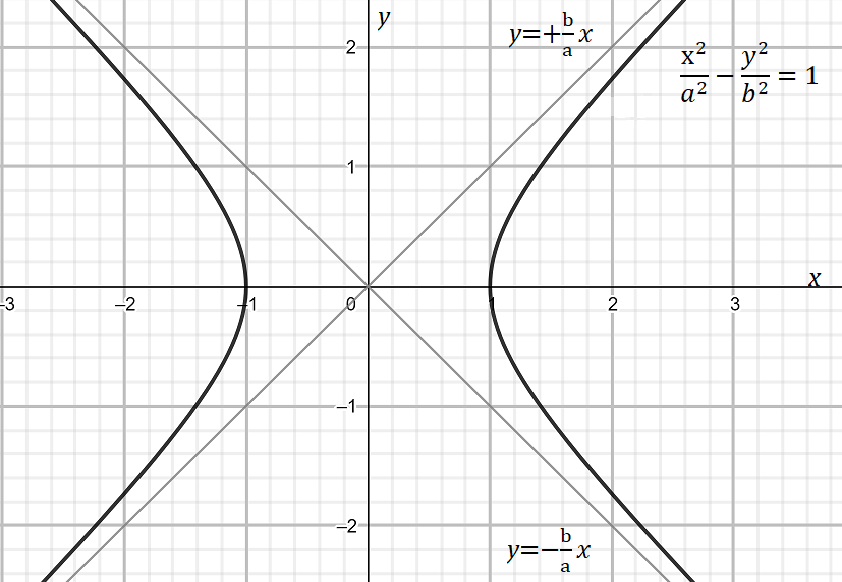
Note: It is required to know the mathematical representation of the hyperbola i.e. \[\dfrac{{{x}^{2}}}{{{a}^{2}}}-\dfrac{{{y}^{2}}}{{{b}^{2}}}=1\]. Students usually can go wrong in transforming the equation to make it equated to y to get the slant asymptotes of hyperbola. It is also necessary to make the assumptions such that we can simplify the equation further.
Complete step-by-step solution:
Let us find the slant asymptotes of a hyperbola of the form, the mathematical representation of a hyperbola is as below,
\[\dfrac{{{x}^{2}}}{{{a}^{2}}}-\dfrac{{{y}^{2}}}{{{b}^{2}}}=1\]
By subtracting \[\dfrac{{{x}^{2}}}{{{a}^{2}}}\] on both LHS and RHS we get,
\[\Rightarrow \dfrac{{{x}^{2}}}{{{a}^{2}}}-\dfrac{{{y}^{2}}}{{{b}^{2}}}-\dfrac{{{x}^{2}}}{{{a}^{2}}}=1-\dfrac{{{x}^{2}}}{{{a}^{2}}}\]
\[\Rightarrow -\dfrac{{{y}^{2}}}{{{b}^{2}}}=1-\dfrac{{{x}^{2}}}{{{a}^{2}}}\]
Now we are suppose to multiplying by\[-{{b}^{2}}\], to get only terms of y in the LHS,
\[\Rightarrow {{y}^{2}}=\dfrac{{{b}^{2}}}{{{a}^{2}}}{{x}^{2}}-{{b}^{2}}\]
In next step take the square root on both the side of the equation to remove the square from y term present in the LHS,
\[\Rightarrow y=\pm \sqrt{\dfrac{{{b}^{2}}}{{{a}^{2}}}{{x}^{2}}-{{b}^{2}}}\]
Here For large value of x, we can say that \[-{{b}^{2}}\] in the square root is negligible, so we can neglect it from the above equation, so we can write the equation as mentioned below,
\[\Rightarrow y=\pm \sqrt{\dfrac{{{b}^{2}}}{{{a}^{2}}}{{x}^{2}}-{{b}^{2}}}\approx \pm \sqrt{\dfrac{{{b}^{2}}}{{{a}^{2}}}{{x}^{2}}}=\pm \dfrac{b}{a}x\]
Hence, the slant asymptotes of the hyperbola are as follows,
\[y=\pm \dfrac{b}{a}x\].
i.e. \[y=+\dfrac{b}{a}x\] and \[y=-\dfrac{b}{a}x\]
Note: It is required to know the mathematical representation of the hyperbola i.e. \[\dfrac{{{x}^{2}}}{{{a}^{2}}}-\dfrac{{{y}^{2}}}{{{b}^{2}}}=1\]. Students usually can go wrong in transforming the equation to make it equated to y to get the slant asymptotes of hyperbola. It is also necessary to make the assumptions such that we can simplify the equation further.
Recently Updated Pages
If x a + bt + ct2 where x is in meters and t is in class 11 physics CBSE

A car covers the first half distance between two places class 11 physics CBSE
The resultant of two vectors overrightarrow P and overrightarrow class 11 physics CBSE
Find the value of cos 135 class 11 maths CBSE
A mass M is held in place by an applied force F and class 11 physics CBSE
A solution of glucose in water is labelled as 10 dfracwv class 11 chemistry CBSE
Trending doubts
One Metric ton is equal to kg A 10000 B 1000 C 100 class 11 physics CBSE
Find the value of the expression given below sin 30circ class 11 maths CBSE
What do you mean by retardation What is its SI uni class 11 physics CBSE
Draw a diagram of nephron and explain its structur class 11 biology CBSE
10 examples of friction in our daily life
Difference between physical and chemical change class 11 chemistry CBSE