




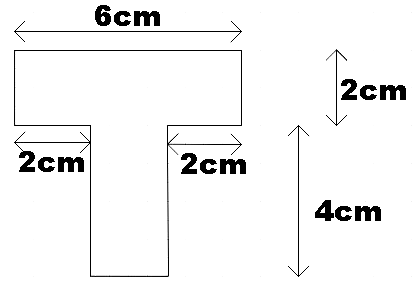
Determine the position of center of mass of the T shaped plate of negligible thickness as shown.
Answer
 Verified
591k+ views
Hint: Firstly separate the T-shaped body into two rectangular parts and thus find their respective centre of masses and express their masses in terms of their mass densities. Then, you could place this plate in an x-y coordinate system. Now, you could recall the expression for X and Y coordinates and then substitute accordingly to get the answer.
Formula used: X and Y-coordinates of centre of mass,
$\overline{X}=\dfrac{{{m}_{1}}{{x}_{1}}+{{m}_{2}}{{x}_{2}}}{{{m}_{1}}+{{m}_{2}}}$
$\overline{Y}=\dfrac{{{m}_{1}}{{y}_{1}}+{{m}_{2}}{{y}_{2}}}{{{m}_{1}}+{{m}_{2}}}$
Complete step by step answer:
In the question we are given a T shaped plate whose thickness is considered negligible being a planar body. Therefore, the whole mass of the plate will be distributed over its area.
The T shaped body could be considered as two triangular parts of mass ${{m}_{1}}$ and${{m}_{2}}$ put together.
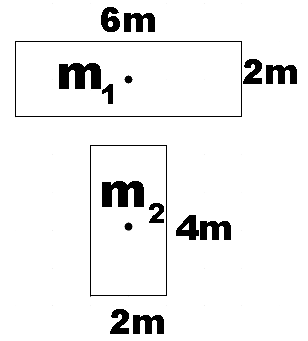
The centre of masses of each part is also marked on the figure. As the mass is equally distributed over the area of the plate, the mass density will be same for both parts and let it be given by m. then,
${{m}_{1}}=m\times {{A}_{1}}=m\left( 6\times 2 \right)$
$\therefore {{m}_{1}}=12m$ …………………………………. (1)
${{m}_{2}}=m\times {{A}_{2}}=m\left( 4\times 2 \right)$
$\therefore {{m}_{2}}=8m$ …………………………………. (2)
The T shaped plate can now be represented on a coordinate axis of x-y plane with O as the origin.
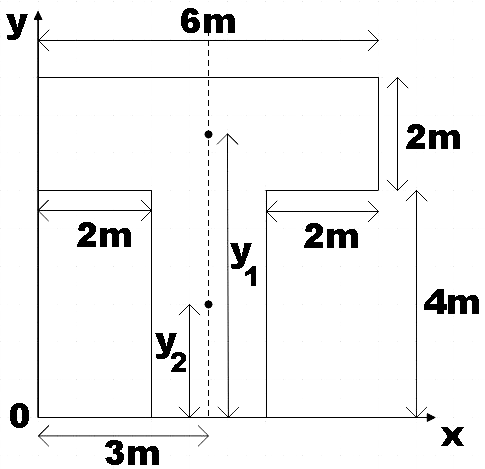
The centre of mass of the whole plate will be on the dotted line connecting the centre of masses of each part (also, by symmetry).
We know that the X and Y coordinates of the centre mass of the system is given respectively as,
$\overline{X}=\dfrac{{{m}_{1}}{{x}_{1}}+{{m}_{2}}{{x}_{2}}}{{{m}_{1}}+{{m}_{2}}}$ ……………………………… (3)
$\overline{Y}=\dfrac{{{m}_{1}}{{y}_{1}}+{{m}_{2}}{{y}_{2}}}{{{m}_{1}}+{{m}_{2}}}$……………………………….. (4)
Now for the X-coordinate, the centre of masses of each part is equidistant from the origin (3m). So,
$\overline{X}=\dfrac{3\left( {{m}_{1}}+{{m}_{2}} \right)}{{{m}_{1}}+{{m}_{2}}}$
Substituting (1) and (2),
$\overline{X}=\dfrac{3\left( 12+8 \right)}{12+8}$
$\therefore \overline{X}=3m$ …………………………………… (5)
Now for the Y-coordinate, centre of masses of parts ${{m}_{1}}$ and ${{m}_{2}}$ are respectively at a distance of ${{y}_{1}}$ and ${{y}_{2}}$ from the origin. So,
$\overline{Y}=\dfrac{{{m}_{1}}{{y}_{1}}+{{m}_{2}}{{y}_{2}}}{{{m}_{1}}+{{m}_{2}}}$
From the figure,
${{y}_{1}}=5m$
${{y}_{2}}=2m$
Substituting these along with (1) and (2), we get,
$\overline{Y}=\dfrac{12\times 5+8\times 2}{12+8}$
Substituting (1) and (2),
$\overline{Y}=\dfrac{60+16}{12+8}$
$\therefore \overline{Y}=3.8m$ …………………………………… (6)
Therefore, from (5) and (6), we see that the X and Y coordinates of the centre of mass of the T plate is given by,$\overline{X}=3m$ and$\overline{Y}=3.8m$.
Hence, the centre of mass of the T-plate is given by,
$\left( \overline{X},\overline{Y} \right)=\left( 3m,3.8m \right)$
Note: Placing the T-shaped plate in the x-y coordinate system is a must step before making the measurements. The distance of the centre of masses of each part should be measured with respect to the coordinate axes, otherwise you will probably end up in the wrong answer. For example, the distance ${{x}_{2}}$ should be measured from the y-axis as 3m, not the end of the plate as 1m.
Formula used: X and Y-coordinates of centre of mass,
$\overline{X}=\dfrac{{{m}_{1}}{{x}_{1}}+{{m}_{2}}{{x}_{2}}}{{{m}_{1}}+{{m}_{2}}}$
$\overline{Y}=\dfrac{{{m}_{1}}{{y}_{1}}+{{m}_{2}}{{y}_{2}}}{{{m}_{1}}+{{m}_{2}}}$
Complete step by step answer:
In the question we are given a T shaped plate whose thickness is considered negligible being a planar body. Therefore, the whole mass of the plate will be distributed over its area.
The T shaped body could be considered as two triangular parts of mass ${{m}_{1}}$ and${{m}_{2}}$ put together.
The centre of masses of each part is also marked on the figure. As the mass is equally distributed over the area of the plate, the mass density will be same for both parts and let it be given by m. then,
${{m}_{1}}=m\times {{A}_{1}}=m\left( 6\times 2 \right)$
$\therefore {{m}_{1}}=12m$ …………………………………. (1)
${{m}_{2}}=m\times {{A}_{2}}=m\left( 4\times 2 \right)$
$\therefore {{m}_{2}}=8m$ …………………………………. (2)
The T shaped plate can now be represented on a coordinate axis of x-y plane with O as the origin.
The centre of mass of the whole plate will be on the dotted line connecting the centre of masses of each part (also, by symmetry).
We know that the X and Y coordinates of the centre mass of the system is given respectively as,
$\overline{X}=\dfrac{{{m}_{1}}{{x}_{1}}+{{m}_{2}}{{x}_{2}}}{{{m}_{1}}+{{m}_{2}}}$ ……………………………… (3)
$\overline{Y}=\dfrac{{{m}_{1}}{{y}_{1}}+{{m}_{2}}{{y}_{2}}}{{{m}_{1}}+{{m}_{2}}}$……………………………….. (4)
Now for the X-coordinate, the centre of masses of each part is equidistant from the origin (3m). So,
$\overline{X}=\dfrac{3\left( {{m}_{1}}+{{m}_{2}} \right)}{{{m}_{1}}+{{m}_{2}}}$
Substituting (1) and (2),
$\overline{X}=\dfrac{3\left( 12+8 \right)}{12+8}$
$\therefore \overline{X}=3m$ …………………………………… (5)
Now for the Y-coordinate, centre of masses of parts ${{m}_{1}}$ and ${{m}_{2}}$ are respectively at a distance of ${{y}_{1}}$ and ${{y}_{2}}$ from the origin. So,
$\overline{Y}=\dfrac{{{m}_{1}}{{y}_{1}}+{{m}_{2}}{{y}_{2}}}{{{m}_{1}}+{{m}_{2}}}$
From the figure,
${{y}_{1}}=5m$
${{y}_{2}}=2m$
Substituting these along with (1) and (2), we get,
$\overline{Y}=\dfrac{12\times 5+8\times 2}{12+8}$
Substituting (1) and (2),
$\overline{Y}=\dfrac{60+16}{12+8}$
$\therefore \overline{Y}=3.8m$ …………………………………… (6)
Therefore, from (5) and (6), we see that the X and Y coordinates of the centre of mass of the T plate is given by,$\overline{X}=3m$ and$\overline{Y}=3.8m$.
Hence, the centre of mass of the T-plate is given by,
$\left( \overline{X},\overline{Y} \right)=\left( 3m,3.8m \right)$
Note: Placing the T-shaped plate in the x-y coordinate system is a must step before making the measurements. The distance of the centre of masses of each part should be measured with respect to the coordinate axes, otherwise you will probably end up in the wrong answer. For example, the distance ${{x}_{2}}$ should be measured from the y-axis as 3m, not the end of the plate as 1m.
Recently Updated Pages
Three beakers labelled as A B and C each containing 25 mL of water were taken A small amount of NaOH anhydrous CuSO4 and NaCl were added to the beakers A B and C respectively It was observed that there was an increase in the temperature of the solutions contained in beakers A and B whereas in case of beaker C the temperature of the solution falls Which one of the following statements isarecorrect i In beakers A and B exothermic process has occurred ii In beakers A and B endothermic process has occurred iii In beaker C exothermic process has occurred iv In beaker C endothermic process has occurred

Master Class 11 Social Science: Engaging Questions & Answers for Success
Master Class 11 Physics: Engaging Questions & Answers for Success
Master Class 11 Maths: Engaging Questions & Answers for Success
Master Class 11 Economics: Engaging Questions & Answers for Success
Master Class 11 Computer Science: Engaging Questions & Answers for Success
Three beakers labelled as A B and C each containing 25 mL of water were taken A small amount of NaOH anhydrous CuSO4 and NaCl were added to the beakers A B and C respectively It was observed that there was an increase in the temperature of the solutions contained in beakers A and B whereas in case of beaker C the temperature of the solution falls Which one of the following statements isarecorrect i In beakers A and B exothermic process has occurred ii In beakers A and B endothermic process has occurred iii In beaker C exothermic process has occurred iv In beaker C endothermic process has occurred
Master Class 11 Social Science: Engaging Questions & Answers for Success
Master Class 11 Physics: Engaging Questions & Answers for Success
Trending doubts
One Metric ton is equal to kg A 10000 B 1000 C 100 class 11 physics CBSE
There are 720 permutations of the digits 1 2 3 4 5 class 11 maths CBSE
State and prove Bernoullis theorem class 11 physics CBSE
Difference Between Prokaryotic Cells and Eukaryotic Cells
1 Quintal is equal to a 110 kg b 10 kg c 100kg d 1000 class 11 physics CBSE
Which among the following are examples of coming together class 11 social science CBSE