




Determine the length of chord, which is at a distance of 7 cm from the circle of radius 25cm.
$\left( a \right)$ 25cm
$\left( b \right)$ 48cm
$\left( c \right)$ 16cm
$\left( d \right)$ 24cm
Answer
 Verified
662.1k+ views
Hint: In this particular question use the concept that the line joining the center and any point of the circumference is nothing but the radius of the circle, so every chord of the circle touches the circle at two points jo join one of the point of the chord to the center of the circle and draw the perpendicular from the center of the circle on the given chord, so use these concepts to reach the solution of the question.
Complete step-by-step answer:
Given data:
Chord is at 7 cm from the circle.
Therefore the shortest distance of the chord from the center of the circle is 7 cm.
Radius of the circle = 25 cm.
Let us consider a circle with center O, and a chord AB as shown in the below figure, join O and A which is the radius of the circle and draw the perpendicular from the center of the circle on the given chord which cuts the chord at point C , so OC = 7 cm as shown in the below figure.
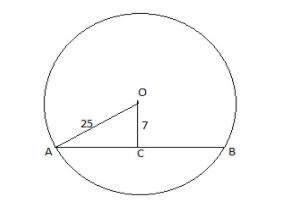
Now as we see that OC is perpendicular to AB, therefore, $\angle OCA = {90^o}$.
So in triangle AOC apply Pythagoras theorem we have,
As we know that according to the Pythagoras theorem that in a right triangle the sum of the square of the base and perpendicular is equal to the square of the hypotenuse.
$ \Rightarrow {\left( {{\text{base}}} \right)^2} + {\left( {{\text{perpendicular}}} \right)^2} = {\left( {{\text{hypotenuse}}} \right)^{^2}}$................. (1)
So in triangle AOC we have,
Base = AC, perpendicular = OC, and hypotenuse = OA.
So from equation (1) we have,
$ \Rightarrow {\left( {{\text{AC}}} \right)^2} + {\left( {{\text{OC}}} \right)^2} = {\left( {{\text{OA}}} \right)^{^2}}$
Now substitute the values we have,
$ \Rightarrow {\left( {{\text{AC}}} \right)^2} + {\left( {\text{7}} \right)^2} = {\left( {{\text{25}}} \right)^{^2}}$
$ \Rightarrow {\left( {{\text{AC}}} \right)^2} = 625 - 49 = 576 = {\left( {24} \right)^2}$
$ \Rightarrow {\text{AC}} = 24$ cm
Now OC is also the bisector of the chord so AB = 2 (AC)
Therefore, the length of chord AB = 2 (24) = 48 cm.
So this is the required length of the chord AB.
So, the correct answer is “Option B”.
Note: Whenever we face such types of question the key concept we have to remember is that always recall the Pythagoras theorem which is stated above then simplify substitute the values as above and simplify we will get the half the length of the chord, then double it we will get the required length of the chord AB.
Complete step-by-step answer:
Given data:
Chord is at 7 cm from the circle.
Therefore the shortest distance of the chord from the center of the circle is 7 cm.
Radius of the circle = 25 cm.
Let us consider a circle with center O, and a chord AB as shown in the below figure, join O and A which is the radius of the circle and draw the perpendicular from the center of the circle on the given chord which cuts the chord at point C , so OC = 7 cm as shown in the below figure.
Now as we see that OC is perpendicular to AB, therefore, $\angle OCA = {90^o}$.
So in triangle AOC apply Pythagoras theorem we have,
As we know that according to the Pythagoras theorem that in a right triangle the sum of the square of the base and perpendicular is equal to the square of the hypotenuse.
$ \Rightarrow {\left( {{\text{base}}} \right)^2} + {\left( {{\text{perpendicular}}} \right)^2} = {\left( {{\text{hypotenuse}}} \right)^{^2}}$................. (1)
So in triangle AOC we have,
Base = AC, perpendicular = OC, and hypotenuse = OA.
So from equation (1) we have,
$ \Rightarrow {\left( {{\text{AC}}} \right)^2} + {\left( {{\text{OC}}} \right)^2} = {\left( {{\text{OA}}} \right)^{^2}}$
Now substitute the values we have,
$ \Rightarrow {\left( {{\text{AC}}} \right)^2} + {\left( {\text{7}} \right)^2} = {\left( {{\text{25}}} \right)^{^2}}$
$ \Rightarrow {\left( {{\text{AC}}} \right)^2} = 625 - 49 = 576 = {\left( {24} \right)^2}$
$ \Rightarrow {\text{AC}} = 24$ cm
Now OC is also the bisector of the chord so AB = 2 (AC)
Therefore, the length of chord AB = 2 (24) = 48 cm.
So this is the required length of the chord AB.
So, the correct answer is “Option B”.
Note: Whenever we face such types of question the key concept we have to remember is that always recall the Pythagoras theorem which is stated above then simplify substitute the values as above and simplify we will get the half the length of the chord, then double it we will get the required length of the chord AB.
Recently Updated Pages
What are the two major island groups in India class 9 social science CBSE

What is Jhum cultivation class 9 biology CBSE
Write an Article on Save Earth Save Life
Silk is obtained from of the silk moth APupa BLarva class 9 chemistry CBSE
Write chemical formulas of the following compounds class 9 chemistry CBSE
The Indo Gangetic Plains of India are fertile due to class 9 social science CBSE
Trending doubts
Fill the blanks with the suitable prepositions 1 The class 9 english CBSE
Difference Between Plant Cell and Animal Cell
Name 10 Living and Non living things class 9 biology CBSE
What is the full form of pH?
On an outline map of India show its neighbouring c class 9 social science CBSE
What is pollution? How many types of pollution? Define it