




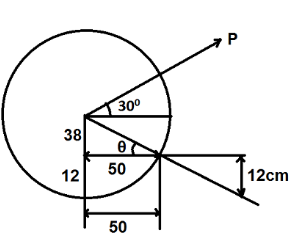
Determine the force P applied at \[{30^ \circ }\] to the horizontal just necessary to start a roller having radius \[50cm\;\] over an obstruction \[12cm\;\] high. If the roller is of mass \[100kg\;\] as shown in figure, also find the magnitude of P when it is minimum.
Answer
 Verified
566.1k+ views
Hint:To solve this problem, we need to use the concept of moment about a point due to forces applied. Here, we will determine the moment about a point where the roller touches the obstruction. We know that to move the roller over the obstruction, the force P should balance the anticlockwise moment due to the weight of the roller about the contact point with the same clockwise moment.
Complete step by step answer:
To solve this question, we will consider the following diagram showing the system of forces required to move the roller over the obstruction.
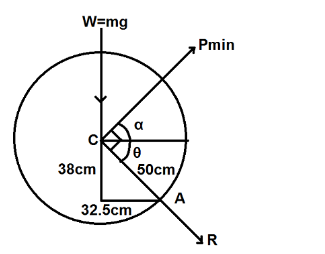
Let A be the contact point of the roller and the obstruction and C be the center of the roller.
From the geometry, we can say that the angle $\theta $ can be calculated as:
$\tan \alpha = \dfrac{{38}}{{32.5}} = 1.169 \\
\Rightarrow \theta = {\tan ^{ - 1}}1.169 = 49.46 \\ $
It is clear from the figure that
$\alpha + \theta = 90 \\
\Rightarrow \alpha = 90 - 49.46 = 40.54 \\ $
For the roller to move over the obstruction, the total moment about the point A must be zero.
$\sum {{M_A}} = 0 \\
\Rightarrow W \times 32.5 - {P_{\min }} \times 50 = 0 \\
\Rightarrow {P_{\min }} = \dfrac{{mg \times 32.5}}{{50}} \\ $
We are given that the mass of the roller $m = 100kg$ and we will take the gravitational acceleration $g = 9.81m/{s^2}$.
${P_{\min }} = \dfrac{{100 \times 9.81 \times 32.5}}{{50}} \\
\therefore {P_{\min }} = 637.65N$
Hence, the magnitude of P when it is minimum is 637.65N.
Note:We have considered that the maximum distance between the point A and line of action of P is AC. Therefore, to create a given moment about A, the force P will be minimum when it acts perpendicular to the line AC. That is why we have considered angle $\alpha $ as the direction of the minimum force.
Complete step by step answer:
To solve this question, we will consider the following diagram showing the system of forces required to move the roller over the obstruction.
Let A be the contact point of the roller and the obstruction and C be the center of the roller.
From the geometry, we can say that the angle $\theta $ can be calculated as:
$\tan \alpha = \dfrac{{38}}{{32.5}} = 1.169 \\
\Rightarrow \theta = {\tan ^{ - 1}}1.169 = 49.46 \\ $
It is clear from the figure that
$\alpha + \theta = 90 \\
\Rightarrow \alpha = 90 - 49.46 = 40.54 \\ $
For the roller to move over the obstruction, the total moment about the point A must be zero.
$\sum {{M_A}} = 0 \\
\Rightarrow W \times 32.5 - {P_{\min }} \times 50 = 0 \\
\Rightarrow {P_{\min }} = \dfrac{{mg \times 32.5}}{{50}} \\ $
We are given that the mass of the roller $m = 100kg$ and we will take the gravitational acceleration $g = 9.81m/{s^2}$.
${P_{\min }} = \dfrac{{100 \times 9.81 \times 32.5}}{{50}} \\
\therefore {P_{\min }} = 637.65N$
Hence, the magnitude of P when it is minimum is 637.65N.
Note:We have considered that the maximum distance between the point A and line of action of P is AC. Therefore, to create a given moment about A, the force P will be minimum when it acts perpendicular to the line AC. That is why we have considered angle $\alpha $ as the direction of the minimum force.
Recently Updated Pages
Three beakers labelled as A B and C each containing 25 mL of water were taken A small amount of NaOH anhydrous CuSO4 and NaCl were added to the beakers A B and C respectively It was observed that there was an increase in the temperature of the solutions contained in beakers A and B whereas in case of beaker C the temperature of the solution falls Which one of the following statements isarecorrect i In beakers A and B exothermic process has occurred ii In beakers A and B endothermic process has occurred iii In beaker C exothermic process has occurred iv In beaker C endothermic process has occurred

Master Class 11 Social Science: Engaging Questions & Answers for Success
Master Class 11 Physics: Engaging Questions & Answers for Success
Master Class 11 Maths: Engaging Questions & Answers for Success
Master Class 11 Economics: Engaging Questions & Answers for Success
Master Class 11 Computer Science: Engaging Questions & Answers for Success
Three beakers labelled as A B and C each containing 25 mL of water were taken A small amount of NaOH anhydrous CuSO4 and NaCl were added to the beakers A B and C respectively It was observed that there was an increase in the temperature of the solutions contained in beakers A and B whereas in case of beaker C the temperature of the solution falls Which one of the following statements isarecorrect i In beakers A and B exothermic process has occurred ii In beakers A and B endothermic process has occurred iii In beaker C exothermic process has occurred iv In beaker C endothermic process has occurred
Master Class 11 Social Science: Engaging Questions & Answers for Success
Master Class 11 Physics: Engaging Questions & Answers for Success
Trending doubts
One Metric ton is equal to kg A 10000 B 1000 C 100 class 11 physics CBSE
There are 720 permutations of the digits 1 2 3 4 5 class 11 maths CBSE
State and prove Bernoullis theorem class 11 physics CBSE
Draw a diagram of a plant cell and label at least eight class 11 biology CBSE
Difference Between Prokaryotic Cells and Eukaryotic Cells
1 Quintal is equal to a 110 kg b 10 kg c 100kg d 1000 class 11 physics CBSE