




How do you determine the exact coordinates of a point on the terminal arm of the angle in standard position given 45 degree
Answer
 Verified
572.4k+ views
Hint: This type of problem is based on the concept of relation between Cartesian and polar coordinates. First, consider the point to be P. Now, we know that the relation between the cartesian and polar coordinates are \[x=r\cos \theta \]and \[y=r\sin \theta \]. To find P(x,y), we have to know the values of \[\theta \] and r. we have been given \[\theta \]=45 degrees.
Complete step-by-step solution:
Consider the point to be in a unit circle with radius r=1. On substituting the values of r and \[\theta \], we can find the values of x and y with the help of the trigonometric table which is the required answer.
According to the question, we are asked to find the Cartesian coordinates of the terminal arm of the angle in standard position with 45 degree.
We have been given the angle is 45 degrees.
We know that the relation between the relation between Cartesian and polar coordinates are \[x=r\cos \theta \]and \[y=r\sin \theta \].
Here, \[\theta \] is the angle obtained by the point and r is the distance between the origin and the point.
Let us plot a graph to understand better.
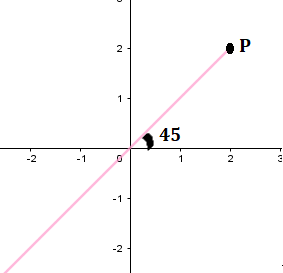
We know that \[\theta \]=45 degrees which can be represented as \[\dfrac{\pi }{4}\].
Let us find the sine and cosine values of \[\dfrac{\pi }{4}\].
We know that \[\sin \left( \dfrac{\pi }{4} \right)=\dfrac{1}{\sqrt{2}}\] and \[\cos \left( \dfrac{\pi }{4} \right)=\dfrac{1}{\sqrt{2}}\].
Substituting these values in (1) and (2), we get
\[x=r\dfrac{1}{\sqrt{2}}\] and
\[y=r\dfrac{1}{\sqrt{2}}\].
We know that r is equal to the radius of a unit circle.
Therefore, we get r=1.
On substituting r in the expression, we get
\[x=\dfrac{1}{\sqrt{2}}\] and \[y=\dfrac{1}{\sqrt{2}}\].
Therefore, the coordinate of the point P is \[\left( \dfrac{1}{\sqrt{2}},\dfrac{1}{\sqrt{2}} \right)\].
Hence, the coordinate of the point on the terminal arm of the angle in the standard position with 45-degree angle is \[\left( \dfrac{1}{\sqrt{2}},\dfrac{1}{\sqrt{2}} \right)\].
Note: We can further simplify the obtained solution.
Multiply \[\sqrt{2}\] on both the numerator and denominator of the coordinates.
We get \[\left( \dfrac{1}{\sqrt{2}},\dfrac{1}{\sqrt{2}} \right)=\left( \dfrac{1\sqrt{2}}{\sqrt{2}\sqrt{2}},\dfrac{1\sqrt{2}}{\sqrt{2}\sqrt{2}} \right)\].
On further simplification, we get
\[\left( \dfrac{1}{\sqrt{2}},\dfrac{1}{\sqrt{2}} \right)=\left( \dfrac{\sqrt{2}}{2},\dfrac{\sqrt{2}}{2} \right)\]
We can also represent the answer in this form also.
Complete step-by-step solution:
Consider the point to be in a unit circle with radius r=1. On substituting the values of r and \[\theta \], we can find the values of x and y with the help of the trigonometric table which is the required answer.
According to the question, we are asked to find the Cartesian coordinates of the terminal arm of the angle in standard position with 45 degree.
We have been given the angle is 45 degrees.
We know that the relation between the relation between Cartesian and polar coordinates are \[x=r\cos \theta \]and \[y=r\sin \theta \].
Here, \[\theta \] is the angle obtained by the point and r is the distance between the origin and the point.
Let us plot a graph to understand better.
We know that \[\theta \]=45 degrees which can be represented as \[\dfrac{\pi }{4}\].
Let us find the sine and cosine values of \[\dfrac{\pi }{4}\].
We know that \[\sin \left( \dfrac{\pi }{4} \right)=\dfrac{1}{\sqrt{2}}\] and \[\cos \left( \dfrac{\pi }{4} \right)=\dfrac{1}{\sqrt{2}}\].
Substituting these values in (1) and (2), we get
\[x=r\dfrac{1}{\sqrt{2}}\] and
\[y=r\dfrac{1}{\sqrt{2}}\].
We know that r is equal to the radius of a unit circle.
Therefore, we get r=1.
On substituting r in the expression, we get
\[x=\dfrac{1}{\sqrt{2}}\] and \[y=\dfrac{1}{\sqrt{2}}\].
Therefore, the coordinate of the point P is \[\left( \dfrac{1}{\sqrt{2}},\dfrac{1}{\sqrt{2}} \right)\].
Hence, the coordinate of the point on the terminal arm of the angle in the standard position with 45-degree angle is \[\left( \dfrac{1}{\sqrt{2}},\dfrac{1}{\sqrt{2}} \right)\].
Note: We can further simplify the obtained solution.
Multiply \[\sqrt{2}\] on both the numerator and denominator of the coordinates.
We get \[\left( \dfrac{1}{\sqrt{2}},\dfrac{1}{\sqrt{2}} \right)=\left( \dfrac{1\sqrt{2}}{\sqrt{2}\sqrt{2}},\dfrac{1\sqrt{2}}{\sqrt{2}\sqrt{2}} \right)\].
On further simplification, we get
\[\left( \dfrac{1}{\sqrt{2}},\dfrac{1}{\sqrt{2}} \right)=\left( \dfrac{\sqrt{2}}{2},\dfrac{\sqrt{2}}{2} \right)\]
We can also represent the answer in this form also.
Recently Updated Pages
Master Class 12 Business Studies: Engaging Questions & Answers for Success

Master Class 12 Biology: Engaging Questions & Answers for Success
Master Class 12 Chemistry: Engaging Questions & Answers for Success
Class 12 Question and Answer - Your Ultimate Solutions Guide
Master Class 11 Social Science: Engaging Questions & Answers for Success
Master Class 11 English: Engaging Questions & Answers for Success
Trending doubts
Explain the Treaty of Vienna of 1815 class 10 social science CBSE
Which Indian city is known as the "City of Victory"?
Which instrument is used to measure the Blood Pressure?
Who Won 36 Oscar Awards? Record Holder Revealed
What is the median of the first 10 natural numbers class 10 maths CBSE
Why is it 530 pm in india when it is 1200 afternoon class 10 social science CBSE