




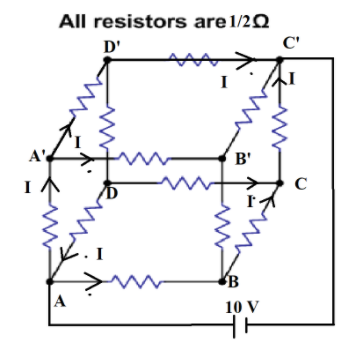
Determine the equivalent resistance of the network.
Answer
 Verified
582.3k+ views
Hint: The above given question is a case of a cubic system of resistances. Now, this network can not be simplified into a parallel or series resistance system. But, we can simplify this network into symmetrical patterns and then apply Kirchhoff's second law.
Complete answer:
The network is not reducible to a single sequence of resistors and parallel combinations. However, there is a strong symmetry in the dilemma that we can manipulate to achieve the network's equal resistance. The paths for all AD and AB are obviously symmetrically placed in the network. Thus, the current in each must be the same, say, I. Further, at the corners A', B and D
I must equally split the incoming current into the two outgoing branches. In this way, using Kirchhoff's first rule and the symmetry in the problem, the current in all the 12 edges of the cube is conveniently written down in terms of I. Next, take a closed loop, say, ABCC'EA, and follow the second law of Kirchhoff:
\[\Rightarrow -IR-(1/2)IR-IR+\varepsilon =0\]
Where the resistance of each edge is R and the battery emf is \[\varepsilon \]
So,
\[\Rightarrow \varepsilon =\dfrac{5}{2}IR\]
Now,
The equivalent resistance of the given network will be
\[\Rightarrow {{R}_{eq}}=\dfrac{\varepsilon }{3I}=\dfrac{5}{6}R\]
Now, for
\[\Rightarrow R=\dfrac{1}{2}\Omega \]
\[\Rightarrow {{R}_{eq}}=\dfrac{5}{12}\Omega \]
Now,
For, \[\varepsilon =10V\]
We have the total current in the network
\[\Rightarrow 3I=\dfrac{10}{(\dfrac{5}{12})\Omega }\]
\[\Rightarrow 3I=24\Omega \]
\[\Rightarrow I=8\Omega \]
So,
The current flowing in each edge will be \[8\Omega \]
Note:
Kirchhoff’s second law is also known as Kirchhoff's Voltage Law. It states that we must define a closed loop when implementing Kirchhoff 's second law, the loop rule, and determine the way to go around it, clockwise or counterclockwise. It was given by Gustav Robert Kirchhoff was a German physicist who contributed to the basic knowledge of electrical circuits, spectroscopy, and hot structures emitting black-body radiation. In 1862, he invented the word black-body radiation.
Complete answer:
The network is not reducible to a single sequence of resistors and parallel combinations. However, there is a strong symmetry in the dilemma that we can manipulate to achieve the network's equal resistance. The paths for all AD and AB are obviously symmetrically placed in the network. Thus, the current in each must be the same, say, I. Further, at the corners A', B and D
I must equally split the incoming current into the two outgoing branches. In this way, using Kirchhoff's first rule and the symmetry in the problem, the current in all the 12 edges of the cube is conveniently written down in terms of I. Next, take a closed loop, say, ABCC'EA, and follow the second law of Kirchhoff:
\[\Rightarrow -IR-(1/2)IR-IR+\varepsilon =0\]
Where the resistance of each edge is R and the battery emf is \[\varepsilon \]
So,
\[\Rightarrow \varepsilon =\dfrac{5}{2}IR\]
Now,
The equivalent resistance of the given network will be
\[\Rightarrow {{R}_{eq}}=\dfrac{\varepsilon }{3I}=\dfrac{5}{6}R\]
Now, for
\[\Rightarrow R=\dfrac{1}{2}\Omega \]
\[\Rightarrow {{R}_{eq}}=\dfrac{5}{12}\Omega \]
Now,
For, \[\varepsilon =10V\]
We have the total current in the network
\[\Rightarrow 3I=\dfrac{10}{(\dfrac{5}{12})\Omega }\]
\[\Rightarrow 3I=24\Omega \]
\[\Rightarrow I=8\Omega \]
So,
The current flowing in each edge will be \[8\Omega \]
Note:
Kirchhoff’s second law is also known as Kirchhoff's Voltage Law. It states that we must define a closed loop when implementing Kirchhoff 's second law, the loop rule, and determine the way to go around it, clockwise or counterclockwise. It was given by Gustav Robert Kirchhoff was a German physicist who contributed to the basic knowledge of electrical circuits, spectroscopy, and hot structures emitting black-body radiation. In 1862, he invented the word black-body radiation.
Recently Updated Pages
Master Class 11 Computer Science: Engaging Questions & Answers for Success

Master Class 11 Business Studies: Engaging Questions & Answers for Success
Master Class 11 Economics: Engaging Questions & Answers for Success
Master Class 11 English: Engaging Questions & Answers for Success
Master Class 11 Maths: Engaging Questions & Answers for Success
Master Class 11 Biology: Engaging Questions & Answers for Success
Trending doubts
One Metric ton is equal to kg A 10000 B 1000 C 100 class 11 physics CBSE
There are 720 permutations of the digits 1 2 3 4 5 class 11 maths CBSE
Discuss the various forms of bacteria class 11 biology CBSE
Draw a diagram of a plant cell and label at least eight class 11 biology CBSE
State the laws of reflection of light
Explain zero factorial class 11 maths CBSE