




How do you determine the amplitude of $y=\cos x$ ?
Answer
 Verified
547.5k+ views
Hint: We have been given a trigonometric function namely the cosine function. The coefficient of this function is equal to 1. We know that the amplitude of a function is defined as how far the function varies from its mid-line either how far above it goes or how far below it goes. Thus, we shall determine its amplitude by sketching the graph of the cosine function.
Complete step by step answer:
The mid-line of a function is a horizontal line on the graph of the function where half of the function is above it and half of the function is below it whereas the amplitude of a periodic function is just half the difference between the minimum and maximum values it taken on.
The graph of $y=\cos x$ is given as:
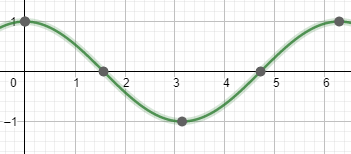
The mid-line of cosine function is the x-axis itself. Thus, we can see that the maximum value $\left( \max \right)$ of the graph is equal to 1 and the minimum value $\left( \min \right)$ of the graph is equal to -1.
$amplitude=\dfrac{\max -\min }{2}$
$\Rightarrow amplitude=\dfrac{1-\left( -1 \right)}{2}$
$\Rightarrow amplitude=\dfrac{2}{2}$
$\Rightarrow amplitude=1$
Therefore, the amplitude of $y=\cos x$ is equal to 1.
Note: Another way of thinking about the amplitude of a periodic function is the amount by which it sways from its middle position. A function is said to be periodic in nature when it starts repeating itself after a fixed interval on the x-axis. This fixed interval on the x-axis is known as the period of the function which changes when there is a change in the coefficient of the input value $\left( x \right)$ of the function. Here, the coefficient of the input value is 1, thus the period of cosine function does not change.
Complete step by step answer:
The mid-line of a function is a horizontal line on the graph of the function where half of the function is above it and half of the function is below it whereas the amplitude of a periodic function is just half the difference between the minimum and maximum values it taken on.
The graph of $y=\cos x$ is given as:
The mid-line of cosine function is the x-axis itself. Thus, we can see that the maximum value $\left( \max \right)$ of the graph is equal to 1 and the minimum value $\left( \min \right)$ of the graph is equal to -1.
$amplitude=\dfrac{\max -\min }{2}$
$\Rightarrow amplitude=\dfrac{1-\left( -1 \right)}{2}$
$\Rightarrow amplitude=\dfrac{2}{2}$
$\Rightarrow amplitude=1$
Therefore, the amplitude of $y=\cos x$ is equal to 1.
Note: Another way of thinking about the amplitude of a periodic function is the amount by which it sways from its middle position. A function is said to be periodic in nature when it starts repeating itself after a fixed interval on the x-axis. This fixed interval on the x-axis is known as the period of the function which changes when there is a change in the coefficient of the input value $\left( x \right)$ of the function. Here, the coefficient of the input value is 1, thus the period of cosine function does not change.
Recently Updated Pages
Master Class 11 Business Studies: Engaging Questions & Answers for Success

Master Class 11 Economics: Engaging Questions & Answers for Success
Master Class 11 Computer Science: Engaging Questions & Answers for Success
Master Class 11 English: Engaging Questions & Answers for Success
Master Class 11 Maths: Engaging Questions & Answers for Success
Master Class 11 Biology: Engaging Questions & Answers for Success
Trending doubts
One Metric ton is equal to kg A 10000 B 1000 C 100 class 11 physics CBSE
Discuss the various forms of bacteria class 11 biology CBSE
Draw a diagram of a plant cell and label at least eight class 11 biology CBSE
State the laws of reflection of light
Explain zero factorial class 11 maths CBSE
10 examples of friction in our daily life