



How do you determine ordered pairs are part of the solution set of inequalities \[3x+y\le 6\] for \[\left( 4,3 \right),\left( -2,4 \right),\left( -5,-3 \right),\left( 3,-3 \right)\]?
Answer
 Verified
536.1k+ views
Hint: Inequalities do not provide a fixed value as a solution; it gives a range. All the values in this range hold the inequality. For this question, as this is a linear inequality in two variables, we can not solve it using only this equation. So, we will substitute the values for the given coordinates of points. If the inequality is satisfied then the pair is part of the solution set.
Complete step by step answer:
We are asked to determine if the ordered pairs are the part of the solution set of inequality \[3x+y\le 6\].
Substituting the first ordered pair \[\left( 4,3 \right)\] in inequality, we get
\[\begin{align}
& 3\times 4+3\le 6 \\
& 15\le 6 \\
\end{align}\]
But this is not true, this pair does not belong to the solution set.
Substituting the next ordered pair \[\left( -2,4 \right)\] in inequality, we get
\[\begin{align}
& 3\times (-2)+4\le 6 \\
& -2\le 6 \\
\end{align}\]
This is true, so this pair belongs to the solution set.
Substituting the next ordered pair \[\left( -5,-3 \right)\] in inequality, we get
\[\begin{align}
& 3\times (-5)-3\le 6 \\
& -18\le 6 \\
\end{align}\]
This is true, so this pair belongs to the solution set.
Substituting the next ordered pair \[\left( 3,-3 \right)\] in inequality, we get
\[\begin{align}
& 3\times 3-3\le 6 \\
& 6\le 6 \\
\end{align}\]
This is true, so this pair belongs to the solution set.
Thus, the ordered pairs that are part of the solution set are \[\left( -2,4 \right),\left( -5,-3 \right),\left( 3,-3 \right)\].
Note: We can also use a different method to solve the given question. Here, we will plot the graph of \[3x+y=6\]. Then, all the values that lie below the graph of this equation belong to the solution set of the inequality \[3x+y\le 6\].
Thus, we get
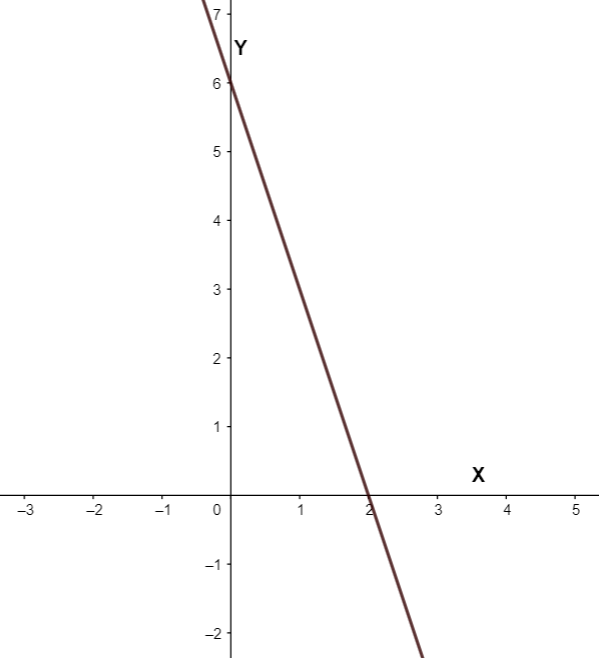
Thus, all points that lie below the graph in the above figure satisfy the given inequality.
Complete step by step answer:
We are asked to determine if the ordered pairs are the part of the solution set of inequality \[3x+y\le 6\].
Substituting the first ordered pair \[\left( 4,3 \right)\] in inequality, we get
\[\begin{align}
& 3\times 4+3\le 6 \\
& 15\le 6 \\
\end{align}\]
But this is not true, this pair does not belong to the solution set.
Substituting the next ordered pair \[\left( -2,4 \right)\] in inequality, we get
\[\begin{align}
& 3\times (-2)+4\le 6 \\
& -2\le 6 \\
\end{align}\]
This is true, so this pair belongs to the solution set.
Substituting the next ordered pair \[\left( -5,-3 \right)\] in inequality, we get
\[\begin{align}
& 3\times (-5)-3\le 6 \\
& -18\le 6 \\
\end{align}\]
This is true, so this pair belongs to the solution set.
Substituting the next ordered pair \[\left( 3,-3 \right)\] in inequality, we get
\[\begin{align}
& 3\times 3-3\le 6 \\
& 6\le 6 \\
\end{align}\]
This is true, so this pair belongs to the solution set.
Thus, the ordered pairs that are part of the solution set are \[\left( -2,4 \right),\left( -5,-3 \right),\left( 3,-3 \right)\].
Note: We can also use a different method to solve the given question. Here, we will plot the graph of \[3x+y=6\]. Then, all the values that lie below the graph of this equation belong to the solution set of the inequality \[3x+y\le 6\].
Thus, we get
Thus, all points that lie below the graph in the above figure satisfy the given inequality.
Recently Updated Pages
Master Class 8 Social Science: Engaging Questions & Answers for Success

Master Class 8 English: Engaging Questions & Answers for Success
Class 8 Question and Answer - Your Ultimate Solutions Guide
Master Class 8 Maths: Engaging Questions & Answers for Success
Master Class 8 Science: Engaging Questions & Answers for Success
Master Class 7 English: Engaging Questions & Answers for Success
Trending doubts
Difference Between Plant Cell and Animal Cell
Fill the blanks with the suitable prepositions 1 The class 9 english CBSE
Who is eligible for RTE class 9 social science CBSE
Which places in India experience sunrise first and class 9 social science CBSE
What is pollution? How many types of pollution? Define it
Name 10 Living and Non living things class 9 biology CBSE