




How to determine height of the cylinder with maximum volume engraved in a sphere with radius $ R $ ?
Answer
 Verified
541.5k+ views
Hint: We have to determine the height of the cylinder with maximum volume engraved in a sphere with radius $ R $ , its cross-sectional area and height are restricted by the sphere , we know that volume of a cylinder is given by $ V = \pi {r^2}h $ . For maximum volume , $ \dfrac{{dV}}{{dh}} = 0 $ .
Complete step-by-step answer:
Consider a cylinder, however, is engraved in a sphere, its cross-sectional area and height are restricted by the sphere and when the sphere cut vertically then we get the required cross-section as shown below ,
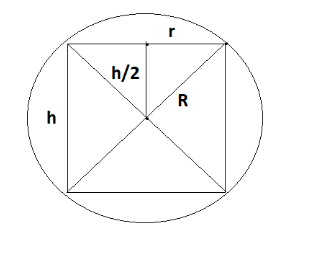
In the above figure ,
‘h’ is the height of the cylinder ,
‘r’ is the radius of the cylinder,
And ‘R’ is the radius of the sphere.
By applying Pythagoras Theorem , we will get the relationship between height of the cylinder, radius of the cylinder, radius of the sphere.
Therefore, we get the following,
$ \Rightarrow {R^2} = {\left( {\dfrac{h}{2}} \right)^2} + {r^2} $
Now, simplifying the above equation, we will get ,
$ \Rightarrow {R^2} = \dfrac{{{h^2}}}{4} + {r^2} $
For solving radius of the cylinder that is $ r $ , we will get ,
$ \Rightarrow {r^2} = {R^2} - \dfrac{{{h^2}}}{4}.......(1) $
Volume of a cylinder , $ V = \pi {r^2}h $ . (original equation)
Now substitute $ (1) $ in our original equation ,
We will get,
$ V = \pi {r^2}h $
$ = \pi \left( {{R^2} - \dfrac{{{h^2}}}{4}} \right)h $
$ = \pi {R^2}h - \dfrac{{{h^3}}}{4} \pi $
For maximum volume , we can write ,
$ \Rightarrow \dfrac{{dV}}{{dh}} = 0 $
$ \Rightarrow \dfrac{d}{{dh}}\left( {\pi {R^2}h - \dfrac{{{h^3}}}{4}}\pi \right) = 0 $
$ \Rightarrow {R^2} - \dfrac{3}{4}({h^2}) = 0 $
We have to solve for height of the cylinder that is $ h $ ,
Subtract $ {R^2} $ from both the side,
\[
\Rightarrow {R^2} - {R^2} - \dfrac{3}{4}({h^2}) = - {R^2} \\
\Rightarrow - \dfrac{3}{4}{h^2} = - {R^2} \;
\]
After simplifying ,
\[ \Rightarrow \dfrac{3}{4}{h^2} = {R^2}\]
Now multiple by $ \dfrac{4}{3} $ both the side of the equation, we will get ,
\[ \Rightarrow {h^2} = \dfrac{4}{3} {R^2}\]
Now, taking square root both the side,
$ \Rightarrow h = \sqrt {\dfrac{4}{3} } R $
We get the required result.
So, the correct answer is “ $ \Rightarrow h = \sqrt {\dfrac{4}{3}} R $ ”.
Note: The important thing to recollect about any equation is that the ‘equals’ sign represents a balance. What the sign says is that what’s on the left-hand side is strictly an equal to what’s on the right-hand side. It is the type of question where only mathematical operations such as addition, subtraction, multiplication and division is used.
Complete step-by-step answer:
Consider a cylinder, however, is engraved in a sphere, its cross-sectional area and height are restricted by the sphere and when the sphere cut vertically then we get the required cross-section as shown below ,
In the above figure ,
‘h’ is the height of the cylinder ,
‘r’ is the radius of the cylinder,
And ‘R’ is the radius of the sphere.
By applying Pythagoras Theorem , we will get the relationship between height of the cylinder, radius of the cylinder, radius of the sphere.
Therefore, we get the following,
$ \Rightarrow {R^2} = {\left( {\dfrac{h}{2}} \right)^2} + {r^2} $
Now, simplifying the above equation, we will get ,
$ \Rightarrow {R^2} = \dfrac{{{h^2}}}{4} + {r^2} $
For solving radius of the cylinder that is $ r $ , we will get ,
$ \Rightarrow {r^2} = {R^2} - \dfrac{{{h^2}}}{4}.......(1) $
Volume of a cylinder , $ V = \pi {r^2}h $ . (original equation)
Now substitute $ (1) $ in our original equation ,
We will get,
$ V = \pi {r^2}h $
$ = \pi \left( {{R^2} - \dfrac{{{h^2}}}{4}} \right)h $
$ = \pi {R^2}h - \dfrac{{{h^3}}}{4} \pi $
For maximum volume , we can write ,
$ \Rightarrow \dfrac{{dV}}{{dh}} = 0 $
$ \Rightarrow \dfrac{d}{{dh}}\left( {\pi {R^2}h - \dfrac{{{h^3}}}{4}}\pi \right) = 0 $
$ \Rightarrow {R^2} - \dfrac{3}{4}({h^2}) = 0 $
We have to solve for height of the cylinder that is $ h $ ,
Subtract $ {R^2} $ from both the side,
\[
\Rightarrow {R^2} - {R^2} - \dfrac{3}{4}({h^2}) = - {R^2} \\
\Rightarrow - \dfrac{3}{4}{h^2} = - {R^2} \;
\]
After simplifying ,
\[ \Rightarrow \dfrac{3}{4}{h^2} = {R^2}\]
Now multiple by $ \dfrac{4}{3} $ both the side of the equation, we will get ,
\[ \Rightarrow {h^2} = \dfrac{4}{3} {R^2}\]
Now, taking square root both the side,
$ \Rightarrow h = \sqrt {\dfrac{4}{3} } R $
We get the required result.
So, the correct answer is “ $ \Rightarrow h = \sqrt {\dfrac{4}{3}} R $ ”.
Note: The important thing to recollect about any equation is that the ‘equals’ sign represents a balance. What the sign says is that what’s on the left-hand side is strictly an equal to what’s on the right-hand side. It is the type of question where only mathematical operations such as addition, subtraction, multiplication and division is used.
Recently Updated Pages
Master Class 12 Economics: Engaging Questions & Answers for Success

Master Class 12 Physics: Engaging Questions & Answers for Success
Master Class 12 English: Engaging Questions & Answers for Success
Master Class 12 Social Science: Engaging Questions & Answers for Success
Master Class 12 Maths: Engaging Questions & Answers for Success
Master Class 12 Business Studies: Engaging Questions & Answers for Success
Trending doubts
What are the major means of transport Explain each class 12 social science CBSE
India is a sovereign socialist secular democratic republic class 12 social science CBSE
How many states of matter are there in total class 12 chemistry CBSE
What are the advantages of vegetative propagation class 12 biology CBSE
Suicide bags of cells are aEndoplasmic reticulum bLysosome class 12 biology CBSE
What is the Full Form of PVC, PET, HDPE, LDPE, PP and PS ?