




Determine, by drawing graphs, whether the following system of linear equations has a unique solution or not: \[2y=4x-6,2x=y+3\].
Answer
 Verified
589.5k+ views
Hint:
First draw the graph of the two given equations. To draw that straight line graph, we need at least two points. So, choose one of the equations and substitute x = 0, determine y, then substitute y = 0, determine x. Now, apply the same process for the second equation. Plot the graph using the points obtained. Now, if the graph of these equations are coincident to each other then the system of equations has infinitely many solutions. In case they are parallel but not coincident then they will have no solution. If the lines in the graph intersect at a particular point, they have a unique solution.
Complete step by step answer:
Let us assume the two equations as: -
\[\Rightarrow 2y=4x-6\] - (1)
\[\Rightarrow 2x=y+3\] - (2)
Considering equation (1), we have,
\[\Rightarrow 2y=4x-6\]
Substituting x = 0, we get,
\[\begin{align}
& \Rightarrow 2y=-6 \\
& \Rightarrow y=-3 \\
\end{align}\]
Substituting y = 0, we get,
\[\begin{align}
& \Rightarrow 0=4x-6 \\
& \Rightarrow 4x=6 \\
& \Rightarrow x=\dfrac{6}{4} \\
& \Rightarrow x=\dfrac{3}{2} \\
\end{align}\]
Therefore, the two points are: \[A\left( \dfrac{3}{2},0 \right)\] and \[B\left( 0,-3 \right)\].
Now, considering equation (2), we have,
\[\Rightarrow 2x=y+3\]
Substituting x = 0, we get,
\[\begin{align}
& \Rightarrow 0=y+3 \\
& \Rightarrow y=-3 \\
\end{align}\]
Substituting y = 0, we get,
\[\begin{align}
& \Rightarrow 2x=3 \\
& \Rightarrow x=\dfrac{3}{2} \\
\end{align}\]
Therefore, the two points are: \[C\left( \dfrac{3}{2},0 \right)\] and \[D\left( 0,-3 \right)\].
Now, let us draw the graphs of the two lines. So, the graph of the two equations can be plotted as: -
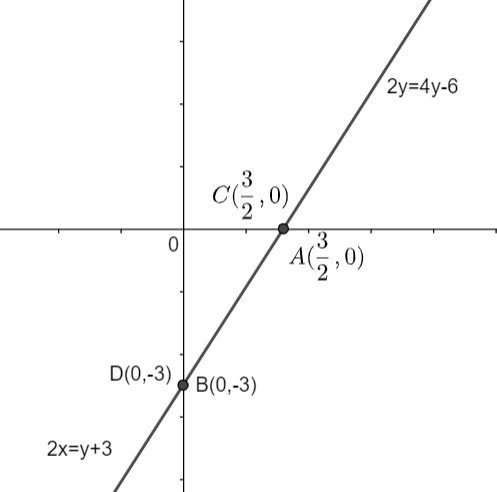
Clearly, we can see that the two lines are coincident to each other. Hence, they intersect at each and every point and therefore, the system of equations has infinitely many solutions.
Therefore, we can conclude that the given system of linear equations does not have a unique solution.
Note:
There is another method to check the consistency or inconsistency of a system of equations without the use of graphs. To apply this method, write the two equations in the form: \[{{a}_{1}}x+{{b}_{1}}y+{{c}_{1}}=0\] and \[{{a}_{2}}x+{{b}_{2}}y+{{c}_{2}}=0\] respectively. Now, consider the ratios: \[\dfrac{{{a}_{1}}}{{{a}_{2}}},\dfrac{{{b}_{1}}}{{{b}_{2}}}\] and \[\dfrac{{{c}_{1}}}{{{c}_{2}}}\]. From here, three cases can arise: -
Case (i): - If \[\dfrac{{{a}_{1}}}{{{a}_{2}}}\ne \dfrac{{{b}_{1}}}{{{b}_{2}}}\] then the system has unique solution.
Case (ii): - If \[\dfrac{{{a}_{1}}}{{{a}_{2}}}=\dfrac{{{b}_{1}}}{{{b}_{2}}}\ne \dfrac{{{c}_{1}}}{{{c}_{2}}}\], then the system has no solution.
Case (ii): - If \[\dfrac{{{a}_{1}}}{{{a}_{2}}}=\dfrac{{{b}_{1}}}{{{b}_{2}}}=\dfrac{{{c}_{1}}}{{{c}_{2}}}\], then the system has infinitely many solutions.
As we can see that the above equations satisfy the condition of case (iii), therefore, the system of equations has infinitely many solutions and not a unique solution.
First draw the graph of the two given equations. To draw that straight line graph, we need at least two points. So, choose one of the equations and substitute x = 0, determine y, then substitute y = 0, determine x. Now, apply the same process for the second equation. Plot the graph using the points obtained. Now, if the graph of these equations are coincident to each other then the system of equations has infinitely many solutions. In case they are parallel but not coincident then they will have no solution. If the lines in the graph intersect at a particular point, they have a unique solution.
Complete step by step answer:
Let us assume the two equations as: -
\[\Rightarrow 2y=4x-6\] - (1)
\[\Rightarrow 2x=y+3\] - (2)
Considering equation (1), we have,
\[\Rightarrow 2y=4x-6\]
Substituting x = 0, we get,
\[\begin{align}
& \Rightarrow 2y=-6 \\
& \Rightarrow y=-3 \\
\end{align}\]
Substituting y = 0, we get,
\[\begin{align}
& \Rightarrow 0=4x-6 \\
& \Rightarrow 4x=6 \\
& \Rightarrow x=\dfrac{6}{4} \\
& \Rightarrow x=\dfrac{3}{2} \\
\end{align}\]
Therefore, the two points are: \[A\left( \dfrac{3}{2},0 \right)\] and \[B\left( 0,-3 \right)\].
Now, considering equation (2), we have,
\[\Rightarrow 2x=y+3\]
Substituting x = 0, we get,
\[\begin{align}
& \Rightarrow 0=y+3 \\
& \Rightarrow y=-3 \\
\end{align}\]
Substituting y = 0, we get,
\[\begin{align}
& \Rightarrow 2x=3 \\
& \Rightarrow x=\dfrac{3}{2} \\
\end{align}\]
Therefore, the two points are: \[C\left( \dfrac{3}{2},0 \right)\] and \[D\left( 0,-3 \right)\].
Now, let us draw the graphs of the two lines. So, the graph of the two equations can be plotted as: -
Clearly, we can see that the two lines are coincident to each other. Hence, they intersect at each and every point and therefore, the system of equations has infinitely many solutions.
Therefore, we can conclude that the given system of linear equations does not have a unique solution.
Note:
There is another method to check the consistency or inconsistency of a system of equations without the use of graphs. To apply this method, write the two equations in the form: \[{{a}_{1}}x+{{b}_{1}}y+{{c}_{1}}=0\] and \[{{a}_{2}}x+{{b}_{2}}y+{{c}_{2}}=0\] respectively. Now, consider the ratios: \[\dfrac{{{a}_{1}}}{{{a}_{2}}},\dfrac{{{b}_{1}}}{{{b}_{2}}}\] and \[\dfrac{{{c}_{1}}}{{{c}_{2}}}\]. From here, three cases can arise: -
Case (i): - If \[\dfrac{{{a}_{1}}}{{{a}_{2}}}\ne \dfrac{{{b}_{1}}}{{{b}_{2}}}\] then the system has unique solution.
Case (ii): - If \[\dfrac{{{a}_{1}}}{{{a}_{2}}}=\dfrac{{{b}_{1}}}{{{b}_{2}}}\ne \dfrac{{{c}_{1}}}{{{c}_{2}}}\], then the system has no solution.
Case (ii): - If \[\dfrac{{{a}_{1}}}{{{a}_{2}}}=\dfrac{{{b}_{1}}}{{{b}_{2}}}=\dfrac{{{c}_{1}}}{{{c}_{2}}}\], then the system has infinitely many solutions.
As we can see that the above equations satisfy the condition of case (iii), therefore, the system of equations has infinitely many solutions and not a unique solution.
Recently Updated Pages
Master Class 12 Business Studies: Engaging Questions & Answers for Success

Master Class 12 Biology: Engaging Questions & Answers for Success
Master Class 12 Chemistry: Engaging Questions & Answers for Success
Class 12 Question and Answer - Your Ultimate Solutions Guide
Master Class 11 Social Science: Engaging Questions & Answers for Success
Master Class 11 English: Engaging Questions & Answers for Success
Trending doubts
Explain the Treaty of Vienna of 1815 class 10 social science CBSE
Which Indian city is known as the "City of Victory"?
Which instrument is used to measure the Blood Pressure?
Who Won 36 Oscar Awards? Record Holder Revealed
What is the median of the first 10 natural numbers class 10 maths CBSE
Why is it 530 pm in india when it is 1200 afternoon class 10 social science CBSE