




Describe with the help of diagram, how compressions and rarefactions are produced in air near a source of sound.
Answer
 Verified
625.8k+ views
Hint:Consider the example of tuning fork as the source of sound. The inward and outward movement of the prongs creates a region of high pressure and low pressure near the prongs. Draw the diagram of compressions and rarefactions as the region of high pressure and the region of low pressure respectively.
Complete answer:
To answer this question, we consider the example of tuning forks. When we hit the prong of the tuning fork on the rubber pad, the two prongs of the tuning fork swings back and forth about their mean position. This vibration of the tuning fork produces a sound of a certain frequency. We know that the sound wave is a longitudinal wave and thus, it requires a medium for the propagation. The vibrations of source of sound create disturbances in the surrounding air by displacing the air molecules from their mean position.
Now, when the prongs of the tuning fork move outward, they push and compress the air near the prongs which results in a region of high pressure. This region is called compression. When the prongs move inward from their mean position, it forms a region of low pressure known as a rarefaction. These series of compressions and rarefactions move away from the source which makes the sound wave to propagate through the air.The following figure will ease our understanding.
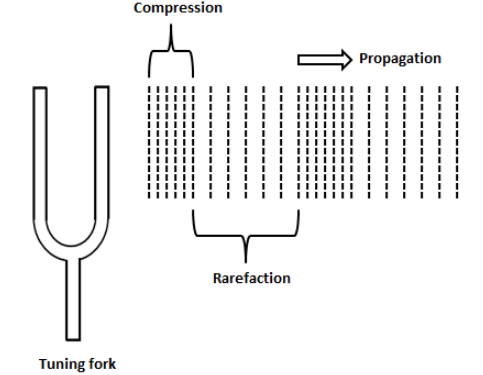
We can see the series of compressions and rarefactions of air molecules near the prongs of the tuning fork.
Note: For the propagation of sound waves, there must be a material medium present around the source of sound. If the tuning fork is sounded in vacuum, there will not be a region of high pressure and low pressure since there are no air molecules or any other molecules. In case of light, it is a transverse wave which does not require a medium for its propagation.
Complete answer:
To answer this question, we consider the example of tuning forks. When we hit the prong of the tuning fork on the rubber pad, the two prongs of the tuning fork swings back and forth about their mean position. This vibration of the tuning fork produces a sound of a certain frequency. We know that the sound wave is a longitudinal wave and thus, it requires a medium for the propagation. The vibrations of source of sound create disturbances in the surrounding air by displacing the air molecules from their mean position.
Now, when the prongs of the tuning fork move outward, they push and compress the air near the prongs which results in a region of high pressure. This region is called compression. When the prongs move inward from their mean position, it forms a region of low pressure known as a rarefaction. These series of compressions and rarefactions move away from the source which makes the sound wave to propagate through the air.The following figure will ease our understanding.
We can see the series of compressions and rarefactions of air molecules near the prongs of the tuning fork.
Note: For the propagation of sound waves, there must be a material medium present around the source of sound. If the tuning fork is sounded in vacuum, there will not be a region of high pressure and low pressure since there are no air molecules or any other molecules. In case of light, it is a transverse wave which does not require a medium for its propagation.
Recently Updated Pages
If x a + bt + ct2 where x is in meters and t is in class 11 physics CBSE

A car covers the first half distance between two places class 11 physics CBSE
The resultant of two vectors overrightarrow P and overrightarrow class 11 physics CBSE
Find the value of cos 135 class 11 maths CBSE
A mass M is held in place by an applied force F and class 11 physics CBSE
A solution of glucose in water is labelled as 10 dfracwv class 11 chemistry CBSE
Trending doubts
One Metric ton is equal to kg A 10000 B 1000 C 100 class 11 physics CBSE
Find the value of the expression given below sin 30circ class 11 maths CBSE
Draw a diagram of nephron and explain its structur class 11 biology CBSE
10 examples of friction in our daily life
Proton was discovered by A Thomson B Rutherford C Chadwick class 11 chemistry CBSE
Bond order ofO2 O2+ O2 and O22 is in order A O2 langle class 11 chemistry CBSE