




Describe with the help of a diagram, how compressions and rarefactions are produced in air near a source of sound?
Answer
 Verified
602.7k+ views
Hint:You can approach the solution to the asked question by trying to remember what rarefactions and compressions are. Compressions and rarefactions occur due to the interference of pressure changes created due to the source of sound.
Complete step by step answer:
We will be trying to answer the question exactly as we told you to do so in the hint section of the solution to this question. We will start by talking about what compressions and rarefactions are and then, we will talk about how they are generated.
When a vibrating object moves forward, it pushes and compresses the air in front of it creating a region of high pressure. This region is called compression. This compression starts to move away from the vibrating object. When the vibrating object moves backwards, it creates a region of low pressure called rarefaction. As the object moves back and forth rapidly, a series of compressions and rarefactions is created in the air.
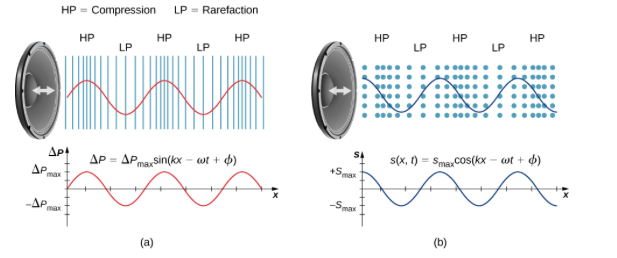
We can see in the diagram that the compression is first generated close to the vibrating tuning fork, and as it moves away from the tuning fork along with tuning fork’s vibrating hand moves behind, it gives birth to a low pressure region, called rarefaction. Basically, when an object starts vibrating it creates disturbance in the medium. Because of the disturbance of the particles of medium, they come closer to each other as compared to their normal position. On the other hand adjacent particles go farther to each other. Both happen simultaneously. The region where particles come closer to each other is called compressions and regions where particles go farther from each other are called rarefactions.
Note:Since the question has asked us to draw a diagram along with describing how rarefactions and compressions are generated, skipping the diagram would cost you precious marks. Another point that you should always remember is that compressions are regions with high pressure while rarefactions are low pressure regions, many students confuse them with each other and lose marks.
Complete step by step answer:
We will be trying to answer the question exactly as we told you to do so in the hint section of the solution to this question. We will start by talking about what compressions and rarefactions are and then, we will talk about how they are generated.
When a vibrating object moves forward, it pushes and compresses the air in front of it creating a region of high pressure. This region is called compression. This compression starts to move away from the vibrating object. When the vibrating object moves backwards, it creates a region of low pressure called rarefaction. As the object moves back and forth rapidly, a series of compressions and rarefactions is created in the air.
We can see in the diagram that the compression is first generated close to the vibrating tuning fork, and as it moves away from the tuning fork along with tuning fork’s vibrating hand moves behind, it gives birth to a low pressure region, called rarefaction. Basically, when an object starts vibrating it creates disturbance in the medium. Because of the disturbance of the particles of medium, they come closer to each other as compared to their normal position. On the other hand adjacent particles go farther to each other. Both happen simultaneously. The region where particles come closer to each other is called compressions and regions where particles go farther from each other are called rarefactions.
Note:Since the question has asked us to draw a diagram along with describing how rarefactions and compressions are generated, skipping the diagram would cost you precious marks. Another point that you should always remember is that compressions are regions with high pressure while rarefactions are low pressure regions, many students confuse them with each other and lose marks.
Recently Updated Pages
Master Class 12 Economics: Engaging Questions & Answers for Success

Master Class 12 English: Engaging Questions & Answers for Success
Master Class 12 Social Science: Engaging Questions & Answers for Success
Master Class 12 Maths: Engaging Questions & Answers for Success
Master Class 12 Physics: Engaging Questions & Answers for Success
Master Class 9 General Knowledge: Engaging Questions & Answers for Success
Trending doubts
One Metric ton is equal to kg A 10000 B 1000 C 100 class 11 physics CBSE
Difference Between Prokaryotic Cells and Eukaryotic Cells
Two of the body parts which do not appear in MRI are class 11 biology CBSE
Find the value of the expression given below sin 30circ class 11 maths CBSE
1 ton equals to A 100 kg B 1000 kg C 10 kg D 10000 class 11 physics CBSE
Draw a diagram of nephron and explain its structur class 11 biology CBSE