




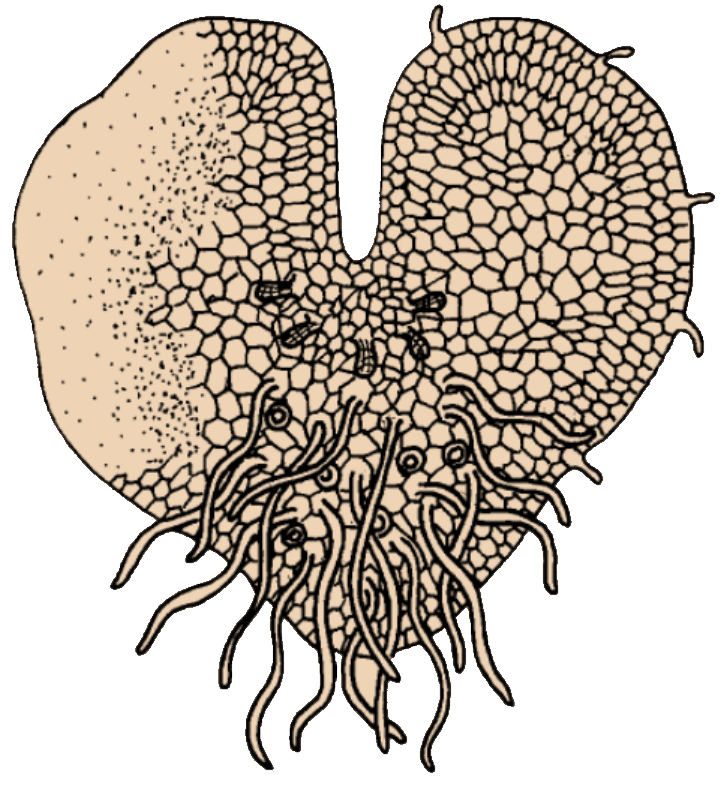
Describe the structure of prothallus in Pteris.
Answer
 Verified
604.8k+ views
Hint: The well developed, heart-shaped, green, homothallic, and independent gametophytic generation of pteridophytes is called Prothallus. Their main plant body is diploid and they reproduce by spore formation.
Complete answer:
The structure of a prothallus is given below:
● In the main plant body (sporophyte), there are found several structures called sporangia in which the formation of spores takes place.
● These sporangia contain spore mother cells which on meiotic division produce haploid spores. Now, these spores are released from the plant body and then germinates on the soil.
● On germination, these spores produce a new structure which is called Prothallus.
● Prothallus is an inconspicuous, small, and multicellular gametophyte structure that is independent of the main plant body.
● It is made up of two major parts -the rhizoids and the thallus.
● Rhizoids (rhizomes) are the hairy root-like structures found in primitive types of plants. The thallus is a type of primitive plant body that does not have any true stems and leaves.
● Prothallus of Pteris is a single layered cellular structure having rhizomes at its ventral surface of the thalloid body.
● Also, the male sex organ ( antheridia) is present in the central portion and the female sex organ ( archaegonia ) at the apical portion of the prothallus.
● Due to the heart-shaped structure of prothallus, there is a notch present in it called an apical notch.
● Prothallus is a non-vascular structure as it lacks water-conducting tissues.
Thus the formation of prothallus occurs in following steps-
- Sporophylls present on the parent plant body will produce sporangia.
- The sporangia produced will develop spore mother cells on them.
- Now these spore mother cells undergo meiotic division and spores are produced which on germination lead to production of prothallus (well developed gametophyte).
Note: Pteridophytes (like Pteris) are the primitive vascular plants that do not produce seeds (cryptogams). Most of the pteridophytes are homosporous (produce only one type of spores) but some are heterosporous also.
● Prothallus performs photosynthesis for its nutritional requirements.
● It requires cool, damp, shady places to grow.
● Due to these specific restricted requirements and the need for water for fertilization, the spread of living pteridophytes is limited.
Complete answer:
The structure of a prothallus is given below:
● In the main plant body (sporophyte), there are found several structures called sporangia in which the formation of spores takes place.
● These sporangia contain spore mother cells which on meiotic division produce haploid spores. Now, these spores are released from the plant body and then germinates on the soil.
● On germination, these spores produce a new structure which is called Prothallus.
● Prothallus is an inconspicuous, small, and multicellular gametophyte structure that is independent of the main plant body.
● It is made up of two major parts -the rhizoids and the thallus.
● Rhizoids (rhizomes) are the hairy root-like structures found in primitive types of plants. The thallus is a type of primitive plant body that does not have any true stems and leaves.
● Prothallus of Pteris is a single layered cellular structure having rhizomes at its ventral surface of the thalloid body.
● Also, the male sex organ ( antheridia) is present in the central portion and the female sex organ ( archaegonia ) at the apical portion of the prothallus.
● Due to the heart-shaped structure of prothallus, there is a notch present in it called an apical notch.
● Prothallus is a non-vascular structure as it lacks water-conducting tissues.
Thus the formation of prothallus occurs in following steps-
- Sporophylls present on the parent plant body will produce sporangia.
- The sporangia produced will develop spore mother cells on them.
- Now these spore mother cells undergo meiotic division and spores are produced which on germination lead to production of prothallus (well developed gametophyte).
Note: Pteridophytes (like Pteris) are the primitive vascular plants that do not produce seeds (cryptogams). Most of the pteridophytes are homosporous (produce only one type of spores) but some are heterosporous also.
● Prothallus performs photosynthesis for its nutritional requirements.
● It requires cool, damp, shady places to grow.
● Due to these specific restricted requirements and the need for water for fertilization, the spread of living pteridophytes is limited.
Recently Updated Pages
Master Class 11 Social Science: Engaging Questions & Answers for Success

Master Class 11 English: Engaging Questions & Answers for Success
Master Class 11 Maths: Engaging Questions & Answers for Success
Master Class 11 Chemistry: Engaging Questions & Answers for Success
Master Class 11 Biology: Engaging Questions & Answers for Success
Master Class 11 Physics: Engaging Questions & Answers for Success
Trending doubts
One Metric ton is equal to kg A 10000 B 1000 C 100 class 11 physics CBSE
Difference Between Prokaryotic Cells and Eukaryotic Cells
How many of the following diseases can be studied with class 11 biology CBSE
Draw a diagram of a plant cell and label at least eight class 11 biology CBSE
Two of the body parts which do not appear in MRI are class 11 biology CBSE
Which gas is abundant in air class 11 chemistry CBSE