




Describe the structure of a dicot seed.
Answer
 Verified
628.2k+ views
Hint: A dicot seed is a non-endospermic seed where endosperm is used up during seed development and food is stored in the two cotyledons.
Complete answer:
A dicot seed primarily consists of two basic parts- seed coat and embryo. The surface of the seed may be smooth or wrinkled. An outer seed coat ‘ tegmen’ and an inner seed coat ‘testa’ covers the seed coat. Testa is leathery, thick, and tough while tegmen is thin, fragile, conspicuous, and papery. It lies closely in contact with testa.
A small notch or furrow bearing ‘Chalaza’, in the middle, is present near the broad end of the seed. In the ovule, it was the site of attachment of nucellus and integuments. On the same side, near the pointed end, a scar is present, known as hilum. The seed is connected to the pod by funiculus or stalk. When the seeds are shed, a scar or hilum appears. A small pore known as micropyle is present near the hilum. Water and air enter through this pore.
The embryo is enclosed in the seed. The embryo contains a short and straight embryonal axis. Two large and broad cotyledons or seed leaves are attached to it by slender and tiny stalks. The radicle or the future root is the tip of the embryo axis. It lies towards the micropylar end. Plumule or the future shoot is located deeper between the cotyledons.
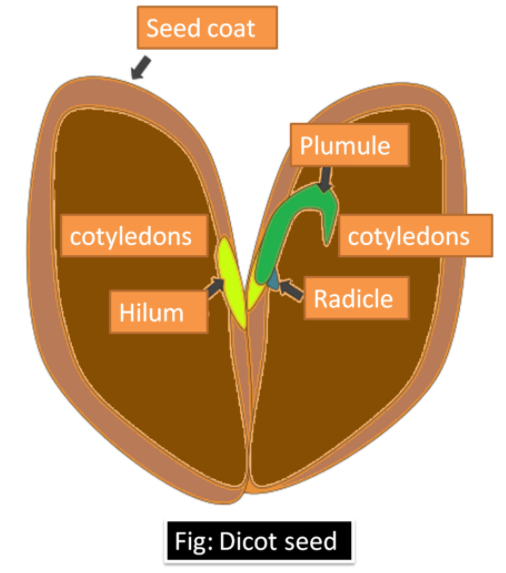
Note: The area of the embryo between the point of attachment of the cotyledons and the plumule is described as the epicotyl while the region between radicle and the place of origin of cotyledons is termed as hypocotyl. The majority of dicots e.g. pea, gram, bean, and some monocots like orchids are non-endospermic.
Complete answer:
A dicot seed primarily consists of two basic parts- seed coat and embryo. The surface of the seed may be smooth or wrinkled. An outer seed coat ‘ tegmen’ and an inner seed coat ‘testa’ covers the seed coat. Testa is leathery, thick, and tough while tegmen is thin, fragile, conspicuous, and papery. It lies closely in contact with testa.
A small notch or furrow bearing ‘Chalaza’, in the middle, is present near the broad end of the seed. In the ovule, it was the site of attachment of nucellus and integuments. On the same side, near the pointed end, a scar is present, known as hilum. The seed is connected to the pod by funiculus or stalk. When the seeds are shed, a scar or hilum appears. A small pore known as micropyle is present near the hilum. Water and air enter through this pore.
The embryo is enclosed in the seed. The embryo contains a short and straight embryonal axis. Two large and broad cotyledons or seed leaves are attached to it by slender and tiny stalks. The radicle or the future root is the tip of the embryo axis. It lies towards the micropylar end. Plumule or the future shoot is located deeper between the cotyledons.
Note: The area of the embryo between the point of attachment of the cotyledons and the plumule is described as the epicotyl while the region between radicle and the place of origin of cotyledons is termed as hypocotyl. The majority of dicots e.g. pea, gram, bean, and some monocots like orchids are non-endospermic.
Recently Updated Pages
Master Class 12 Economics: Engaging Questions & Answers for Success

Master Class 12 English: Engaging Questions & Answers for Success
Master Class 12 Social Science: Engaging Questions & Answers for Success
Master Class 12 Maths: Engaging Questions & Answers for Success
Master Class 12 Physics: Engaging Questions & Answers for Success
Master Class 9 General Knowledge: Engaging Questions & Answers for Success
Trending doubts
Draw ray diagrams each showing i myopic eye and ii class 12 physics CBSE
The ratio of E to B in electromagnetic waves is equal class 12 physics CBSE
Sulphuric acid is known as the king of acids State class 12 chemistry CBSE
Which of the following is referred to as the Evil Quartet class 12 biology CBSE
Derive an expression for the electric field intensity class 12 physics CBSE
Percentage of photosynthetically active radiation PAR class 12 biology CBSE