




How would you describe the structure and synthesis of ATP and its universal role as energy currency in all living organisms?
Answer
 Verified
607.8k+ views
Hint: It is dissolvable so it very well may be shipped effectively around the body, to any place it is required. The inorganic phosphate can be utilized to decrease the initiation energy of phosphorylating, so it permits responses to happen with less energy.
Complete answer:
All living things including plants, creatures, birds, creepy crawlies, people need energy for the appropriate working of cells, tissues, and other organ frameworks. As we know that green plants get their energy from the daylight, and creatures get their energy by benefiting from these plants. Energy goes about as a wellspring of fuel.
We, people, acquire energy from the food we eat, yet how is the energy created and put away in our body. Loss of phosphate prompts energy discharge. On hydrolysis of ATP to ADP, $30.5 KJ mol^-1$ of energy is delivered. ADP + Pi ó ATP (reversible response). Adept is integrated from substrate-level phosphorylation during glycolysis and Krebs cycles.
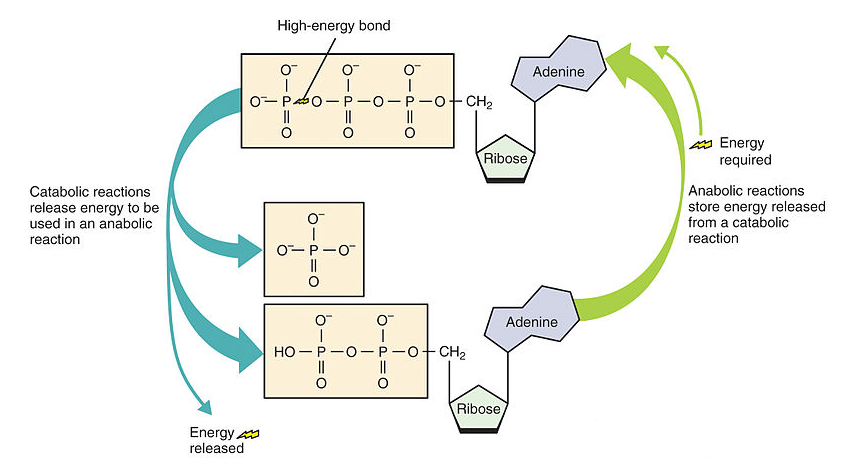
ATP is combined utilizing electron transporters in oxidative phosphorylation and photophosphorylation. ATP creation happens in mitochondria and chloroplast. In these organelles, ATP synthase is available which goes about as a channel for hydrogen particles, driving a chemiosmotic ally to the creation of ATP. ATP is utilized by cells as a prompt energy benefactor. ATP goes about as a connection between energy-yielding and energy-requiring responses. ATP is associated with Active Transport, Muscle Contraction, Calvin Cycle, and Protein Synthesis.
Note: It comprises adenine, ribose (a sugar), and three phosphate gatherings. It very well may be delivered of its energy by breaking the phosphate bond, in a 1 stage hydrolysis, subsequently, it is a snappy wellspring of energy.
Complete answer:
All living things including plants, creatures, birds, creepy crawlies, people need energy for the appropriate working of cells, tissues, and other organ frameworks. As we know that green plants get their energy from the daylight, and creatures get their energy by benefiting from these plants. Energy goes about as a wellspring of fuel.
We, people, acquire energy from the food we eat, yet how is the energy created and put away in our body. Loss of phosphate prompts energy discharge. On hydrolysis of ATP to ADP, $30.5 KJ mol^-1$ of energy is delivered. ADP + Pi ó ATP (reversible response). Adept is integrated from substrate-level phosphorylation during glycolysis and Krebs cycles.
ATP is combined utilizing electron transporters in oxidative phosphorylation and photophosphorylation. ATP creation happens in mitochondria and chloroplast. In these organelles, ATP synthase is available which goes about as a channel for hydrogen particles, driving a chemiosmotic ally to the creation of ATP. ATP is utilized by cells as a prompt energy benefactor. ATP goes about as a connection between energy-yielding and energy-requiring responses. ATP is associated with Active Transport, Muscle Contraction, Calvin Cycle, and Protein Synthesis.
Note: It comprises adenine, ribose (a sugar), and three phosphate gatherings. It very well may be delivered of its energy by breaking the phosphate bond, in a 1 stage hydrolysis, subsequently, it is a snappy wellspring of energy.
Recently Updated Pages
Which will be the least stable resonating structure class 11 chemistry CBSE

How many 5 digit telephone numbers can be construc-class-11-maths-CBSE
How do you find the angle of the resultant vector class 11 physics CBSE
Draw labelled diagram of the following i Gram seed class 11 biology CBSE
1 Quintal is equal to a 110 kg b 10 kg c 100kg d 1000 class 11 physics CBSE
What is the need and importance of classification class 11 biology CBSE
Trending doubts
Find the value of the expression given below sin 30circ class 11 maths CBSE
One Metric ton is equal to kg A 10000 B 1000 C 100 class 11 physics CBSE
10 examples of friction in our daily life
Draw a diagram of a plant cell and label at least eight class 11 biology CBSE
Difference between physical and chemical change class 11 chemistry CBSE
Proton was discovered by A Thomson B Rutherford C Chadwick class 11 chemistry CBSE