




Describe the structure and function of sieve tubes?
Answer
 Verified
548.7k+ views
Hint: Sieve tubes are the important component of the vascular tissue in the plant called the phloem. Phloem is associated with the transport of food from leaves to various parts of the plants. Sieve tube cells function in association with other components of the phloem.
Complete answer:
The phloem is the most important tissue in the plant which helps in the translocation of food that is glucose to various parts of the plant. The components of phloem are companion cells, sieve tubes, phloem fibres and phloem parenchyma. The only living component in the phloem is the phloem parenchyma.
Let us discuss the structure and function of sieve tubes.
Sieve elements are the conducting element in the phloem. It works in association with the companion cells and brings about conduction. It is made up of sieve cells and sieve tubes.
Structure of sieve tubes- It is the highly organised tissue which lacks nucleus. It comprises elongated cells and lie parallelly to the tissue they are present in. whose walls are perforated like a sieve called the sieve plates. These pores help in connecting with the adjacent cells and thus bring about transportation of the organic molecules. The sieve tubes lack ribosomes. Sieve tubes are shorter and wider so as to provide greater surface area for transport. It is found in the angiosperms.
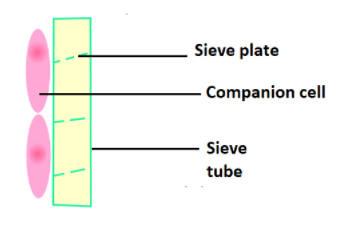
Function: It is the major conducting component in the phloem. The main function is to transport the product formed by the photosynthesis that is the glucose. The sieve tube works in association with the companion cells which are nucleated.
Note: All the organelles are absent in the sieve tube element. It resembles a prokaryotic cell. The gymnosperms and nonvascular plants have sieve cells which are similar in function but are longer and narrower as compared to sieve tubes.
Complete answer:
The phloem is the most important tissue in the plant which helps in the translocation of food that is glucose to various parts of the plant. The components of phloem are companion cells, sieve tubes, phloem fibres and phloem parenchyma. The only living component in the phloem is the phloem parenchyma.
Let us discuss the structure and function of sieve tubes.
Sieve elements are the conducting element in the phloem. It works in association with the companion cells and brings about conduction. It is made up of sieve cells and sieve tubes.
Structure of sieve tubes- It is the highly organised tissue which lacks nucleus. It comprises elongated cells and lie parallelly to the tissue they are present in. whose walls are perforated like a sieve called the sieve plates. These pores help in connecting with the adjacent cells and thus bring about transportation of the organic molecules. The sieve tubes lack ribosomes. Sieve tubes are shorter and wider so as to provide greater surface area for transport. It is found in the angiosperms.
Function: It is the major conducting component in the phloem. The main function is to transport the product formed by the photosynthesis that is the glucose. The sieve tube works in association with the companion cells which are nucleated.
Note: All the organelles are absent in the sieve tube element. It resembles a prokaryotic cell. The gymnosperms and nonvascular plants have sieve cells which are similar in function but are longer and narrower as compared to sieve tubes.
Recently Updated Pages
Master Class 11 English: Engaging Questions & Answers for Success

Master Class 11 Social Science: Engaging Questions & Answers for Success
Master Class 11 Maths: Engaging Questions & Answers for Success
Master Class 11 Chemistry: Engaging Questions & Answers for Success
Master Class 11 Biology: Engaging Questions & Answers for Success
Master Class 11 Physics: Engaging Questions & Answers for Success
Trending doubts
One Metric ton is equal to kg A 10000 B 1000 C 100 class 11 physics CBSE
Difference Between Prokaryotic Cells and Eukaryotic Cells
Find the value of the expression given below sin 30circ class 11 maths CBSE
1 ton equals to A 100 kg B 1000 kg C 10 kg D 10000 class 11 physics CBSE
Two of the body parts which do not appear in MRI are class 11 biology CBSE
What are hard magnetic materials class 11 physics CBSE