




Describe the structure and function of different types of epithelial tissues.
Answer
 Verified
596.7k+ views
Hint: Epithelial tissues cover most organs and cavities of the body system and keep them separate which differentiate them from each other structurally and functionally. They have origin from all the three germ layers.
Complete answer:
The protecting or protective tissues in the body of the animal are epithelial tissues. Within the body, epithelium protects most organs and cavities and holds different body structures independent. Epithelial tissue is entirely composed of the skin, the lining of the lips, the wrapping of nerves, lung alveoli and kidney tubules.
Epithelial tissue cells are firmly stuffed and structure a continuous sheet. They have just a limited quantity of establishing material among them and basically no intercellular spaces. The porousness of the cells of different epithelia assumes a significant function in directing the trading of materials between the body and the outer environment and furthermore between various parts of the body.
Epithelial tissues are of following types:
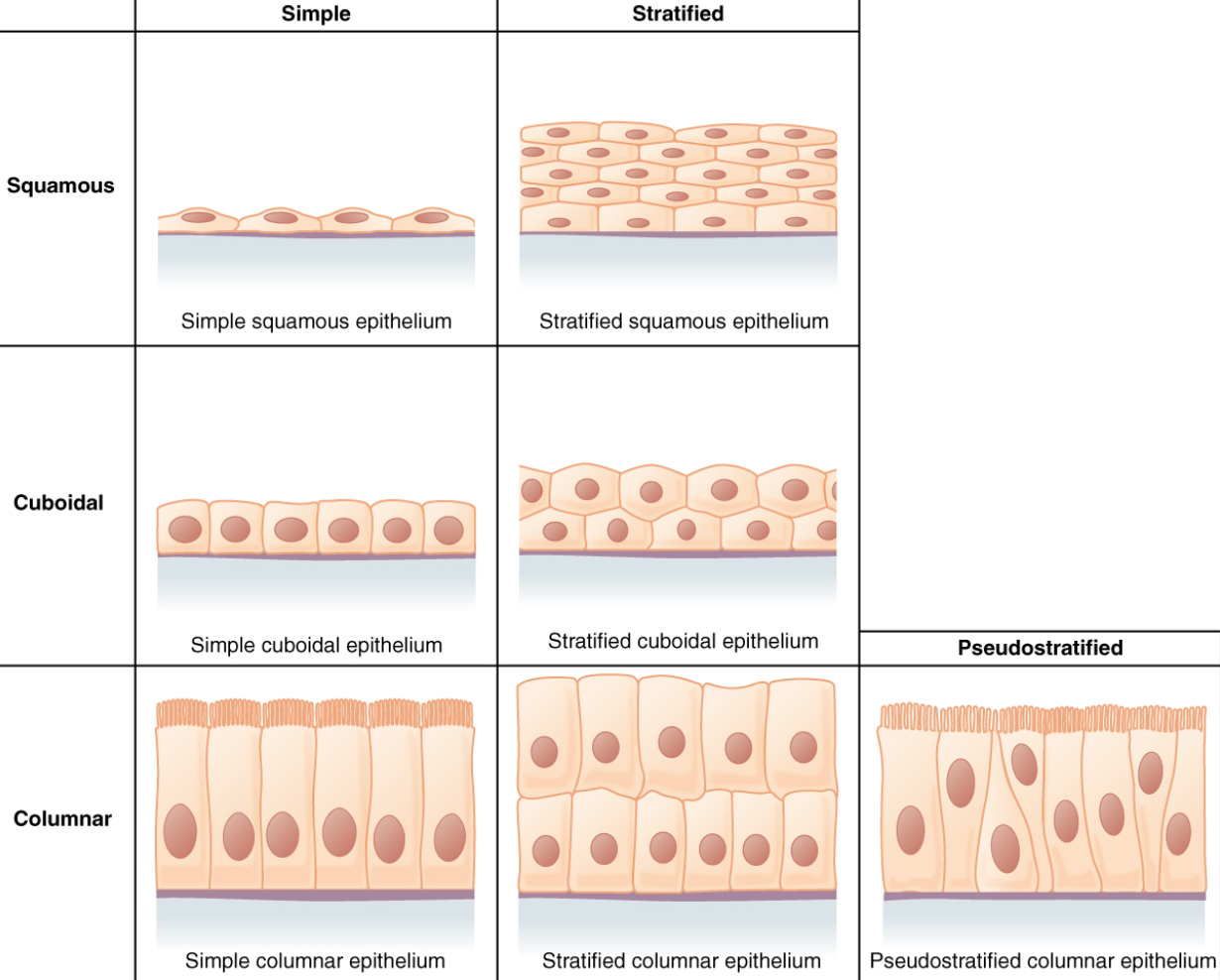
Note: Regardless of the sort, all epithelia are generally detached from the basic tissue by an extracellular fibrous basement membrane. Transitional epithelium is however an exception to this which is found in the urinary bladder, ureter and uterus.
Complete answer:
The protecting or protective tissues in the body of the animal are epithelial tissues. Within the body, epithelium protects most organs and cavities and holds different body structures independent. Epithelial tissue is entirely composed of the skin, the lining of the lips, the wrapping of nerves, lung alveoli and kidney tubules.
Epithelial tissue cells are firmly stuffed and structure a continuous sheet. They have just a limited quantity of establishing material among them and basically no intercellular spaces. The porousness of the cells of different epithelia assumes a significant function in directing the trading of materials between the body and the outer environment and furthermore between various parts of the body.
Epithelial tissues are of following types:
| TYPES OF TISSUES | STRUCTURE | FUNCTION | EXAMPLE |
| Simple Squamous | It forms a single layer of flat cells which is in contact with the basal lamina. | It helps in the filtration or diffusion of molecules. | Lining of Bowman's capsule |
| Simple Cuboidal | It forms a single thick layer and is made of cube-shaped cells. | It helps in secretions. | Lines the salivary glands |
| Simple Columnar | It forms uni-layered, elongated shaped cells. | It helps in the secretion of digestive fluids and absorbs nutrients. | Lining layer of intestinal mucosa |
| Pseudostratified | It appears 2-3 layered (but in actual it is single layered). | It helps in removing mucus. | Lines the respiratory tracts |
| Stratified squamous | It consists of squamous (flattened) epithelial cells arranged in layers over a basal membrane. | It forms a protective layer, block diffusion/microbes. | Epidermis of skin |
Note: Regardless of the sort, all epithelia are generally detached from the basic tissue by an extracellular fibrous basement membrane. Transitional epithelium is however an exception to this which is found in the urinary bladder, ureter and uterus.
Recently Updated Pages
Master Class 11 English: Engaging Questions & Answers for Success

Master Class 11 Social Science: Engaging Questions & Answers for Success
Master Class 11 Maths: Engaging Questions & Answers for Success
Master Class 11 Biology: Engaging Questions & Answers for Success
Master Class 11 Physics: Engaging Questions & Answers for Success
Master Class 11 Chemistry: Engaging Questions & Answers for Success
Trending doubts
Explain the Treaty of Vienna of 1815 class 10 social science CBSE
What is the full form of POSCO class 10 social science CBSE
Define Potential, Developed, Stock and Reserved resources
The diagonals of a rhombus are 10cm and 24cm Find the class 10 maths CBSE
Fill the blanks with proper collective nouns 1 A of class 10 english CBSE
What planets have no moons Which one has only one moon class 10 physics CBSE