




Describe the shapes of \[{\text{B}}{{\text{F}}_{\text{3}}}{\text{ & BH}}_{\text{4}}^{\text{ - }}\] . Assign the hybridization of boron in these species.
Answer
 Verified
617.4k+ views
Hint: Determine the number of bond pairs and lone pairs of electrons around the central atom in each compound. Based on the total number of lone pairs and bond pairs of electrons, assign the type of hybridization. From the type of hybridization, determine the geometry.
Complete answer:
The atomic number of boron is 5. The electronic configuration of boron is \[1{s^2}2{s^2}2{p^1}\] . A boron atom has three valence electrons. In the boron trifluoride molecule, the boron atom is the central atom with three boron-fluorine single bonds. The number of lone pairs of electrons on a boron atom is 0. Thus, the total number of lone pairs and bond pairs of electrons (the steric number) is three. Steric number of three is associated with \[s{p^2}\] hybridization. Boron atoms undergo \[s{p^2}\] hybridization. \[2s,2{p_x},2{p_y}\] atomic orbitals participate in hybridization to form three degenerate hybrid orbitals. These three hybrid orbitals of boron overlap with orbitals of three fluorine atoms to form three boron fluorine single bonds. The molecular shape is trigonal planar. Central boron atoms and three fluorine atoms are in a plane. Three fluorine atoms are present at three corners of a triangle. The Boron atom is present at the center of the triangle. The fluorine-boron-fluorine bond angle is \[120^\circ \].
In the borohydride anion, the boron atom is the central atom with four boron-hydrogen single bonds. The number of lone pairs of electrons on a boron atom is 0. Thus, the total number of lone pairs and bond pairs of electrons (the steric number) is four. Steric number of four is associated with \[s{p^3}\] hybridization. Boron atoms undergo \[s{p^3}\] hybridization. \[{\text{2s,2}}{{\text{p}}_{\text{x}}}{\text{,2}}{{\text{p}}_{\text{z}}}{\text{,2}}{{\text{p}}_{\text{y}}}\] atomic orbitals participate in hybridization to form four degenerate hybrid orbitals. These four hybrid orbitals of boron overlap with orbitals of four hydrogen atoms to form four boron hydrogen single bonds. The molecular shape is tetrahedral. Four hydrogen atoms are present at four corners of a regular tetrahedron. The Boron atom is present at the center of the tetrahedron. The hydrogen-boron-hydrogen bond angle is \[109.28^\circ \].
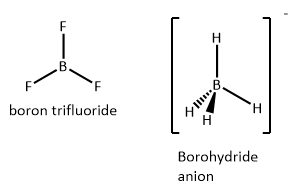
Note: Since in boron trifluoride molecule and borohydride anion, the number of lone pairs of electrons is zero, the molecular/ ionic geometry is the same as electron pair geometry. If the number of lone pairs of electrons is not equal to zero, then the molecular / ionic geometry will be different from electron pair geometry.
Complete answer:
The atomic number of boron is 5. The electronic configuration of boron is \[1{s^2}2{s^2}2{p^1}\] . A boron atom has three valence electrons. In the boron trifluoride molecule, the boron atom is the central atom with three boron-fluorine single bonds. The number of lone pairs of electrons on a boron atom is 0. Thus, the total number of lone pairs and bond pairs of electrons (the steric number) is three. Steric number of three is associated with \[s{p^2}\] hybridization. Boron atoms undergo \[s{p^2}\] hybridization. \[2s,2{p_x},2{p_y}\] atomic orbitals participate in hybridization to form three degenerate hybrid orbitals. These three hybrid orbitals of boron overlap with orbitals of three fluorine atoms to form three boron fluorine single bonds. The molecular shape is trigonal planar. Central boron atoms and three fluorine atoms are in a plane. Three fluorine atoms are present at three corners of a triangle. The Boron atom is present at the center of the triangle. The fluorine-boron-fluorine bond angle is \[120^\circ \].
In the borohydride anion, the boron atom is the central atom with four boron-hydrogen single bonds. The number of lone pairs of electrons on a boron atom is 0. Thus, the total number of lone pairs and bond pairs of electrons (the steric number) is four. Steric number of four is associated with \[s{p^3}\] hybridization. Boron atoms undergo \[s{p^3}\] hybridization. \[{\text{2s,2}}{{\text{p}}_{\text{x}}}{\text{,2}}{{\text{p}}_{\text{z}}}{\text{,2}}{{\text{p}}_{\text{y}}}\] atomic orbitals participate in hybridization to form four degenerate hybrid orbitals. These four hybrid orbitals of boron overlap with orbitals of four hydrogen atoms to form four boron hydrogen single bonds. The molecular shape is tetrahedral. Four hydrogen atoms are present at four corners of a regular tetrahedron. The Boron atom is present at the center of the tetrahedron. The hydrogen-boron-hydrogen bond angle is \[109.28^\circ \].
Note: Since in boron trifluoride molecule and borohydride anion, the number of lone pairs of electrons is zero, the molecular/ ionic geometry is the same as electron pair geometry. If the number of lone pairs of electrons is not equal to zero, then the molecular / ionic geometry will be different from electron pair geometry.
Recently Updated Pages
Master Class 12 Economics: Engaging Questions & Answers for Success

Master Class 12 English: Engaging Questions & Answers for Success
Master Class 12 Social Science: Engaging Questions & Answers for Success
Master Class 12 Maths: Engaging Questions & Answers for Success
Master Class 12 Physics: Engaging Questions & Answers for Success
Master Class 11 Social Science: Engaging Questions & Answers for Success
Trending doubts
One Metric ton is equal to kg A 10000 B 1000 C 100 class 11 physics CBSE
Difference Between Prokaryotic Cells and Eukaryotic Cells
Find the value of the expression given below sin 30circ class 11 maths CBSE
Two of the body parts which do not appear in MRI are class 11 biology CBSE
Draw a diagram of nephron and explain its structur class 11 biology CBSE
10 examples of friction in our daily life