




Describe the oxy-hemoglobin dissociation curve.
Answer
 Verified
659.4k+ views
Hint: This curve plots the proportion of hemoglobin in its saturated form on the vertical axis against the oxygen tension on the horizontal axis and is of sigmoid shape.
Complete answer:
The transport of the oxygen from the lungs to the target tissues of the body by the blood is due to the ability of hemoglobin to combine reversibly by the oxygen.
At a tension of 100 mm Hg or more than this, the hemoglobin is completely saturated. The function of hemoglobin is to carry oxygen in the blood.
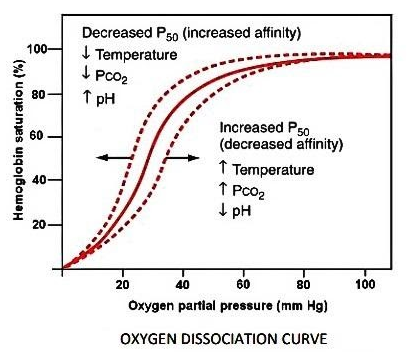
The vital relationship between the saturation of hemoglobin and the oxygen tension is shown by the dissociation curve in which percent saturation is plotted with the oxygen tension. The curve is drawn with carbonic oxide at a tension of 40 mm of Hg, this is considered as representative of normal physiological condition.
The hemoglobin in this condition is 94 – 98% saturated in the arterial blood. This saturation of hemoglobin declines slowly with the fall in oxygen tension and rapid unloading of oxygen takes place at the oxygen tension of 50 mm Hg. This is the unloading tension of hemoglobin.
While in tissues the oxygen tension is about 40 mm of Hg which helps in the dissociation of the oxy-hemoglobin complex making the oxygen readily available to the cells.
Additional Information:
Factors affecting Dissociation of Oxy-haemoglobin-
-temperature
- The rise in temperature leads to a decrease in the hemoglobin saturation.
-Effect of carbon dioxide
-The influence of carbon dioxide on the shape of the dissociation curve is the effect of the formation of carbonic acid.
-The carbonic acid makes the pH go lower and creates an acidity which facilitates the dissociation of oxy-hemoglobin.
-This ability of carbon dioxide to shift the curve to the right is called a Bohr effect.
Note:
When hemoglobin combines with carbon monoxide the complex carboxyhemoglobin is formed. Which in turn reduces the amount of hemoglobin to carry oxygen.
When the decrease in the normal oxygen concentration happens then it results in the formation of bluish skin which is called cyanosis.
Complete answer:
The transport of the oxygen from the lungs to the target tissues of the body by the blood is due to the ability of hemoglobin to combine reversibly by the oxygen.
At a tension of 100 mm Hg or more than this, the hemoglobin is completely saturated. The function of hemoglobin is to carry oxygen in the blood.
The vital relationship between the saturation of hemoglobin and the oxygen tension is shown by the dissociation curve in which percent saturation is plotted with the oxygen tension. The curve is drawn with carbonic oxide at a tension of 40 mm of Hg, this is considered as representative of normal physiological condition.
The hemoglobin in this condition is 94 – 98% saturated in the arterial blood. This saturation of hemoglobin declines slowly with the fall in oxygen tension and rapid unloading of oxygen takes place at the oxygen tension of 50 mm Hg. This is the unloading tension of hemoglobin.
While in tissues the oxygen tension is about 40 mm of Hg which helps in the dissociation of the oxy-hemoglobin complex making the oxygen readily available to the cells.
Additional Information:
Factors affecting Dissociation of Oxy-haemoglobin-
-temperature
- The rise in temperature leads to a decrease in the hemoglobin saturation.
-Effect of carbon dioxide
-The influence of carbon dioxide on the shape of the dissociation curve is the effect of the formation of carbonic acid.
-The carbonic acid makes the pH go lower and creates an acidity which facilitates the dissociation of oxy-hemoglobin.
-This ability of carbon dioxide to shift the curve to the right is called a Bohr effect.
Note:
When hemoglobin combines with carbon monoxide the complex carboxyhemoglobin is formed. Which in turn reduces the amount of hemoglobin to carry oxygen.
When the decrease in the normal oxygen concentration happens then it results in the formation of bluish skin which is called cyanosis.
Recently Updated Pages
If x a + bt + ct2 where x is in meters and t is in class 11 physics CBSE

A car covers the first half distance between two places class 11 physics CBSE
The resultant of two vectors overrightarrow P and overrightarrow class 11 physics CBSE
Find the value of cos 135 class 11 maths CBSE
A mass M is held in place by an applied force F and class 11 physics CBSE
A solution of glucose in water is labelled as 10 dfracwv class 11 chemistry CBSE
Trending doubts
One Metric ton is equal to kg A 10000 B 1000 C 100 class 11 physics CBSE
Find the value of the expression given below sin 30circ class 11 maths CBSE
What do you mean by retardation What is its SI uni class 11 physics CBSE
Draw a diagram of nephron and explain its structur class 11 biology CBSE
10 examples of friction in our daily life
Difference between physical and chemical change class 11 chemistry CBSE