




Describe the mechanism of electron transport during oxidative phosphorylation. In which part of the cell is this mechanism located? How many ATP molecules would be produced when (i) NADH is oxidised and (ii) Succinic acid is oxidised.
Answer
 Verified
617.4k+ views
Hint: Oxidative phosphorylation can be considered the last sage in metabolism of carbohydrates, fats, and proteins, where energy is finally generated in the form of ATP from various intermediate molecules.
Complete answer:
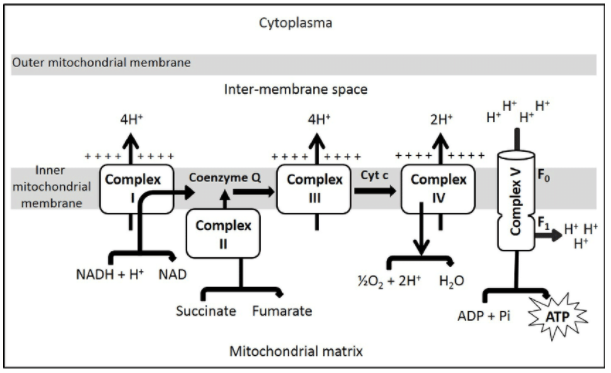
Oxidative phosphorylation occurs in the mitochondria, specifically across the inner membrane. During this process, $H^+$ is transported across the membrane generating a chemiosmotic gradient while electrons move from one complex to the next. The energy produced by this concentration gradient is used to then drive the synthesis of ATP from ADP. There are three membrane bound complexes and one matrix complex involved in the process.
NADH,$H^+$ enters the electron transport chain at complex I. A series of redox reactions as well as mobile electron carriers cause this molecule to be oxidised, and the process continues through complex III and IV, ending with the production of a molecule of water. The resultant proton gradient then drives ATP synthesis. As NADH,H+ oxidation involves three of these complexes, each NADH,H+ is responsible for the production of 3 molecules of ATP in oxidative phosphorylation.
Oxidation of Succinic acid in the Krebs’s cycle produces a molecule of $FADH_2$. Succinate dehydrogenase is linked to Complex II of the electron transport chain, but it is present in the matrix, and not the membrane. So the proton gradient generated involves only complex III and IV, and therefore oxidation of succinic acid results in the synthesis of 2 molecules of ATP. ATP synthase is also called complex V. As the protons re-enter the matrix, this enzyme produces ATP from ADP.
Note: While ATP can be produced directly via stages in the other metabolic pathways and cycles, the maximum production is through the final oxidative phosphorylation of NADH,H+ and FADH2 in the mitochondria.
Complete answer:
Oxidative phosphorylation occurs in the mitochondria, specifically across the inner membrane. During this process, $H^+$ is transported across the membrane generating a chemiosmotic gradient while electrons move from one complex to the next. The energy produced by this concentration gradient is used to then drive the synthesis of ATP from ADP. There are three membrane bound complexes and one matrix complex involved in the process.
NADH,$H^+$ enters the electron transport chain at complex I. A series of redox reactions as well as mobile electron carriers cause this molecule to be oxidised, and the process continues through complex III and IV, ending with the production of a molecule of water. The resultant proton gradient then drives ATP synthesis. As NADH,H+ oxidation involves three of these complexes, each NADH,H+ is responsible for the production of 3 molecules of ATP in oxidative phosphorylation.
Oxidation of Succinic acid in the Krebs’s cycle produces a molecule of $FADH_2$. Succinate dehydrogenase is linked to Complex II of the electron transport chain, but it is present in the matrix, and not the membrane. So the proton gradient generated involves only complex III and IV, and therefore oxidation of succinic acid results in the synthesis of 2 molecules of ATP. ATP synthase is also called complex V. As the protons re-enter the matrix, this enzyme produces ATP from ADP.
Note: While ATP can be produced directly via stages in the other metabolic pathways and cycles, the maximum production is through the final oxidative phosphorylation of NADH,H+ and FADH2 in the mitochondria.
Recently Updated Pages
Master Class 11 English: Engaging Questions & Answers for Success

Master Class 11 Physics: Engaging Questions & Answers for Success
Master Class 11 Computer Science: Engaging Questions & Answers for Success
Master Class 11 Chemistry: Engaging Questions & Answers for Success
Master Class 11 Social Science: Engaging Questions & Answers for Success
Master Class 11 Accountancy: Engaging Questions & Answers for Success
Trending doubts
Difference Between Prokaryotic Cells and Eukaryotic Cells
Two of the body parts which do not appear in MRI are class 11 biology CBSE
One Metric ton is equal to kg A 10000 B 1000 C 100 class 11 physics CBSE
10 examples of friction in our daily life
Draw a diagram of nephron and explain its structur class 11 biology CBSE
Draw a diagram of a plant cell and label at least eight class 11 biology CBSE