




Describe the given picture.
Answer
 Verified
579.6k+ views
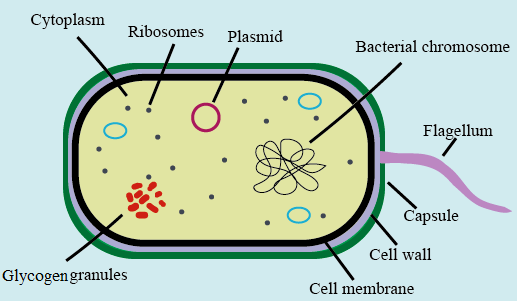
Hint: The given image is microscopic in nature as the labeled parts cannot be seen to the naked eye. The labeled bacterial chromosome suggests it is a bacterial cell. There is also a presence of the cell wall and capsule which gives an idea of whether the bacterial cell is Gram-positive or negative.
Complete answer:
The given image of a bacteria, a microscopic prokaryotic organism.
- The cell consists of a cell membrane and a cell wall and is additionally enclosed in a capsule. These structures are to provide shape, protection, and to allow the exchange of various molecules from the outer environment.
- A flagellum projects from the cell wall and helps in the motility of the cell.
- The bacterial chromosome is present without a nuclear envelope, which is a characteristic of the organism. There are plasmids also present that provide genetic material other than the chromosome.
- The cytoplasm is the matrix that holds all of the organelles inside the cell together. It also stores nutrients and enzymes for metabolic processes.
- Glycogen granules are the structures for the storage of food for the cell.
- The presence of a cell wall may be an indication that the cell is Gram-positive in nature.
- Bacteria is a large domain of microscopic organisms and they consist of numerous phyla. Examples include Actinobacteria, Firmicutes, Deinococcus, etc.
- Bacteria display a wide variety of morphologies such as coccus, bacillus, coccobacillus, filamentous, vibrio, etc.
Note:
Some bacteria exist in groups such as diploids (Neisseria), tetrads, chains (Streptococci), sarcina (Sarcinae), etc.
- Bacteria exist in groups for carrying out various functions such as biofilms, quorum sensing, secondary structures, etc.
Complete answer:
The given image of a bacteria, a microscopic prokaryotic organism.
- The cell consists of a cell membrane and a cell wall and is additionally enclosed in a capsule. These structures are to provide shape, protection, and to allow the exchange of various molecules from the outer environment.
- A flagellum projects from the cell wall and helps in the motility of the cell.
- The bacterial chromosome is present without a nuclear envelope, which is a characteristic of the organism. There are plasmids also present that provide genetic material other than the chromosome.
- The cytoplasm is the matrix that holds all of the organelles inside the cell together. It also stores nutrients and enzymes for metabolic processes.
- Glycogen granules are the structures for the storage of food for the cell.
- The presence of a cell wall may be an indication that the cell is Gram-positive in nature.
- Bacteria is a large domain of microscopic organisms and they consist of numerous phyla. Examples include Actinobacteria, Firmicutes, Deinococcus, etc.
- Bacteria display a wide variety of morphologies such as coccus, bacillus, coccobacillus, filamentous, vibrio, etc.
Note:
Some bacteria exist in groups such as diploids (Neisseria), tetrads, chains (Streptococci), sarcina (Sarcinae), etc.
- Bacteria exist in groups for carrying out various functions such as biofilms, quorum sensing, secondary structures, etc.
Recently Updated Pages
Master Class 11 English: Engaging Questions & Answers for Success

Master Class 11 Social Science: Engaging Questions & Answers for Success
Master Class 11 Maths: Engaging Questions & Answers for Success
Master Class 11 Biology: Engaging Questions & Answers for Success
Master Class 11 Physics: Engaging Questions & Answers for Success
Master Class 11 Chemistry: Engaging Questions & Answers for Success
Trending doubts
One Metric ton is equal to kg A 10000 B 1000 C 100 class 11 physics CBSE
Difference Between Prokaryotic Cells and Eukaryotic Cells
Find the value of the expression given below sin 30circ class 11 maths CBSE
Two of the body parts which do not appear in MRI are class 11 biology CBSE
Draw a diagram of a plant cell and label at least eight class 11 biology CBSE
10 examples of friction in our daily life