




Describe the digestive system of cockroach.
Answer
 Verified
595.4k+ views
Hint: The digestive system of cockroach consists of two parts i.e., alimentary canal and associated glands.
Complete Answer:
Cockroaches are omnivorous in nature and can eat all kinds of organic food sources available to them.
Parts of alimentary canal:
Alimentary canal is elongated & coiled. It starts from the mouth and ends with anus.
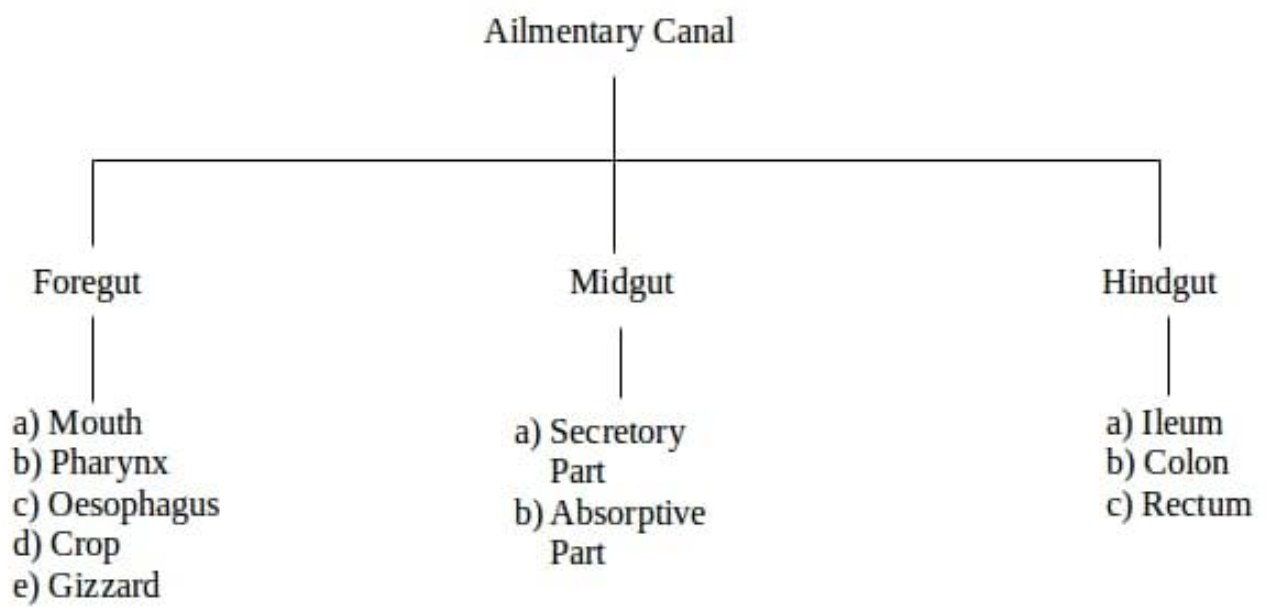
The alimentary canal of cockroach is divided into three regions: foregut, midgut, and hindgut.
1. Foregut: It consists of a mouth which is followed by a short tubular pharynx. The pharynx leads into a narrow and short tube known as oesophagus which in turn opens into a sac like structure called crop. Crop is used for storing food. The crop is followed by a gizzard. It has six teeth. Gizzard helps in grinding food particles.
2. Midgut or mesenteron: It is the middle part of the alimentary canal. Gastric or hepatic caeca (ring of 6-8 blind tubular structure) secret digestive juices that are present at the junction of foregut and midgut. Malpighian tubules (yellow color thin filamentous ring of 100-150) help in removal of excretory products present at the junction of midgut and hindgut. Mesenteron is the main site of enzyme production, digestion and absorption.
3. Hindgut: The hindgut is differentiated into: a. Ileum, b. Colon and c. Rectum. The hindgut opens outside through the anus.
Note: Digestion begins first at the mouth. The food once entering the stomach (mesenteron) is treated by the digestive enzymes secreted by the gastric caeca. Digestive glands include salivary glands, hepatic caeca and mesenteric glands.
Complete Answer:
Cockroaches are omnivorous in nature and can eat all kinds of organic food sources available to them.
Parts of alimentary canal:
Alimentary canal is elongated & coiled. It starts from the mouth and ends with anus.
The alimentary canal of cockroach is divided into three regions: foregut, midgut, and hindgut.
1. Foregut: It consists of a mouth which is followed by a short tubular pharynx. The pharynx leads into a narrow and short tube known as oesophagus which in turn opens into a sac like structure called crop. Crop is used for storing food. The crop is followed by a gizzard. It has six teeth. Gizzard helps in grinding food particles.
2. Midgut or mesenteron: It is the middle part of the alimentary canal. Gastric or hepatic caeca (ring of 6-8 blind tubular structure) secret digestive juices that are present at the junction of foregut and midgut. Malpighian tubules (yellow color thin filamentous ring of 100-150) help in removal of excretory products present at the junction of midgut and hindgut. Mesenteron is the main site of enzyme production, digestion and absorption.
3. Hindgut: The hindgut is differentiated into: a. Ileum, b. Colon and c. Rectum. The hindgut opens outside through the anus.
Note: Digestion begins first at the mouth. The food once entering the stomach (mesenteron) is treated by the digestive enzymes secreted by the gastric caeca. Digestive glands include salivary glands, hepatic caeca and mesenteric glands.
Recently Updated Pages
What is BLO What is the full form of BLO class 8 social science CBSE

Write structures of the following compounds i 2 Chloro3methylpentane class 11 chemistry CBSE
If x a + bt + ct2 where x is in meters and t is in class 11 physics CBSE
A car covers the first half distance between two places class 11 physics CBSE
The resultant of two vectors overrightarrow P and overrightarrow class 11 physics CBSE
Find the value of cos 135 class 11 maths CBSE
Trending doubts
One Metric ton is equal to kg A 10000 B 1000 C 100 class 11 physics CBSE
Find the value of the expression given below sin 30circ class 11 maths CBSE
Draw a diagram of nephron and explain its structur class 11 biology CBSE
10 examples of friction in our daily life
Draw a diagram of a plant cell and label at least eight class 11 biology CBSE
Proton was discovered by A Thomson B Rutherford C Chadwick class 11 chemistry CBSE