




Describe the construction of a laboratory thermometer.
Answer
 Verified
674.1k+ views
Hint: Laboratory thermometer is constructed on the basis of mercury based thermometers. Thermometers have a thin column of mercury within a glass casing. When the temperature of mercury increases, it expands within the tube. Since the area of the tube is fixed, the expansion causes a rise in height of the mercury column, which is interpreted as rise in temperature.
Complete step by step answer:
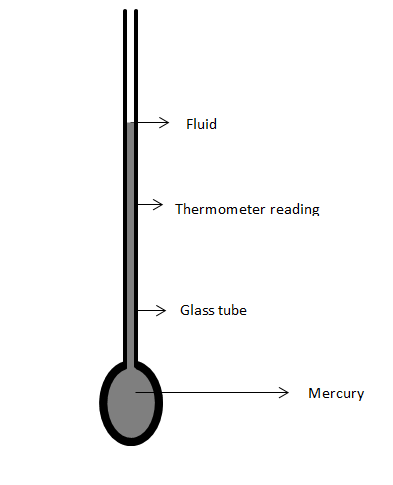
Laboratory thermometer consists of a thick walled fine bore glass capillary tube. It has a small thin bulb at its lower end and it is filled with pure /dry Hg or colored alcohol. The portion of the capillary tube above the bulb is commonly called stem. Laboratory thermometer is made in Celsius scale ranging from $ - {10^0}C$ to ${110^0}C$. Laboratory thermometers are constructed on the basis of mercury based thermometers. The wall of the bulb is usually thin. The capillary tube is narrow in nature. This helps in making the thermometer more sensitive.
When a thermometer is used to measure our body temperature the glass wall attains thermal equilibrium with our body. And the mercury which is in contact with the glass wall will eventually reach thermal equilibrium. Using the zeroth law of thermodynamics we can say that our body and mercury are in thermal equilibrium i.e. in same temperature.This is how mercury thermometer measures the temperature.
Though a thermometer needs to be in contact with the system to measure temperature, Physical contact is not always necessary for heat to flow. There are various modes of heat transfer, such as conduction, convection and radiation. Mercury thermometers expand and contract according to the rise and fall of temperature.
Note: We know measure of temperature helps us to determine whether heat will flow from one object to another. Using this law we can determine and compare the temperatures of different objects.
Thermometers are the most elegant example for the Zeroth Law of thermodynamics in action.
Complete step by step answer:
Laboratory thermometer consists of a thick walled fine bore glass capillary tube. It has a small thin bulb at its lower end and it is filled with pure /dry Hg or colored alcohol. The portion of the capillary tube above the bulb is commonly called stem. Laboratory thermometer is made in Celsius scale ranging from $ - {10^0}C$ to ${110^0}C$. Laboratory thermometers are constructed on the basis of mercury based thermometers. The wall of the bulb is usually thin. The capillary tube is narrow in nature. This helps in making the thermometer more sensitive.
When a thermometer is used to measure our body temperature the glass wall attains thermal equilibrium with our body. And the mercury which is in contact with the glass wall will eventually reach thermal equilibrium. Using the zeroth law of thermodynamics we can say that our body and mercury are in thermal equilibrium i.e. in same temperature.This is how mercury thermometer measures the temperature.
Though a thermometer needs to be in contact with the system to measure temperature, Physical contact is not always necessary for heat to flow. There are various modes of heat transfer, such as conduction, convection and radiation. Mercury thermometers expand and contract according to the rise and fall of temperature.
Note: We know measure of temperature helps us to determine whether heat will flow from one object to another. Using this law we can determine and compare the temperatures of different objects.
Thermometers are the most elegant example for the Zeroth Law of thermodynamics in action.
Recently Updated Pages
Master Class 10 Computer Science: Engaging Questions & Answers for Success

Differentiate between voluntary action and reflex class 10 biology CBSE
The uses of bleaching powder are A It is used bleaching class 10 chemistry CBSE
Fill in the blanks with abstract nouns of the words class 10 english CBSE
How many threedigit numbers are there class 10 maths CBSE
What is a reflex arc class 10 biology CBSE
Trending doubts
Explain the Treaty of Vienna of 1815 class 10 social science CBSE
10 examples of evaporation in daily life with explanations
Which country is known as "The land of Fire and Ice"?
What is the full form of POSCO class 10 social science CBSE
Make a sketch of the human nerve cell What function class 10 biology CBSE
In which year voting age was reduced from 21 to 18?