




Describe the biogas plant with a neat labelled diagram.
Answer
 Verified
576.3k+ views
Hint: Organic matter upon decomposition liberates several types of gases and other byproducts. The important gases produced by the breakdown of organic matter are methane and carbon dioxide. These two gases are gases which can cause pollution of the air if they are not treated properly. The gases produced by the organic decomposition is known as biogas. In natural conditions, the wetland soil are the main sources of methane.
Complete answer:
The biogas is produced on a large scale in plants known as the biogas plants and they act as anaerobic digester into which wastes from agricultural and dairy farming is fed into to produce the gases. The biogas plants are also known as anaerobic digester. During this process, the microorganism converts the biomass into biogas and a byproduct known as digestate. The processes that take place during the digestion of biomass are mesophilic digestion and thermophilic digestion. The digestion depends on the temperature maintained for the reaction.
The organic matter is stored in a collection tank and is homogenized with the help of water. The uniform material produced is then passed through a macerator which breaks down the components in smaller particles. The particles are then pumped into the digester tanks for anaerobic reactions. Through the agency of different types of bacteria, the material is converted into methane and carbon dioxide.
The gas is then dried and vented out to a unit linked to a generator to produce heat and electricity. The remaining material or the digested substrate is then passed through screw presses for removal of excess moisture and it is dried to produce high quality fertilizer. The different processes are monitored closely to maintain optimum environmental parameters.
Additional Information:
The mixture of gases that are produced during the breakdown or decomposition of organic matter such as plant wastes, agricultural waste, manure, sewage or food waste, is referred to as biogas. It is produced due to anaerobically digestion of the materials. The process occurs in the presence of anaerobic microorganisms which decompose the materials which are biodegradable in nature and produce carbon dioxide and methane. The important gases that are produced through this process are methane, hydrogen sulfide along with carbon dioxide. These gases are combustible in nature when combined with oxygen. It is used as a type of biofuel and is considered as a renewable resource. The gas obtained is used as a cleaner option of harmful pollution causing gases.
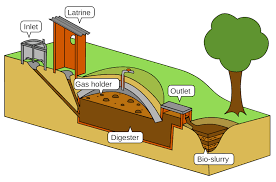
Fig: Diagram of a biogas plant.
Note:
The agricultural wastes and other organic materials are treated and fed into tanks with controlled atmosphere and results in the production of gases such as carbon dioxide, methane and hydrogen sulfide. The gases are combustible and used to generate heat and electricity and are a cheaper and cleaner option as related to other types of fuels such as fossil fuels.
Complete answer:
The biogas is produced on a large scale in plants known as the biogas plants and they act as anaerobic digester into which wastes from agricultural and dairy farming is fed into to produce the gases. The biogas plants are also known as anaerobic digester. During this process, the microorganism converts the biomass into biogas and a byproduct known as digestate. The processes that take place during the digestion of biomass are mesophilic digestion and thermophilic digestion. The digestion depends on the temperature maintained for the reaction.
The organic matter is stored in a collection tank and is homogenized with the help of water. The uniform material produced is then passed through a macerator which breaks down the components in smaller particles. The particles are then pumped into the digester tanks for anaerobic reactions. Through the agency of different types of bacteria, the material is converted into methane and carbon dioxide.
The gas is then dried and vented out to a unit linked to a generator to produce heat and electricity. The remaining material or the digested substrate is then passed through screw presses for removal of excess moisture and it is dried to produce high quality fertilizer. The different processes are monitored closely to maintain optimum environmental parameters.
Additional Information:
The mixture of gases that are produced during the breakdown or decomposition of organic matter such as plant wastes, agricultural waste, manure, sewage or food waste, is referred to as biogas. It is produced due to anaerobically digestion of the materials. The process occurs in the presence of anaerobic microorganisms which decompose the materials which are biodegradable in nature and produce carbon dioxide and methane. The important gases that are produced through this process are methane, hydrogen sulfide along with carbon dioxide. These gases are combustible in nature when combined with oxygen. It is used as a type of biofuel and is considered as a renewable resource. The gas obtained is used as a cleaner option of harmful pollution causing gases.
Fig: Diagram of a biogas plant.
Note:
The agricultural wastes and other organic materials are treated and fed into tanks with controlled atmosphere and results in the production of gases such as carbon dioxide, methane and hydrogen sulfide. The gases are combustible and used to generate heat and electricity and are a cheaper and cleaner option as related to other types of fuels such as fossil fuels.
Recently Updated Pages
Master Class 11 Computer Science: Engaging Questions & Answers for Success

Master Class 11 Business Studies: Engaging Questions & Answers for Success
Master Class 11 Economics: Engaging Questions & Answers for Success
Master Class 11 English: Engaging Questions & Answers for Success
Master Class 11 Maths: Engaging Questions & Answers for Success
Master Class 11 Biology: Engaging Questions & Answers for Success
Trending doubts
One Metric ton is equal to kg A 10000 B 1000 C 100 class 11 physics CBSE
There are 720 permutations of the digits 1 2 3 4 5 class 11 maths CBSE
Discuss the various forms of bacteria class 11 biology CBSE
Draw a diagram of a plant cell and label at least eight class 11 biology CBSE
State the laws of reflection of light
Explain zero factorial class 11 maths CBSE