




Describe cardiac muscle tissue.
Answer
 Verified
598.8k+ views
Hint: One of the kinds of muscles present in vertebrates is the cardiac muscle, which is also called the myocardium or heart muscle. Only in the heart, such muscles are present. It constitutes the key tissue that covers the heart's wall.
Complete answer: Muscles are soft tissues that make up a species. For the contraction and relaxation of the muscle, protein filaments called actin and myosin are responsible. The muscle's job is to generate strength and motion. In vertebrates, three kinds of muscle tissues are present. There are skeletal muscles, heart muscles, and smooth muscles. Involuntary muscles are cardiac muscles, but they are only located in the heart. Cardiac muscles are branched in shape and are cylindrical. Cardiac muscles are branched in shape and are cylindrical. They are cells which are uninucleate. Cardiac muscle contraction and relaxation is similar to that of skeletal muscles, although there are several differences. The heart's cardiac cells are specialized excitable cells that can induce electrical impulses and give rise to the potential for action. Often called cardiomyocytes are cardiac muscle cells. The contraction of cardiac muscles is induced by calcium ions that stimulate the cell's capacity for action. If more calcium ion inflow takes place, the heart muscles can experience a prolonged state of contraction. This will trigger the heart rate to rise abnormally.
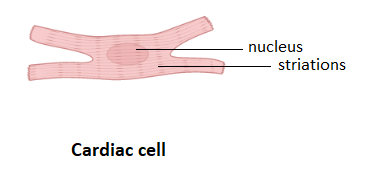
Note: The smallest and most functional unit of striated muscle tissue is the sarcomere. The sarcomere sequence appears as a muscle tissue band responsible for the presence of the striations. Two types of striated muscle are cardiac muscle and skeletal muscle. For skeletal movements like maintaining body balance and locomotion, skeletal muscles are connected to the skeleton of the body.
Complete answer: Muscles are soft tissues that make up a species. For the contraction and relaxation of the muscle, protein filaments called actin and myosin are responsible. The muscle's job is to generate strength and motion. In vertebrates, three kinds of muscle tissues are present. There are skeletal muscles, heart muscles, and smooth muscles. Involuntary muscles are cardiac muscles, but they are only located in the heart. Cardiac muscles are branched in shape and are cylindrical. Cardiac muscles are branched in shape and are cylindrical. They are cells which are uninucleate. Cardiac muscle contraction and relaxation is similar to that of skeletal muscles, although there are several differences. The heart's cardiac cells are specialized excitable cells that can induce electrical impulses and give rise to the potential for action. Often called cardiomyocytes are cardiac muscle cells. The contraction of cardiac muscles is induced by calcium ions that stimulate the cell's capacity for action. If more calcium ion inflow takes place, the heart muscles can experience a prolonged state of contraction. This will trigger the heart rate to rise abnormally.
Note: The smallest and most functional unit of striated muscle tissue is the sarcomere. The sarcomere sequence appears as a muscle tissue band responsible for the presence of the striations. Two types of striated muscle are cardiac muscle and skeletal muscle. For skeletal movements like maintaining body balance and locomotion, skeletal muscles are connected to the skeleton of the body.
Recently Updated Pages
Master Class 11 English: Engaging Questions & Answers for Success

Master Class 11 Social Science: Engaging Questions & Answers for Success
Master Class 11 Maths: Engaging Questions & Answers for Success
Master Class 11 Biology: Engaging Questions & Answers for Success
Master Class 11 Physics: Engaging Questions & Answers for Success
Master Class 11 Chemistry: Engaging Questions & Answers for Success
Trending doubts
One Metric ton is equal to kg A 10000 B 1000 C 100 class 11 physics CBSE
Difference Between Prokaryotic Cells and Eukaryotic Cells
1 ton equals to A 100 kg B 1000 kg C 10 kg D 10000 class 11 physics CBSE
Find the value of the expression given below sin 30circ class 11 maths CBSE
Two of the body parts which do not appear in MRI are class 11 biology CBSE
Draw a diagram of a plant cell and label at least eight class 11 biology CBSE