




Describe an experiment to prove that solids expand on heating.
Answer
 Verified
568.2k+ views
Hint: We need to understand that to solve the problem, the sole purpose the experiment we are modelling here is to understand any difference in the size of a solid after heating it to a considerable amount and the initial size of the solid before heating.
Complete answer:
Consider a spherical metal ball and a ring in which the ball can perfectly fit in at initial condition.
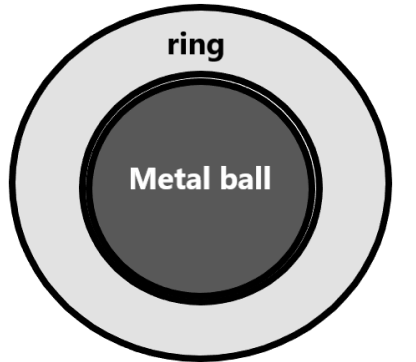
Now, we know that the sphere has a radius which is approximately equal to the inner radius of the ring. Le that radius be ‘r’ and therefore, the volume of the sphere initially will be given as –
\[V=\dfrac{4}{3}\pi {{r}^{3}}\]
Now, take the spherical ball out and heat it for a while. We need to heat the metal to a fairly high temperature to observe any changes as required. Now, after heating it, try to keep the spherical ball of metal back in the ring which it initially fit.
We will observe that the sphere will not fix in the ring the way it used to be. It will have a radius that is exceeding the ring’s inner radius such that the sphere doesn’t get inside the ring anymore.
From this experiment we can infer that the heating of the spherical ball of metal has caused the metal to expand and thus the radius of the sphere, i.e., volume of the sphere increased to a great extent that it is easily noticeable. This proves that the metal expands on heating.
This is the required solution.
Note:
We can see that when the spherical ball is heated using a flame given at the bottom of the sphere, the heating will not uniform across the sphere as a result the expansion will not be equal in all directions, so we may lose the spherical property of the ball after heating.
Complete answer:
Consider a spherical metal ball and a ring in which the ball can perfectly fit in at initial condition.
Now, we know that the sphere has a radius which is approximately equal to the inner radius of the ring. Le that radius be ‘r’ and therefore, the volume of the sphere initially will be given as –
\[V=\dfrac{4}{3}\pi {{r}^{3}}\]
Now, take the spherical ball out and heat it for a while. We need to heat the metal to a fairly high temperature to observe any changes as required. Now, after heating it, try to keep the spherical ball of metal back in the ring which it initially fit.
We will observe that the sphere will not fix in the ring the way it used to be. It will have a radius that is exceeding the ring’s inner radius such that the sphere doesn’t get inside the ring anymore.
From this experiment we can infer that the heating of the spherical ball of metal has caused the metal to expand and thus the radius of the sphere, i.e., volume of the sphere increased to a great extent that it is easily noticeable. This proves that the metal expands on heating.
This is the required solution.
Note:
We can see that when the spherical ball is heated using a flame given at the bottom of the sphere, the heating will not uniform across the sphere as a result the expansion will not be equal in all directions, so we may lose the spherical property of the ball after heating.
Recently Updated Pages
Master Class 12 Economics: Engaging Questions & Answers for Success

Master Class 12 Physics: Engaging Questions & Answers for Success
Master Class 12 English: Engaging Questions & Answers for Success
Master Class 12 Social Science: Engaging Questions & Answers for Success
Master Class 12 Maths: Engaging Questions & Answers for Success
Master Class 12 Business Studies: Engaging Questions & Answers for Success
Trending doubts
Which are the Top 10 Largest Countries of the World?
What are the major means of transport Explain each class 12 social science CBSE
Draw a labelled sketch of the human eye class 12 physics CBSE
Differentiate between insitu conservation and exsitu class 12 biology CBSE
Draw a neat and well labeled diagram of TS of ovary class 12 biology CBSE
Give 10 examples of unisexual and bisexual flowers