




Describe an experiment to demonstrate the thermal expansion of a solid.
Answer
 Verified
598.2k+ views
Hint: Recall the basic information about the thermal expansion of solids. Draw the neat diagram for the experiment showing the thermal expansion of the solids using a metal spherical ball and a ring. Explain the experiment and show that the solids expand when they are heated. Then give the explanation for the thermal expansion of solids.
Complete answer:
The thermal expansion of the solids is the increase in the volume of the solids when heated. When the solids are heated, the heat energy given to the solid gives extra energy to the atoms in the solids. These atoms due to the extra energy start vibrating about their mean position. This vibrations of the atoms about their mean position increases the net volume of the solids and hence, the solids expand when they are heated.
This thermal expansion of the solids can be demonstrated with an experiment as follows: Take a spherical ball made up of the metal and a ring attached to a stand. The size of the metal ball should be such that the spherical metal ball passes through the ring. Attach the metal spherical ball to a chain and fix it on the same stand.
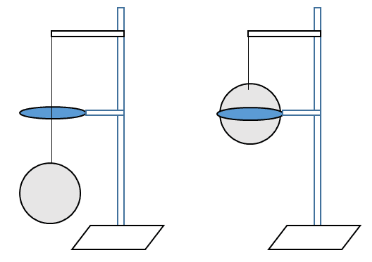
Initially when the spherical metal ball is passed through the ring, it passes easily through the ring.Now heat the metal ball on a burner for some time and then try to pass the metal ball though the ring. The metal ball will not pass through the ring and gets stuck in the ring.This shows that when the metal ball is heated, the size of the metal ball increases which is the proof of thermal expansion of solids.
Note: The students should keep in mind that we should choose the ring and the metal spherical ball carefully. The size of the metal spherical ball should be such that the ball just passes through the ring. If the diameter of the ring is much more than the diameter of the metal ball then the thermal expansion of the metal ball cannot be observed as the expansion is not much.
Complete answer:
The thermal expansion of the solids is the increase in the volume of the solids when heated. When the solids are heated, the heat energy given to the solid gives extra energy to the atoms in the solids. These atoms due to the extra energy start vibrating about their mean position. This vibrations of the atoms about their mean position increases the net volume of the solids and hence, the solids expand when they are heated.
This thermal expansion of the solids can be demonstrated with an experiment as follows: Take a spherical ball made up of the metal and a ring attached to a stand. The size of the metal ball should be such that the spherical metal ball passes through the ring. Attach the metal spherical ball to a chain and fix it on the same stand.
Initially when the spherical metal ball is passed through the ring, it passes easily through the ring.Now heat the metal ball on a burner for some time and then try to pass the metal ball though the ring. The metal ball will not pass through the ring and gets stuck in the ring.This shows that when the metal ball is heated, the size of the metal ball increases which is the proof of thermal expansion of solids.
Note: The students should keep in mind that we should choose the ring and the metal spherical ball carefully. The size of the metal spherical ball should be such that the ball just passes through the ring. If the diameter of the ring is much more than the diameter of the metal ball then the thermal expansion of the metal ball cannot be observed as the expansion is not much.
Recently Updated Pages
Master Class 11 English: Engaging Questions & Answers for Success

Master Class 11 Social Science: Engaging Questions & Answers for Success
Master Class 11 Maths: Engaging Questions & Answers for Success
Master Class 11 Biology: Engaging Questions & Answers for Success
Master Class 11 Physics: Engaging Questions & Answers for Success
Master Class 11 Chemistry: Engaging Questions & Answers for Success
Trending doubts
One Metric ton is equal to kg A 10000 B 1000 C 100 class 11 physics CBSE
Difference Between Prokaryotic Cells and Eukaryotic Cells
Find the value of the expression given below sin 30circ class 11 maths CBSE
Difference between physical and chemical change class 11 chemistry CBSE
Two of the body parts which do not appear in MRI are class 11 biology CBSE
Draw a diagram of a plant cell and label at least eight class 11 biology CBSE