




Describe an activity to show that sound requires a material medium for its propagation.
Answer
 Verified
608.1k+ views
Hint: Bell jar experiment showing sound cannot travel in a vacuum
Sound is a mechanical wave that needs a material medium like air, water, steel, etc., for its propagation. A sound wave travels in the form of a longitudinal wave and it requires a material medium for its propagation. Sound always originates from some vibrating body. These vibrations are produced by tuning forks, drums, bells, the strings of a guitar, etc. The bell jar experiment is a common experiment used to demonstrate that sound needs a medium to travel.
Complete Step By Step Solution
Activity:
Take an electric bell and an airtight glass bell jar.
The electric bell is suspended inside the airtight bell jar.
The bell jar is connected to a vacuum pump. If you press the switch you will be able to hear the bell. Now start the vacuum pump.
When the air in the jar is pumped out gradually, the sound becomes fainter, although the same current is passing through the bell. After some time when less air is left inside the bell jar, you will hear a very feeble sound. And finally, when there is no air present inside the jar, there is no sound detectable.
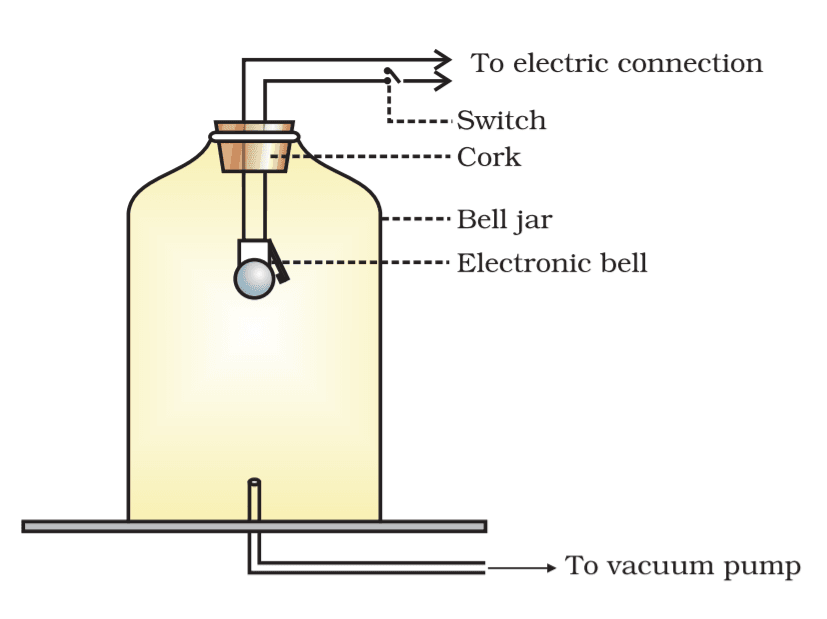
Result:This proves sound needs a material medium to propagate and cannot propagate through the vacuum.
Additional information:
What is sound?
Sound is a mechanical wave that needs a material medium like air, water, steel, etc., for its propagation. We can describe a sound wave by its frequency, wavelength and velocity. The sound wave is a longitudinal wave, ie., the particles of the medium vibrate in a direction parallel to the direction of the propagation of the wave.
Note:
Human voice originates from the vibrations of the vocal cords and the sound from the musical instruments is due to the vibrations of the air columns. In some cases, the vibrating frequency of the source may be so very small or so very large that it is not audible to the human ear. The audible frequency ranges from $20Hz$to $20Khz$. The frequency below 20 Hz is called infrasonic and the frequency above$20Khz$ is called ultrasonic.
Sound is a mechanical wave that needs a material medium like air, water, steel, etc., for its propagation. A sound wave travels in the form of a longitudinal wave and it requires a material medium for its propagation. Sound always originates from some vibrating body. These vibrations are produced by tuning forks, drums, bells, the strings of a guitar, etc. The bell jar experiment is a common experiment used to demonstrate that sound needs a medium to travel.
Complete Step By Step Solution
Activity:
Take an electric bell and an airtight glass bell jar.
The electric bell is suspended inside the airtight bell jar.
The bell jar is connected to a vacuum pump. If you press the switch you will be able to hear the bell. Now start the vacuum pump.
When the air in the jar is pumped out gradually, the sound becomes fainter, although the same current is passing through the bell. After some time when less air is left inside the bell jar, you will hear a very feeble sound. And finally, when there is no air present inside the jar, there is no sound detectable.
Result:This proves sound needs a material medium to propagate and cannot propagate through the vacuum.
Additional information:
What is sound?
Sound is a mechanical wave that needs a material medium like air, water, steel, etc., for its propagation. We can describe a sound wave by its frequency, wavelength and velocity. The sound wave is a longitudinal wave, ie., the particles of the medium vibrate in a direction parallel to the direction of the propagation of the wave.
Note:
Human voice originates from the vibrations of the vocal cords and the sound from the musical instruments is due to the vibrations of the air columns. In some cases, the vibrating frequency of the source may be so very small or so very large that it is not audible to the human ear. The audible frequency ranges from $20Hz$to $20Khz$. The frequency below 20 Hz is called infrasonic and the frequency above$20Khz$ is called ultrasonic.
Recently Updated Pages
Which will be the least stable resonating structure class 11 chemistry CBSE

How many 5 digit telephone numbers can be construc-class-11-maths-CBSE
How do you find the angle of the resultant vector class 11 physics CBSE
Draw labelled diagram of the following i Gram seed class 11 biology CBSE
1 Quintal is equal to a 110 kg b 10 kg c 100kg d 1000 class 11 physics CBSE
What is the need and importance of classification class 11 biology CBSE
Trending doubts
One Metric ton is equal to kg A 10000 B 1000 C 100 class 11 physics CBSE
Find the value of the expression given below sin 30circ class 11 maths CBSE
Draw a diagram of nephron and explain its structur class 11 biology CBSE
10 examples of friction in our daily life
Proton was discovered by A Thomson B Rutherford C Chadwick class 11 chemistry CBSE
The teeth used for biting and cutting food are called class 11 biology CBSE