




Derive the Fourier`s conduction equation for general bodies.
$\left( {\dfrac{{dq}}{{dt}} = - kA\dfrac{{dt}}{{dx}}} \right)$
Answer
 Verified
580.8k+ views
Hint: Fourier law of heat conduction is the governing law for conduction equations. It states that the rate of heat transfer is directly proportional to the area normal to the direction of heat flow and temperature gradient i.e., drop in temperature per unit length.
Complete solution:
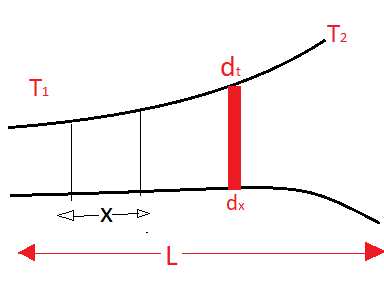
Let us consider a small elemental area from the above body
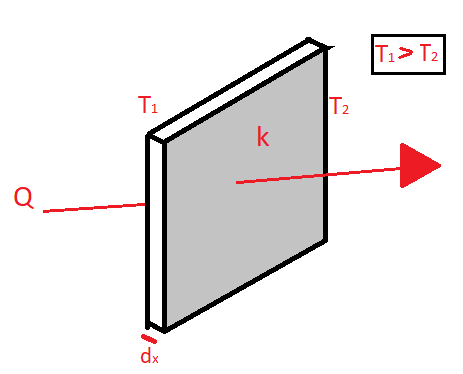
Let the width of this elemental part be $dx$
The small change in temperature be $dt$
A temperature gradient will be the change in temperature per unit area or $\dfrac{{dt}}{{dx}}$
And let $A$ be the area perpendicular to the direction of heat flow
Refer to the diagram
Now as per Fourier’s law
$\dfrac{{dq}}{{dt}} \propto {\rm A}$and,
$\dfrac{{dq}}{{dt}} \propto \dfrac{{dt}}{{dx}}$
$\therefore \dfrac{{dq}}{{dt}} \propto {\rm A}\dfrac{{dt}}{{dx}}$
$\dfrac{{dq}}{{dt}}$ is the rate of heat transferred?
Here to remove the proportionality a constant of proportionality is inserted which
$k$ which is known as Thermal conductivity of the material or wall and is expressed in $\left( {\dfrac{w}{m}K} \right)$
$\therefore \dfrac{{dq}}{{dt}} = - kA\dfrac{{dt}}{{dx}}$
Here the negative sign indicates the drop in temperature across the body
Since $dt$ is the change in temperature so it will be expressed as
$dt = {T_2} - {T_1}$
And as it is evident that ${T_2}$ will be lower than ${T_1}$ so we`ll get a negative value of $dt$ so we use a negative sign before $k$ to nullify this and make heat transfer rate positive
The heat flow rate $\dfrac{{dq}}{{dt}}$ across a body will be $\dfrac{{dq}}{{dt}} = - kA\dfrac{{dt}}{{dx}}$.
Note: The heat always flows from higher temperature to lower temperature that’s why ${T_1}$ will always be greater than ${T_2}$.
The area perpendicular to heat flow rate will always be considered because it is the only area which will cause resistance to the flow of heat and thus will reduce its temperature.
The thermal conductivity $\left( k \right)$is the internal property of the body; it is the measure of how easily heat can be conducted through a body. It is generally higher for metals and lowers for non-metals .
Complete solution:
Let us consider a small elemental area from the above body
Let the width of this elemental part be $dx$
The small change in temperature be $dt$
A temperature gradient will be the change in temperature per unit area or $\dfrac{{dt}}{{dx}}$
And let $A$ be the area perpendicular to the direction of heat flow
Refer to the diagram
Now as per Fourier’s law
$\dfrac{{dq}}{{dt}} \propto {\rm A}$and,
$\dfrac{{dq}}{{dt}} \propto \dfrac{{dt}}{{dx}}$
$\therefore \dfrac{{dq}}{{dt}} \propto {\rm A}\dfrac{{dt}}{{dx}}$
$\dfrac{{dq}}{{dt}}$ is the rate of heat transferred?
Here to remove the proportionality a constant of proportionality is inserted which
$k$ which is known as Thermal conductivity of the material or wall and is expressed in $\left( {\dfrac{w}{m}K} \right)$
$\therefore \dfrac{{dq}}{{dt}} = - kA\dfrac{{dt}}{{dx}}$
Here the negative sign indicates the drop in temperature across the body
Since $dt$ is the change in temperature so it will be expressed as
$dt = {T_2} - {T_1}$
And as it is evident that ${T_2}$ will be lower than ${T_1}$ so we`ll get a negative value of $dt$ so we use a negative sign before $k$ to nullify this and make heat transfer rate positive
The heat flow rate $\dfrac{{dq}}{{dt}}$ across a body will be $\dfrac{{dq}}{{dt}} = - kA\dfrac{{dt}}{{dx}}$.
Note: The heat always flows from higher temperature to lower temperature that’s why ${T_1}$ will always be greater than ${T_2}$.
The area perpendicular to heat flow rate will always be considered because it is the only area which will cause resistance to the flow of heat and thus will reduce its temperature.
The thermal conductivity $\left( k \right)$is the internal property of the body; it is the measure of how easily heat can be conducted through a body. It is generally higher for metals and lowers for non-metals .
Recently Updated Pages
Understanding the Sun's Density: Exploring the Mass Density of a Hot Plasma - FAQs and Data Analysis

The magnetic field in a plane electromagnetic wave class 11 physics CBSE
The branch of science which deals with nature and natural class 10 physics CBSE
Where is the Centre for Environmental Education Located?
How is Abiogenesis Theory Disproved Experimentally?
Which country won UEFA Euro 2020 tournament (played in 2021)?
Trending doubts
One Metric ton is equal to kg A 10000 B 1000 C 100 class 11 physics CBSE
What are the examples of C3 and C4 plants class 11 biology CBSE
What is charge mass and charge to mass ratio of an class 11 chemistry CBSE
State and prove Bernoullis theorem class 11 physics CBSE
Difference Between Prokaryotic Cells and Eukaryotic Cells
1 ton equals to A 100 kg B 1000 kg C 10 kg D 10000 class 11 physics CBSE