




Derive the formula for the volume of the frustum of a cone.
Answer
 Verified
623.1k+ views
Hint: A cone is a three-dimensional geometric shape that tapers smoothly from a flat base to a point called the apex or vertex and its volume is given by, $\dfrac{1}{3}\pi {r^2}h$
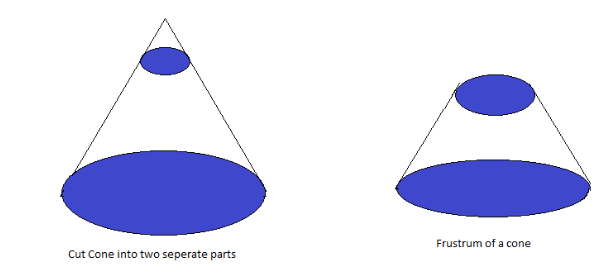
While, a frustum is the portion of a solid that lies between one or two parallel planes cutting.
A right frustum is a parallel truncation of a right pyramid or right cone. So to solve this particular question we just have to subtract the volume of a smaller portion of the cone from the whole volume of the cone.
Complete step-by-step answer:
In order to solve the question, let us mark all the edges and points of cone for our simplicity as shown below,
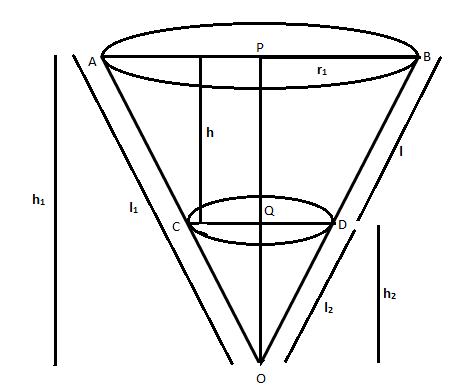
There are two cones \[OCD\]&\[OAB\],
We are given
Height of frustum \[ = h\]
Slant height of frustum \[ = l\]
Radius \[PB = {\text{ }}{r_1}\]
Radius \[QB = {\text{ }}{r_2}\]
We need to find
Curved Surface Area and Total surface Area
Here,
We need to write \[\;{h_1},{\text{ }}{l_1},{\text{ }}{h_2},{\text{ }}{l_2}\] in terms of \[h\] and \[l\]
Volume of frustum = Volume of cone OAB - Volume of cone OCD \[ = \dfrac{1}{3}\pi {r_1}^2{h_1} - \dfrac{1}{3}\pi {r_2}^2{h_{^2}}....(1)\]\[\Delta {\text{OPB & }}\Delta {\text{OQD}}\]
\[\angle BOP = \angle DOQ\] (Common)
\[\angle OPB = \angle OQD\] (Both are \[{90^o}\] as heights are perpendicular)
\[{\text{So, }}\Delta {\text{OPB ~ }}\Delta {\text{OQD}}\]
\[\therefore {\text{ }}\dfrac{{{\text{PB}}}}{{{\text{QD}}}}{\text{ = }}\dfrac{{{\text{OB}}}}{{{\text{OD}}}}\]
Since, Corresponding sides of similar triangles are proportional
\[\therefore {\text{ }}\dfrac{{{r_1}}}{{{r_2}}} = \dfrac{{{h_1}}}{{{h_2}}}\]
Putting, \[{h_1} = h + {h_2}\]
\[\dfrac{{{r_1}}}{{{r_2}}} = \dfrac{{h + {h_2}}}{{{h_2}}}\]
We split the RHS we get,
\[\dfrac{{{r_1}}}{{{r_2}}} = \dfrac{h}{{{h_2}}} + \dfrac{{{h_2}}}{{{h_2}}}\]
On cancel the term we get,
\[\dfrac{{{r_1}}}{{{r_2}}} = \dfrac{h}{{{h_2}}} + 1\]
Taking 1 on RHS we get,
\[\dfrac{{{r_1}}}{{{r_2}}} - 1 = \dfrac{h}{{{h_2}}}\]
Let us take LCM we get,
\[\dfrac{{{r_1} - {r_2}}}{{{r_2}}} = \dfrac{h}{{{h_2}}}\]
We can take a cross multiplication we get,
\[{h_2}\left( {\dfrac{{{r_1} - {r_2}}}{{{r_2}}}} \right) = h\]
Again we do cross multiplication we get,
\[{h_2} = h\left( {\dfrac{{{r_2}}}{{{r_1} - {r_2}}}} \right)....(2)\]
From\[\left( 1 \right)\], Volume of the frustum\[ = \dfrac{1}{3}\pi {r_1}^2{h_1} - \dfrac{1}{3}\pi {r_2}^2{h_{^2}}\]
putting, \[{h_1} = h + {h_2}\]
Volume of the frustum \[{\text{ }} = \dfrac{1}{3}\pi {r_1}^2\left( {h + {h_2}} \right) - \dfrac{1}{3}\pi {r_2}^2{h_{^2}}\]
From \[\left( 2 \right)\]: Putting \[{h_2} = h\left( {\dfrac{{{r_2}}}{{{r_1} - {r_2}}}} \right)\]
\[ = \dfrac{1}{3}\pi {r_1}^2\left( {h + h\left( {\dfrac{{{r_2}}}{{{r_1} - {r_2}}}} \right)} \right) - \dfrac{1}{3}\pi {r_2}^2h\left( {\dfrac{{{r_2}}}{{{r_1} - {r_2}}}} \right)\]
Taking h as common on the terms we get,
\[ = \dfrac{1}{3}\pi {r_1}^2h\left( {1 + \left( {\dfrac{{{r_2}}}{{{r_1} - {r_2}}}} \right)} \right) - \dfrac{1}{3}\pi {r_2}^2h\left( {\dfrac{{{r_2}}}{{{r_1} - {r_2}}}} \right)\]
Let us take the LCM of the first term we get,
\[ = \dfrac{1}{3}\pi {r_1}^2h\left( {\dfrac{{{r_1} - {r_2} + {r_2}}}{{{r_1} - {r_2}}}} \right) - \dfrac{1}{3}\pi {r_2}^2h\left( {\dfrac{{{r_2}}}{{{r_1} - {r_2}}}} \right)\]
On some simplification in the numerator term we get,
\[ = \dfrac{1}{3}\pi {r_1}^2h\left( {\dfrac{{{r_1}}}{{{r_1} - {r_2}}}} \right) - \dfrac{1}{3}\pi {r_2}^2h\left( {\dfrac{{{r_2}}}{{{r_1} - {r_2}}}} \right)\]
On multiplying \[r\] terms we get,
\[ = \dfrac{1}{3}\pi h\left( {\dfrac{{{r_1}^3}}{{{r_1} - {r_2}}}} \right) - \dfrac{1}{3}\pi h\left( {\dfrac{{{r_2}^3}}{{{r_1} - {r_2}}}} \right)\]
Let us take the common terms we get,
\[ = \dfrac{1}{3}\pi h\left( {\dfrac{{{r_1}^3 - {r_2}^3}}{{{r_1} - {r_2}}}} \right)\]
Using the formula, \[{{\text{a}}^{\text{3}}}{\text{ - }}{{\text{b}}^{\text{3}}}{\text{ = (a - b)(}}{{\text{a}}^{\text{2}}}{\text{ + }}{{\text{b}}^{\text{2}}}{\text{ + ab)}}\] in the above term becomes
\[ = \dfrac{1}{3}\pi h\left( {\dfrac{{({r_1} - {r_2})({r_1}^2 + {r_2}^2 + {r_1}{r_2})}}{{{r_1} - {r_2}}}} \right)\]
On cancel the same terms we get,
\[ = \dfrac{1}{3}\pi h({r_1}^2 + {r_2}^2 + {r_1}{r_2})\]
$\therefore $ Volume of frustum=\[ = \dfrac{1}{3}\pi h({r_1}^2 + {r_2}^2 + {r_1}{r_2})\]
Hence we proved the formula for the volume of the frustum of a cone.
Note: In geometry, a frustum is the portion of a solid (normally a cone or pyramid) that lies between one or two parallel planes cutting it.
Here, we have to find the volume of the cone. Volume is the quantity of three-dimensional space enclosed by a closed surface of the frustum of a cone.
Therefore, basic knowledge about geometric shapes must be known by any student. Like in this problem, students shouldn’t be confused with whose volume is to be determined.
While, a frustum is the portion of a solid that lies between one or two parallel planes cutting.
A right frustum is a parallel truncation of a right pyramid or right cone. So to solve this particular question we just have to subtract the volume of a smaller portion of the cone from the whole volume of the cone.
Complete step-by-step answer:
In order to solve the question, let us mark all the edges and points of cone for our simplicity as shown below,
There are two cones \[OCD\]&\[OAB\],
We are given
Height of frustum \[ = h\]
Slant height of frustum \[ = l\]
Radius \[PB = {\text{ }}{r_1}\]
Radius \[QB = {\text{ }}{r_2}\]
We need to find
Curved Surface Area and Total surface Area
Here,
We need to write \[\;{h_1},{\text{ }}{l_1},{\text{ }}{h_2},{\text{ }}{l_2}\] in terms of \[h\] and \[l\]
Volume of frustum = Volume of cone OAB - Volume of cone OCD \[ = \dfrac{1}{3}\pi {r_1}^2{h_1} - \dfrac{1}{3}\pi {r_2}^2{h_{^2}}....(1)\]\[\Delta {\text{OPB & }}\Delta {\text{OQD}}\]
\[\angle BOP = \angle DOQ\] (Common)
\[\angle OPB = \angle OQD\] (Both are \[{90^o}\] as heights are perpendicular)
\[{\text{So, }}\Delta {\text{OPB ~ }}\Delta {\text{OQD}}\]
\[\therefore {\text{ }}\dfrac{{{\text{PB}}}}{{{\text{QD}}}}{\text{ = }}\dfrac{{{\text{OB}}}}{{{\text{OD}}}}\]
Since, Corresponding sides of similar triangles are proportional
\[\therefore {\text{ }}\dfrac{{{r_1}}}{{{r_2}}} = \dfrac{{{h_1}}}{{{h_2}}}\]
Putting, \[{h_1} = h + {h_2}\]
\[\dfrac{{{r_1}}}{{{r_2}}} = \dfrac{{h + {h_2}}}{{{h_2}}}\]
We split the RHS we get,
\[\dfrac{{{r_1}}}{{{r_2}}} = \dfrac{h}{{{h_2}}} + \dfrac{{{h_2}}}{{{h_2}}}\]
On cancel the term we get,
\[\dfrac{{{r_1}}}{{{r_2}}} = \dfrac{h}{{{h_2}}} + 1\]
Taking 1 on RHS we get,
\[\dfrac{{{r_1}}}{{{r_2}}} - 1 = \dfrac{h}{{{h_2}}}\]
Let us take LCM we get,
\[\dfrac{{{r_1} - {r_2}}}{{{r_2}}} = \dfrac{h}{{{h_2}}}\]
We can take a cross multiplication we get,
\[{h_2}\left( {\dfrac{{{r_1} - {r_2}}}{{{r_2}}}} \right) = h\]
Again we do cross multiplication we get,
\[{h_2} = h\left( {\dfrac{{{r_2}}}{{{r_1} - {r_2}}}} \right)....(2)\]
From\[\left( 1 \right)\], Volume of the frustum\[ = \dfrac{1}{3}\pi {r_1}^2{h_1} - \dfrac{1}{3}\pi {r_2}^2{h_{^2}}\]
putting, \[{h_1} = h + {h_2}\]
Volume of the frustum \[{\text{ }} = \dfrac{1}{3}\pi {r_1}^2\left( {h + {h_2}} \right) - \dfrac{1}{3}\pi {r_2}^2{h_{^2}}\]
From \[\left( 2 \right)\]: Putting \[{h_2} = h\left( {\dfrac{{{r_2}}}{{{r_1} - {r_2}}}} \right)\]
\[ = \dfrac{1}{3}\pi {r_1}^2\left( {h + h\left( {\dfrac{{{r_2}}}{{{r_1} - {r_2}}}} \right)} \right) - \dfrac{1}{3}\pi {r_2}^2h\left( {\dfrac{{{r_2}}}{{{r_1} - {r_2}}}} \right)\]
Taking h as common on the terms we get,
\[ = \dfrac{1}{3}\pi {r_1}^2h\left( {1 + \left( {\dfrac{{{r_2}}}{{{r_1} - {r_2}}}} \right)} \right) - \dfrac{1}{3}\pi {r_2}^2h\left( {\dfrac{{{r_2}}}{{{r_1} - {r_2}}}} \right)\]
Let us take the LCM of the first term we get,
\[ = \dfrac{1}{3}\pi {r_1}^2h\left( {\dfrac{{{r_1} - {r_2} + {r_2}}}{{{r_1} - {r_2}}}} \right) - \dfrac{1}{3}\pi {r_2}^2h\left( {\dfrac{{{r_2}}}{{{r_1} - {r_2}}}} \right)\]
On some simplification in the numerator term we get,
\[ = \dfrac{1}{3}\pi {r_1}^2h\left( {\dfrac{{{r_1}}}{{{r_1} - {r_2}}}} \right) - \dfrac{1}{3}\pi {r_2}^2h\left( {\dfrac{{{r_2}}}{{{r_1} - {r_2}}}} \right)\]
On multiplying \[r\] terms we get,
\[ = \dfrac{1}{3}\pi h\left( {\dfrac{{{r_1}^3}}{{{r_1} - {r_2}}}} \right) - \dfrac{1}{3}\pi h\left( {\dfrac{{{r_2}^3}}{{{r_1} - {r_2}}}} \right)\]
Let us take the common terms we get,
\[ = \dfrac{1}{3}\pi h\left( {\dfrac{{{r_1}^3 - {r_2}^3}}{{{r_1} - {r_2}}}} \right)\]
Using the formula, \[{{\text{a}}^{\text{3}}}{\text{ - }}{{\text{b}}^{\text{3}}}{\text{ = (a - b)(}}{{\text{a}}^{\text{2}}}{\text{ + }}{{\text{b}}^{\text{2}}}{\text{ + ab)}}\] in the above term becomes
\[ = \dfrac{1}{3}\pi h\left( {\dfrac{{({r_1} - {r_2})({r_1}^2 + {r_2}^2 + {r_1}{r_2})}}{{{r_1} - {r_2}}}} \right)\]
On cancel the same terms we get,
\[ = \dfrac{1}{3}\pi h({r_1}^2 + {r_2}^2 + {r_1}{r_2})\]
$\therefore $ Volume of frustum=\[ = \dfrac{1}{3}\pi h({r_1}^2 + {r_2}^2 + {r_1}{r_2})\]
Hence we proved the formula for the volume of the frustum of a cone.
Note: In geometry, a frustum is the portion of a solid (normally a cone or pyramid) that lies between one or two parallel planes cutting it.
Here, we have to find the volume of the cone. Volume is the quantity of three-dimensional space enclosed by a closed surface of the frustum of a cone.
Therefore, basic knowledge about geometric shapes must be known by any student. Like in this problem, students shouldn’t be confused with whose volume is to be determined.
Recently Updated Pages
Master Class 11 English: Engaging Questions & Answers for Success

Master Class 11 Social Science: Engaging Questions & Answers for Success
Master Class 11 Maths: Engaging Questions & Answers for Success
Master Class 11 Biology: Engaging Questions & Answers for Success
Master Class 11 Physics: Engaging Questions & Answers for Success
Master Class 11 Chemistry: Engaging Questions & Answers for Success
Trending doubts
Explain the Treaty of Vienna of 1815 class 10 social science CBSE
What is the full form of CNG A Complete Natural Gas class 10 social science CBSE
In cricket, what is a "Yorker" designed to do?
What is the full form of POSCO class 10 social science CBSE
Define Potential, Developed, Stock and Reserved resources
What were the majoritarian measures taken in Sri Lanka class 10 social science CBSE