




Derive the formula for electric potential energy of an electric dipole in a uniform electric field.
Answer
 Verified
621.9k+ views
Hint: Potential energy can be described as the capacity for performing work which is due to the position or configuration. In the electrical case, a charge can exert a force on any other charge and potential energy is felt from any group of charges. As the potential energy increases, then electric potential increases.
Complete step by step answer:
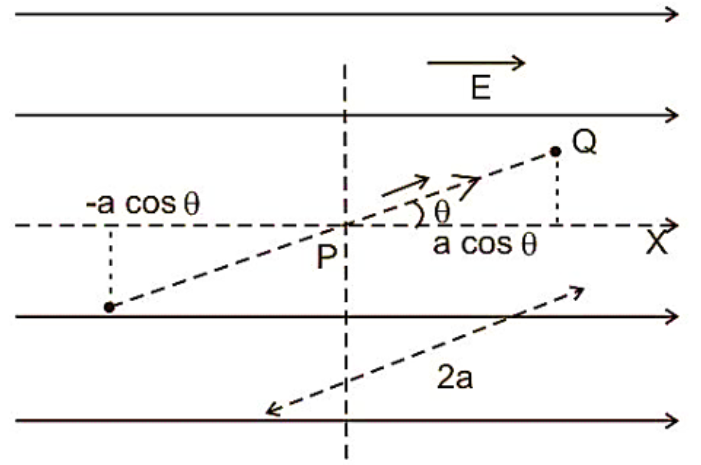
First of all let us discuss the electrical potential energy. Electric potential energy is the energy that is required to move a charge against the electric field. The energy that we used to move a particle away from the plate is stored in the particle itself as electrical potential energy. It is the potential that the particle is taken to move when it's let go. So here the potential energy of a dipole in uniform electric field. $\overrightarrow{\tau }=\overrightarrow{P}\times \overrightarrow{E}$
Work done in rotating dipole by smaller angle
$dw=\tau d\theta $
$=-PE\sin \theta d\theta $
Therefore the potential energy is given by
$dU=-dW=pE\sin \theta d\theta $
If changes from $90{}^\circ $ to $\theta {}^\circ $
Therefore we can write that,
$U\left( \theta \right)-U\left( 90{}^\circ \right)=\int\limits_{90{}^\circ }^{0{}^\circ }{PE\sin \theta d\theta }$
Perform the integration, then we can write that
$=PE\left[ -\cos \theta \right]_{90}^{0}$
That is,
$=-\overrightarrow{P}\cdot \overrightarrow{E}$
Therefore the potential energy of an electric dipole in a uniform electric field is,
$U\left( \theta \right)=-\overrightarrow{P}\cdot \overrightarrow{E}$
Note: The major difference between electric potential and electric potential energy is that electric potential at a point in an electric field is the measure of work done to bring the unit positive charge from the infinity to the particular point. In the similar sense, electric potential energy is the energy that is required to move a charge against the electric field. Unit of electrical potential energy is given in $J$. And it is a scalar quantity also.
Complete step by step answer:
First of all let us discuss the electrical potential energy. Electric potential energy is the energy that is required to move a charge against the electric field. The energy that we used to move a particle away from the plate is stored in the particle itself as electrical potential energy. It is the potential that the particle is taken to move when it's let go. So here the potential energy of a dipole in uniform electric field. $\overrightarrow{\tau }=\overrightarrow{P}\times \overrightarrow{E}$
Work done in rotating dipole by smaller angle
$dw=\tau d\theta $
$=-PE\sin \theta d\theta $
Therefore the potential energy is given by
$dU=-dW=pE\sin \theta d\theta $
If changes from $90{}^\circ $ to $\theta {}^\circ $
Therefore we can write that,
$U\left( \theta \right)-U\left( 90{}^\circ \right)=\int\limits_{90{}^\circ }^{0{}^\circ }{PE\sin \theta d\theta }$
Perform the integration, then we can write that
$=PE\left[ -\cos \theta \right]_{90}^{0}$
That is,
$=-\overrightarrow{P}\cdot \overrightarrow{E}$
Therefore the potential energy of an electric dipole in a uniform electric field is,
$U\left( \theta \right)=-\overrightarrow{P}\cdot \overrightarrow{E}$
Note: The major difference between electric potential and electric potential energy is that electric potential at a point in an electric field is the measure of work done to bring the unit positive charge from the infinity to the particular point. In the similar sense, electric potential energy is the energy that is required to move a charge against the electric field. Unit of electrical potential energy is given in $J$. And it is a scalar quantity also.
Recently Updated Pages
Master Class 12 Economics: Engaging Questions & Answers for Success

Master Class 12 English: Engaging Questions & Answers for Success
Master Class 12 Social Science: Engaging Questions & Answers for Success
Master Class 12 Maths: Engaging Questions & Answers for Success
Master Class 12 Physics: Engaging Questions & Answers for Success
Master Class 9 General Knowledge: Engaging Questions & Answers for Success
Trending doubts
One Metric ton is equal to kg A 10000 B 1000 C 100 class 11 physics CBSE
Difference Between Prokaryotic Cells and Eukaryotic Cells
Two of the body parts which do not appear in MRI are class 11 biology CBSE
1 ton equals to A 100 kg B 1000 kg C 10 kg D 10000 class 11 physics CBSE
Draw a diagram of nephron and explain its structur class 11 biology CBSE
10 examples of friction in our daily life