




Derive the expression for the magnetic field due to a current-carrying coil of the radius $r$ at a distance $x$ from the center along $X - axis$.
Answer
 Verified
603.9k+ views
Hint: We will calculate the magnetic field due to a current-carrying coil of radius $r$ at a distance $x$ from the center of along $X - $ axis by using BIOT-SAVART’S LAW. We can also say that it is the application of BIOT-SAVART LAW.
Complete step by step answer:
Here, we will use BIOT-SAVART’S LAW to calculate the magnetic field due to a current-carrying loop.
For this, we will consider a circular loop, which is a plane circular ring of a conducting wire.
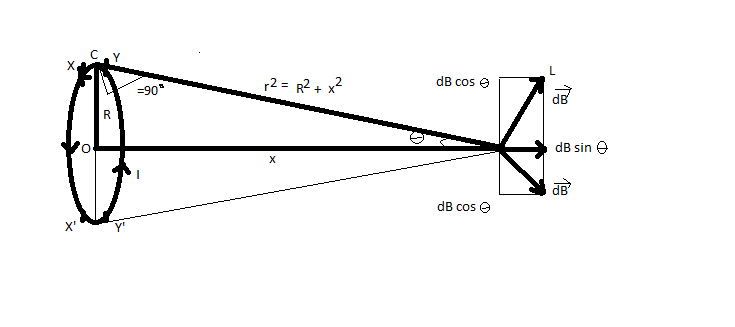
Now, let P be the point on the axis of the circular loop or coil, where the magnetic field is to be calculated. Here, $R$ is the radius of a current-carrying loop and $x$ is the distance of point P from the center of the coil.
Let XY be a small element of length $dl$ at a distance $r$from point P. We know that every current element is perpendicular to $\hat r$.
Now, according to BIOT-SAVART’S LAW, magnetic field due to a small element XY at point P is given by
$dB = \dfrac{{{\mu _0}}}{{4\pi }}\,\dfrac{{I\,dl\,\sin \phi }}{{{r^2}}}.$
Since, $\phi = 90^\circ $, as shown in the figure, therefore, the above equation can be written as
$dB = \dfrac{{{\mu _0}}}{{4\pi }}\,\dfrac{{I\,dl\,\sin 90^\circ }}{{{r^2}}}$
$ \Rightarrow $ $dB = \dfrac{{{\mu _0}}}{{4\pi }}\,\dfrac{{I\,dl}}{{{r^2}}}$
Now, from the above equation, we can say that the direction of $d\vec B$ is perpendicular to the plane formed by $d\vec l$ and $\vec r$ and is along PL which is perpendicular to PC.
Now, we will resolve $dB$ into two components and is given by
i) $dB\,\cos \theta $, which is perpendicular to the axis of the coil and
ii) $dB\,\sin \theta $, which is along the axis of the coil and away from the center of the coil.
Now, we can see that the $dB\,\sin \theta $ component of the magnetic field due to each element of the coil or loop is directed in the same direction. Therefore, the magnetic field at P due to the whole coil or loop is equal to the sum of the $dB\,\sin \theta $ component of the magnetic field due to each element.
i.e. $B = \sum {dB\,\sin \theta } $ or $B = \int {dB\,\sin \theta } $
Now, putting the value of $dB$in the above equation we get,
$B = \int {\dfrac{{{\mu _0}I\,dl}}{{4\pi {r^2}}}\sin \theta } $
$ \Rightarrow $ $B = \dfrac{{{\mu _0}I\,\sin \theta }}{{4\pi {r^2}}}\int {dl} $
Here, $I$, $\theta $ and $r$ are constant.
Also, $\int {dl = } $ the length of the circular coil $ = $ the circumference of the coil $ = 2\pi R$.
Therefore, $dB = \dfrac{{{\mu _0}I\,\sin \theta \times 2\pi R}}{{4\pi {r^2}}}$
Now, from the figure, we can say that
$\sin \theta = \dfrac{R}{r}$
Putting this value, we get
$B = \dfrac{{{\mu _0}I}}{{4\pi {r^2}}}\,\dfrac{{R\,2\pi R}}{r}$
$ \Rightarrow \,B = \dfrac{{{\mu _0}}}{{4\pi }}(\dfrac{{2\pi I{R^2}}}{{{r^3}}})$
But, $r = \sqrt {{R^2} + {x^2}} $
Therefore $\,\,B = \dfrac{{{\mu _0}}}{{4\pi }}\,\dfrac{{2\pi I{R^2}}}{{{{\left( {{R^2} + {x^2}} \right)}^{\dfrac{3}{2}}}}}$, Which is the magnetic at the axis of the current-carrying loop.
Additional Information:
Now, if we consider a case in which the observation point P is far away from the loop or coil (i.e. $x \gg \,R$), then we can neglect the ${R^2}$ as compared to the ${x^2}$.
Hence, ${\left( {{R^2} + {x^2}} \right)^{\dfrac{3}{2}}} = {x^3}$
Therefore, the equation of magnetic field becomes
$B = \dfrac{{{\mu _0}}}{{4\pi }}\,\dfrac{{2\pi I{R^2}}}{{{x^3}}}$
Since, area of loop, $A = \pi {R^2}$
Therefore $\,B' = \dfrac{{{\mu _0}}}{{4\pi }}\,\dfrac{{2IA}}{{{x^3}}}.$
Note: We can also calculate magnetic if the coil has $N$ turns which is given by
$B = \dfrac{{{\mu _0}}}{{4\pi }}\,\dfrac{{2\pi NI{R^2}}}{{{{\left( {{R^2} + {x^2}} \right)}^{\dfrac{3}{2}}}}}$
And $B' = \dfrac{{{\mu _0}}}{{4\pi }}\,\dfrac{{2\pi NI}}{R}$.
Complete step by step answer:
Here, we will use BIOT-SAVART’S LAW to calculate the magnetic field due to a current-carrying loop.
For this, we will consider a circular loop, which is a plane circular ring of a conducting wire.
Now, let P be the point on the axis of the circular loop or coil, where the magnetic field is to be calculated. Here, $R$ is the radius of a current-carrying loop and $x$ is the distance of point P from the center of the coil.
Let XY be a small element of length $dl$ at a distance $r$from point P. We know that every current element is perpendicular to $\hat r$.
Now, according to BIOT-SAVART’S LAW, magnetic field due to a small element XY at point P is given by
$dB = \dfrac{{{\mu _0}}}{{4\pi }}\,\dfrac{{I\,dl\,\sin \phi }}{{{r^2}}}.$
Since, $\phi = 90^\circ $, as shown in the figure, therefore, the above equation can be written as
$dB = \dfrac{{{\mu _0}}}{{4\pi }}\,\dfrac{{I\,dl\,\sin 90^\circ }}{{{r^2}}}$
$ \Rightarrow $ $dB = \dfrac{{{\mu _0}}}{{4\pi }}\,\dfrac{{I\,dl}}{{{r^2}}}$
Now, from the above equation, we can say that the direction of $d\vec B$ is perpendicular to the plane formed by $d\vec l$ and $\vec r$ and is along PL which is perpendicular to PC.
Now, we will resolve $dB$ into two components and is given by
i) $dB\,\cos \theta $, which is perpendicular to the axis of the coil and
ii) $dB\,\sin \theta $, which is along the axis of the coil and away from the center of the coil.
Now, we can see that the $dB\,\sin \theta $ component of the magnetic field due to each element of the coil or loop is directed in the same direction. Therefore, the magnetic field at P due to the whole coil or loop is equal to the sum of the $dB\,\sin \theta $ component of the magnetic field due to each element.
i.e. $B = \sum {dB\,\sin \theta } $ or $B = \int {dB\,\sin \theta } $
Now, putting the value of $dB$in the above equation we get,
$B = \int {\dfrac{{{\mu _0}I\,dl}}{{4\pi {r^2}}}\sin \theta } $
$ \Rightarrow $ $B = \dfrac{{{\mu _0}I\,\sin \theta }}{{4\pi {r^2}}}\int {dl} $
Here, $I$, $\theta $ and $r$ are constant.
Also, $\int {dl = } $ the length of the circular coil $ = $ the circumference of the coil $ = 2\pi R$.
Therefore, $dB = \dfrac{{{\mu _0}I\,\sin \theta \times 2\pi R}}{{4\pi {r^2}}}$
Now, from the figure, we can say that
$\sin \theta = \dfrac{R}{r}$
Putting this value, we get
$B = \dfrac{{{\mu _0}I}}{{4\pi {r^2}}}\,\dfrac{{R\,2\pi R}}{r}$
$ \Rightarrow \,B = \dfrac{{{\mu _0}}}{{4\pi }}(\dfrac{{2\pi I{R^2}}}{{{r^3}}})$
But, $r = \sqrt {{R^2} + {x^2}} $
Therefore $\,\,B = \dfrac{{{\mu _0}}}{{4\pi }}\,\dfrac{{2\pi I{R^2}}}{{{{\left( {{R^2} + {x^2}} \right)}^{\dfrac{3}{2}}}}}$, Which is the magnetic at the axis of the current-carrying loop.
Additional Information:
Now, if we consider a case in which the observation point P is far away from the loop or coil (i.e. $x \gg \,R$), then we can neglect the ${R^2}$ as compared to the ${x^2}$.
Hence, ${\left( {{R^2} + {x^2}} \right)^{\dfrac{3}{2}}} = {x^3}$
Therefore, the equation of magnetic field becomes
$B = \dfrac{{{\mu _0}}}{{4\pi }}\,\dfrac{{2\pi I{R^2}}}{{{x^3}}}$
Since, area of loop, $A = \pi {R^2}$
Therefore $\,B' = \dfrac{{{\mu _0}}}{{4\pi }}\,\dfrac{{2IA}}{{{x^3}}}.$
Note: We can also calculate magnetic if the coil has $N$ turns which is given by
$B = \dfrac{{{\mu _0}}}{{4\pi }}\,\dfrac{{2\pi NI{R^2}}}{{{{\left( {{R^2} + {x^2}} \right)}^{\dfrac{3}{2}}}}}$
And $B' = \dfrac{{{\mu _0}}}{{4\pi }}\,\dfrac{{2\pi NI}}{R}$.
Recently Updated Pages
Master Class 12 Business Studies: Engaging Questions & Answers for Success

Master Class 12 Biology: Engaging Questions & Answers for Success
Master Class 12 Chemistry: Engaging Questions & Answers for Success
Class 12 Question and Answer - Your Ultimate Solutions Guide
Master Class 11 Social Science: Engaging Questions & Answers for Success
Master Class 11 English: Engaging Questions & Answers for Success
Trending doubts
Which is more stable and why class 12 chemistry CBSE
Which are the Top 10 Largest Countries of the World?
Draw a labelled sketch of the human eye class 12 physics CBSE
Differentiate between homogeneous and heterogeneous class 12 chemistry CBSE
What are the major means of transport Explain each class 12 social science CBSE
Sulphuric acid is known as the king of acids State class 12 chemistry CBSE