




Derive the equation of motion using the calculus method?
Answer
 Verified
600k+ views
Hint: In this question, we need to derive the equations of motion strictly by using calculus only. The instantaneous acceleration of a moving particle is defined as the rate of change of velocity of the particle. The equations of motion describe the behavior of a physical system as a set of mathematical functions in terms of dynamic variables.
Complete step by step answer:
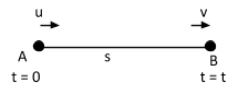
Let us consider a particle is moving in a straight line with uniform acceleration$'a'$. The initial velocity of the particle is $u$ , and after time $'t'$the final velocity becomes$'v'$. Let’s say the particle is moving from A to B, where $AB = s$, i.e., $s$is the displacement of the particle.
The first equation of motion is $\left[ {v = u + at} \right]$:
The rate of change of velocity of a particle is known as the acceleration of the particle, i.e., $\Rightarrow a = \dfrac{{dv}}{{dt}}$. This equation can also be written as:
$
\Rightarrow a = \dfrac{{dv}}{{dt}} \\
\Rightarrow dv = adt \\
$
Integrating both sides of the above equation, we get
$\Rightarrow \int {dv = \int {adt} } $
For applying the limit of integration we choose,
(I) when the particle was at $A(t = 0),$the velocity of the particle was $u$ , and it becomes $v$ at the time $B\left( {t = t} \right)$,
\[
\Rightarrow\int\limits_u^v {dv} = \int\limits_0^t {adt} \\
\Rightarrow\int\limits_u^v {dv} = a\int\limits_0^t {dt} \\
\Rightarrow \left[ v \right]\begin{array}{*{20}{c}}
v \\
u
\end{array} = a\left[ t \right]\begin{array}{*{20}{c}}
t \\
o
\end{array} \\
\Rightarrow v - u = a\left( {t - 0} \right) \\
\Rightarrow v - u = at \\
\Rightarrow v = u + at \\
\]
The second equation of motion is $\left[ {s = ut + \dfrac{1}{2}a{t^2}} \right]$:
We know the acceleration in the form of displacement is given by, \[a = v\left( {\dfrac{{dv}}{{ds}}} \right)\]
The equation can also be written as:
$\Rightarrow ads = vdv........\left( i \right)$
From the first equation of motion, i.e.,$v = u + at$
Differentiating this equation with respect to time, we will get
$
\Rightarrow \dfrac{{dv}}{{dt}} = 0 + a \\
\Rightarrow \dfrac{{dv}}{{dt}} = a \\
\Rightarrow dv = adt \\
$
Putting these values $\left( {v = u + at} \right)$and $\left( {dv = a\,\,dt} \right)$in equation (i), we have
$
\Rightarrow ads = \left( {u + at} \right)\left( {adt} \right) \\
\Rightarrow ds = \left( {u + at} \right)dt \\
$
Integrating both sides:
$
\Rightarrow \int\limits_0^s {ds} = \int\limits_0^t {\left( {u + at} \right)} dt \\
\Rightarrow \int\limits_0^s {ds = \int\limits_0^t {udt + a\int\limits_0^t {tdt} } } \\
\Rightarrow\left[ s \right]\begin{array}{*{20}{c}}
s \\
0
\end{array} = u\left[ t \right]\begin{array}{*{20}{c}}
t \\
0
\end{array} + a\left[ {\dfrac{{{t^2}}}{2}} \right]\begin{array}{*{20}{c}}
t \\
0
\end{array} \\
\Rightarrow s - 0 = u\left( {t - 0} \right) + \dfrac{a}{2}\left( {{t^2} - {0^2}} \right) \\
\Rightarrow s = u + \dfrac{1}{2}a{t^2} \\
$
The third equation of motion is $\left[ {{v^2} = {u^2} + 2us} \right]$:
From equation (i), we can write
$ads = vdv$
Integrating both sides, we get
$
\Rightarrow a\int\limits_0^s {ds} = \int\limits_u^v {udv} \\
\Rightarrow a\left[ s \right]\begin{array}{*{20}{c}}
s \\
0
\end{array} = \left[ {\dfrac{{{v^2}}}{2}} \right]\begin{array}{*{20}{c}}
v \\
u
\end{array} \\
\Rightarrow a\left( {s - 0} \right) = \dfrac{1}{2}\left( {{v^2} - {u^2}} \right) \\
\Rightarrow as = \dfrac{1}{2}\left( {{v^2} - {u^2}} \right) \\
\Rightarrow 2as = \left( {{v^2} - {u^2}} \right) \\
\Rightarrow {v^2} = {u^2} + 2as \\
$
Note:The motion of equations are valid for a uniform acceleration. If the acceleration of the particle is not uniform, then we use integration for calculating the value of acceleration. The formula for the acceleration of the particle is
(i) $a = \dfrac{{dv}}{{dt}}$
(ii) $a = v\left( {\dfrac{{dv}}{{ds}}} \right)$.
The equations of motion are equations that describe the behavior of a physical system in terms of its motion as a function of time.
Complete step by step answer:
Let us consider a particle is moving in a straight line with uniform acceleration$'a'$. The initial velocity of the particle is $u$ , and after time $'t'$the final velocity becomes$'v'$. Let’s say the particle is moving from A to B, where $AB = s$, i.e., $s$is the displacement of the particle.
The first equation of motion is $\left[ {v = u + at} \right]$:
The rate of change of velocity of a particle is known as the acceleration of the particle, i.e., $\Rightarrow a = \dfrac{{dv}}{{dt}}$. This equation can also be written as:
$
\Rightarrow a = \dfrac{{dv}}{{dt}} \\
\Rightarrow dv = adt \\
$
Integrating both sides of the above equation, we get
$\Rightarrow \int {dv = \int {adt} } $
For applying the limit of integration we choose,
(I) when the particle was at $A(t = 0),$the velocity of the particle was $u$ , and it becomes $v$ at the time $B\left( {t = t} \right)$,
\[
\Rightarrow\int\limits_u^v {dv} = \int\limits_0^t {adt} \\
\Rightarrow\int\limits_u^v {dv} = a\int\limits_0^t {dt} \\
\Rightarrow \left[ v \right]\begin{array}{*{20}{c}}
v \\
u
\end{array} = a\left[ t \right]\begin{array}{*{20}{c}}
t \\
o
\end{array} \\
\Rightarrow v - u = a\left( {t - 0} \right) \\
\Rightarrow v - u = at \\
\Rightarrow v = u + at \\
\]
The second equation of motion is $\left[ {s = ut + \dfrac{1}{2}a{t^2}} \right]$:
We know the acceleration in the form of displacement is given by, \[a = v\left( {\dfrac{{dv}}{{ds}}} \right)\]
The equation can also be written as:
$\Rightarrow ads = vdv........\left( i \right)$
From the first equation of motion, i.e.,$v = u + at$
Differentiating this equation with respect to time, we will get
$
\Rightarrow \dfrac{{dv}}{{dt}} = 0 + a \\
\Rightarrow \dfrac{{dv}}{{dt}} = a \\
\Rightarrow dv = adt \\
$
Putting these values $\left( {v = u + at} \right)$and $\left( {dv = a\,\,dt} \right)$in equation (i), we have
$
\Rightarrow ads = \left( {u + at} \right)\left( {adt} \right) \\
\Rightarrow ds = \left( {u + at} \right)dt \\
$
Integrating both sides:
$
\Rightarrow \int\limits_0^s {ds} = \int\limits_0^t {\left( {u + at} \right)} dt \\
\Rightarrow \int\limits_0^s {ds = \int\limits_0^t {udt + a\int\limits_0^t {tdt} } } \\
\Rightarrow\left[ s \right]\begin{array}{*{20}{c}}
s \\
0
\end{array} = u\left[ t \right]\begin{array}{*{20}{c}}
t \\
0
\end{array} + a\left[ {\dfrac{{{t^2}}}{2}} \right]\begin{array}{*{20}{c}}
t \\
0
\end{array} \\
\Rightarrow s - 0 = u\left( {t - 0} \right) + \dfrac{a}{2}\left( {{t^2} - {0^2}} \right) \\
\Rightarrow s = u + \dfrac{1}{2}a{t^2} \\
$
The third equation of motion is $\left[ {{v^2} = {u^2} + 2us} \right]$:
From equation (i), we can write
$ads = vdv$
Integrating both sides, we get
$
\Rightarrow a\int\limits_0^s {ds} = \int\limits_u^v {udv} \\
\Rightarrow a\left[ s \right]\begin{array}{*{20}{c}}
s \\
0
\end{array} = \left[ {\dfrac{{{v^2}}}{2}} \right]\begin{array}{*{20}{c}}
v \\
u
\end{array} \\
\Rightarrow a\left( {s - 0} \right) = \dfrac{1}{2}\left( {{v^2} - {u^2}} \right) \\
\Rightarrow as = \dfrac{1}{2}\left( {{v^2} - {u^2}} \right) \\
\Rightarrow 2as = \left( {{v^2} - {u^2}} \right) \\
\Rightarrow {v^2} = {u^2} + 2as \\
$
Note:The motion of equations are valid for a uniform acceleration. If the acceleration of the particle is not uniform, then we use integration for calculating the value of acceleration. The formula for the acceleration of the particle is
(i) $a = \dfrac{{dv}}{{dt}}$
(ii) $a = v\left( {\dfrac{{dv}}{{ds}}} \right)$.
The equations of motion are equations that describe the behavior of a physical system in terms of its motion as a function of time.
Recently Updated Pages
Master Class 11 Social Science: Engaging Questions & Answers for Success

Master Class 11 Physics: Engaging Questions & Answers for Success
Master Class 11 Maths: Engaging Questions & Answers for Success
Master Class 11 Economics: Engaging Questions & Answers for Success
Master Class 11 Computer Science: Engaging Questions & Answers for Success
Master Class 11 Chemistry: Engaging Questions & Answers for Success
Trending doubts
One Metric ton is equal to kg A 10000 B 1000 C 100 class 11 physics CBSE
There are 720 permutations of the digits 1 2 3 4 5 class 11 maths CBSE
1 Quintal is equal to a 110 kg b 10 kg c 100kg d 1000 class 11 physics CBSE
State and prove Bernoullis theorem class 11 physics CBSE
Difference Between Prokaryotic Cells and Eukaryotic Cells
Discuss the various forms of bacteria class 11 biology CBSE