




Derive an expression for work done in sliding a body down an inclined rough plane.
Answer
 Verified
562.2k+ views
Hint: The frictional force can be calculated by taking the product of coefficient of friction and the normal force acting over it. Find out the frictional force first. Then find the net force acting in the forward direction. And find out the work done by the body in order to move a particular displacement. These all may help you to solve this question.
Complete answer:
The body is sliding down with a force acting over it. The total force acting on the body can be shown in a diagram as,
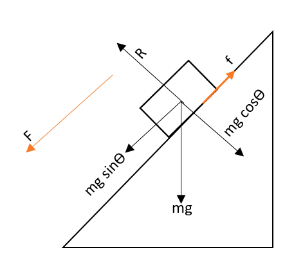
Let us assume that the frictional force acting over the body is given as $f$. This can be found by the equation,
$f=\mu N$
Here $\mu $be the coefficient of friction and $N$ be the normal force acting on the body. From the figure, we can see that this normal force is equivalent to the cosine component of the gravitational force acting. That is we can write that,
$N=mg\cos \theta $
Substituting this in the equation will give,
$f=\mu mg\cos \theta $
The resultant force in the forward direction can be written as,
$F=mg\sin \theta -\mu mg\cos \theta $
Let us assume that the distance travelled by the body down the plane is given as $S$.
Therefore the work done can be calculated as,
$W=F\cdot S$
Substituting the values in it will give the equation as,
$W=\left( mg\sin \theta -\mu mg\cos \theta \right)\cdot S$
Note:
Frictional Force is defined as the force created by two surfaces that are in contact and slide against each other. These forces are primarily affected by the nature of surface and quantity of force requiring them together. The volume of frictional force is affected by the angle and position of the object. Coefficient of friction is described as the ratio of the force needed to move the sliding surfaces over each other, and the force holding them together.
Complete answer:
The body is sliding down with a force acting over it. The total force acting on the body can be shown in a diagram as,
Let us assume that the frictional force acting over the body is given as $f$. This can be found by the equation,
$f=\mu N$
Here $\mu $be the coefficient of friction and $N$ be the normal force acting on the body. From the figure, we can see that this normal force is equivalent to the cosine component of the gravitational force acting. That is we can write that,
$N=mg\cos \theta $
Substituting this in the equation will give,
$f=\mu mg\cos \theta $
The resultant force in the forward direction can be written as,
$F=mg\sin \theta -\mu mg\cos \theta $
Let us assume that the distance travelled by the body down the plane is given as $S$.
Therefore the work done can be calculated as,
$W=F\cdot S$
Substituting the values in it will give the equation as,
$W=\left( mg\sin \theta -\mu mg\cos \theta \right)\cdot S$
Note:
Frictional Force is defined as the force created by two surfaces that are in contact and slide against each other. These forces are primarily affected by the nature of surface and quantity of force requiring them together. The volume of frictional force is affected by the angle and position of the object. Coefficient of friction is described as the ratio of the force needed to move the sliding surfaces over each other, and the force holding them together.
Recently Updated Pages
Master Class 11 English: Engaging Questions & Answers for Success

Master Class 11 Social Science: Engaging Questions & Answers for Success
Master Class 11 Maths: Engaging Questions & Answers for Success
Master Class 11 Biology: Engaging Questions & Answers for Success
Master Class 11 Physics: Engaging Questions & Answers for Success
Master Class 11 Chemistry: Engaging Questions & Answers for Success
Trending doubts
Find the value of the expression given below sin 30circ class 11 maths CBSE
Difference between physical and chemical change class 11 chemistry CBSE
Draw a diagram of a plant cell and label at least eight class 11 biology CBSE
Draw a diagram showing the external features of fish class 11 biology CBSE
10 examples of law on inertia in our daily life
Draw a diagram of nephron and explain its structur class 11 biology CBSE