




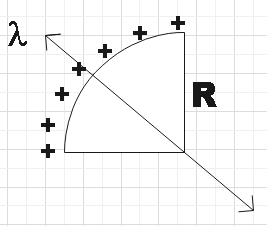
Derive an expression for the electric field at the centre.
Answer
 Verified
563.4k+ views
Hint: You could firstly consider an arbitrary element from the given quarter circle and then find the electric field due to that small element. On resolving the electric field thus found we understand that we have such components in every one of the small elements in that quarter circle. You could find the net electric components by integrating using appropriate limits for x and y directions and then find their resultant to get the answer.
Formula used:
Electric field,
$\overrightarrow{dE}=k\dfrac{dq}{R}$
Complete answer:
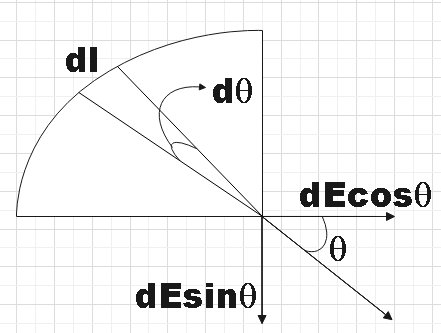
In the question we are given a quarter circle of uniform charge density and are asked to find the net electric field at its centre. We could consider a small element dl that subtends a small angle $d\theta $ at the centre.
Linear charge density $\lambda $ could be given by,
$\lambda =\dfrac{dq}{dl}$
$\Rightarrow dq=\lambda dl$ ………………………………. (1)
We also have,
$d\theta =\dfrac{dl}{R}$
$\Rightarrow dl=Rd\theta $ ………………………………. (2)
Substituting (2) in (1) we get,
$dq=\lambda Rd\theta $ ………………………………….. (3)
Now the electric field due to this small element under consideration could be given by,
$\overrightarrow{dE}=k\dfrac{dq}{R}$
Substituting (3),
$\overrightarrow{dE}=\dfrac{k\lambda Rd\theta }{{{R}^{2}}}=\dfrac{k\lambda }{R}d\theta $ ……………………………….. (4)
We could resolve $\overrightarrow{dE}$ into its components $dE\cos \theta $ and $dE\sin \theta $
For every small element of the quarter circle will have these components and we have to find the resultant of all these components. Is ${{E}_{x}}=\int{dE\cos \theta }$ and ${{E}_{y}}=\int{dE\sin \theta }$ are the net electric field along x and y directions respectively, then the net electric field due to the given quarter circle would be,
${{\overrightarrow{E}}_{net}}=\sqrt{{{E}_{x}}^{2}+{{E}_{y}}^{2}}$ ……………………………………………… (5)
Now,
${{E}_{x}}=\int{dE\cos \theta }$
From (4),
$\Rightarrow {{E}_{x}}=\int\limits_{0}^{\dfrac{\pi }{2}}{\dfrac{k\lambda }{R}}d\theta \cos \theta =\dfrac{k\lambda }{R}\int\limits_{0}^{\dfrac{\pi }{2}}{\cos \theta d\theta }$
$\Rightarrow {{E}_{x}}=\dfrac{k\lambda }{R}\left[ \sin \theta \right]_{0}^{\dfrac{\pi }{2}}=\dfrac{k\lambda }{R}\left[ 1-0 \right]$
$\Rightarrow {{E}_{x}}=\dfrac{k\lambda }{R}$ …………………………………………… (6)
And,
${{E}_{y}}=\int{dE\sin \theta }$
$\Rightarrow {{E}_{y}}=\int\limits_{0}^{\dfrac{\pi }{2}}{\dfrac{k\lambda }{R}}d\theta \sin \theta =\dfrac{k\lambda }{R}\int\limits_{0}^{\dfrac{\pi }{2}}{\sin \theta d\theta }$
$\Rightarrow {{E}_{y}}=\dfrac{k\lambda }{R}\left[ -\cos \theta \right]_{0}^{\dfrac{\pi }{2}}=\dfrac{k\lambda }{R}\left[ 0-\left( -1 \right) \right]$
$\Rightarrow {{E}_{y}}=\dfrac{k\lambda }{R}$ …………………………………………… (7)
From (6) and (7),
${{E}_{x}}={{E}_{y}}=E=\dfrac{k\lambda }{R}$
Equation (5) now becomes,
${{\overrightarrow{E}}_{net}}=\sqrt{{{E}_{x}}^{2}+{{E}_{y}}^{2}}$
$\Rightarrow {{\overrightarrow{E}}_{net}}=\sqrt{2{{E}^{2}}}=\sqrt{2}E$
$\therefore {{\overrightarrow{E}}_{net}}=\sqrt{2}\dfrac{k\lambda }{R}$
Therefore, we found the electric field at the centre of the quarter circle to be,
${{\overrightarrow{E}}_{net}}=\sqrt{2}\dfrac{k\lambda }{R}$
Note:
You may have noticed the constant that is being used throughout the solution ‘k’. This constant can ‘k’ can be given by,
$k=\dfrac{1}{4\pi {{\varepsilon }_{0}}}=9\times {{10}^{9}}$
Now, we applied limits for the integral from 0 to $\dfrac{\pi }{2}$ as we are performing integration for $d\theta $ and we have applied the limits appropriately for a quarter circle.
Formula used:
Electric field,
$\overrightarrow{dE}=k\dfrac{dq}{R}$
Complete answer:
In the question we are given a quarter circle of uniform charge density and are asked to find the net electric field at its centre. We could consider a small element dl that subtends a small angle $d\theta $ at the centre.
Linear charge density $\lambda $ could be given by,
$\lambda =\dfrac{dq}{dl}$
$\Rightarrow dq=\lambda dl$ ………………………………. (1)
We also have,
$d\theta =\dfrac{dl}{R}$
$\Rightarrow dl=Rd\theta $ ………………………………. (2)
Substituting (2) in (1) we get,
$dq=\lambda Rd\theta $ ………………………………….. (3)
Now the electric field due to this small element under consideration could be given by,
$\overrightarrow{dE}=k\dfrac{dq}{R}$
Substituting (3),
$\overrightarrow{dE}=\dfrac{k\lambda Rd\theta }{{{R}^{2}}}=\dfrac{k\lambda }{R}d\theta $ ……………………………….. (4)
We could resolve $\overrightarrow{dE}$ into its components $dE\cos \theta $ and $dE\sin \theta $
For every small element of the quarter circle will have these components and we have to find the resultant of all these components. Is ${{E}_{x}}=\int{dE\cos \theta }$ and ${{E}_{y}}=\int{dE\sin \theta }$ are the net electric field along x and y directions respectively, then the net electric field due to the given quarter circle would be,
${{\overrightarrow{E}}_{net}}=\sqrt{{{E}_{x}}^{2}+{{E}_{y}}^{2}}$ ……………………………………………… (5)
Now,
${{E}_{x}}=\int{dE\cos \theta }$
From (4),
$\Rightarrow {{E}_{x}}=\int\limits_{0}^{\dfrac{\pi }{2}}{\dfrac{k\lambda }{R}}d\theta \cos \theta =\dfrac{k\lambda }{R}\int\limits_{0}^{\dfrac{\pi }{2}}{\cos \theta d\theta }$
$\Rightarrow {{E}_{x}}=\dfrac{k\lambda }{R}\left[ \sin \theta \right]_{0}^{\dfrac{\pi }{2}}=\dfrac{k\lambda }{R}\left[ 1-0 \right]$
$\Rightarrow {{E}_{x}}=\dfrac{k\lambda }{R}$ …………………………………………… (6)
And,
${{E}_{y}}=\int{dE\sin \theta }$
$\Rightarrow {{E}_{y}}=\int\limits_{0}^{\dfrac{\pi }{2}}{\dfrac{k\lambda }{R}}d\theta \sin \theta =\dfrac{k\lambda }{R}\int\limits_{0}^{\dfrac{\pi }{2}}{\sin \theta d\theta }$
$\Rightarrow {{E}_{y}}=\dfrac{k\lambda }{R}\left[ -\cos \theta \right]_{0}^{\dfrac{\pi }{2}}=\dfrac{k\lambda }{R}\left[ 0-\left( -1 \right) \right]$
$\Rightarrow {{E}_{y}}=\dfrac{k\lambda }{R}$ …………………………………………… (7)
From (6) and (7),
${{E}_{x}}={{E}_{y}}=E=\dfrac{k\lambda }{R}$
Equation (5) now becomes,
${{\overrightarrow{E}}_{net}}=\sqrt{{{E}_{x}}^{2}+{{E}_{y}}^{2}}$
$\Rightarrow {{\overrightarrow{E}}_{net}}=\sqrt{2{{E}^{2}}}=\sqrt{2}E$
$\therefore {{\overrightarrow{E}}_{net}}=\sqrt{2}\dfrac{k\lambda }{R}$
Therefore, we found the electric field at the centre of the quarter circle to be,
${{\overrightarrow{E}}_{net}}=\sqrt{2}\dfrac{k\lambda }{R}$
Note:
You may have noticed the constant that is being used throughout the solution ‘k’. This constant can ‘k’ can be given by,
$k=\dfrac{1}{4\pi {{\varepsilon }_{0}}}=9\times {{10}^{9}}$
Now, we applied limits for the integral from 0 to $\dfrac{\pi }{2}$ as we are performing integration for $d\theta $ and we have applied the limits appropriately for a quarter circle.
Recently Updated Pages
Master Class 11 Social Science: Engaging Questions & Answers for Success

Master Class 11 English: Engaging Questions & Answers for Success
Master Class 11 Maths: Engaging Questions & Answers for Success
Master Class 11 Chemistry: Engaging Questions & Answers for Success
Master Class 11 Biology: Engaging Questions & Answers for Success
Master Class 11 Physics: Engaging Questions & Answers for Success
Trending doubts
Differentiate between an exothermic and an endothermic class 11 chemistry CBSE
One Metric ton is equal to kg A 10000 B 1000 C 100 class 11 physics CBSE
Difference Between Prokaryotic Cells and Eukaryotic Cells
There are 720 permutations of the digits 1 2 3 4 5 class 11 maths CBSE
Two of the body parts which do not appear in MRI are class 11 biology CBSE
Which gas is abundant in air class 11 chemistry CBSE