




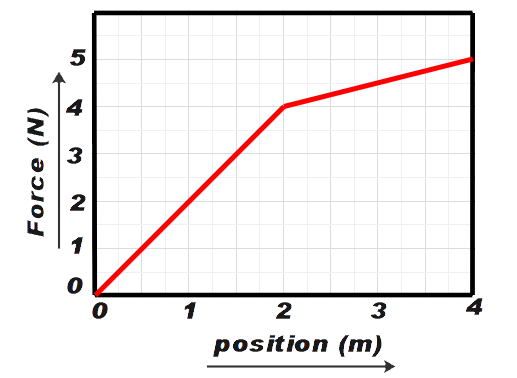
Depicted in the plot below is the horizontal force a cube experiences as it slides on a frictionless surface. The force that the cube experiences changes as the function of distance, which is shown on the horizontal axis. What is the work done on the cube from x = 1 m to x = 3 m.
A. 3 J
B. 7.25 J
C. 8 J
D. 4.25 J
E. 7 J
Answer
 Verified
580.2k+ views
Hint: In this question we have been asked to calculate the work done on the given cube from x = 1 m to x = 3 m. We have been given a force versus position graph. We know that work done is given as the product of force and displacement. But we also know that area under the force-position graph shall always give us the work done on an object, Therefore, we shall find the area under the curve from x = 1 to x = 3.
Complete answer:
We know that area under the Force-position graph gives us the work done on the particle. Therefore, we shall calculate the area under the given graph from x = 1 to x = 3 meters.
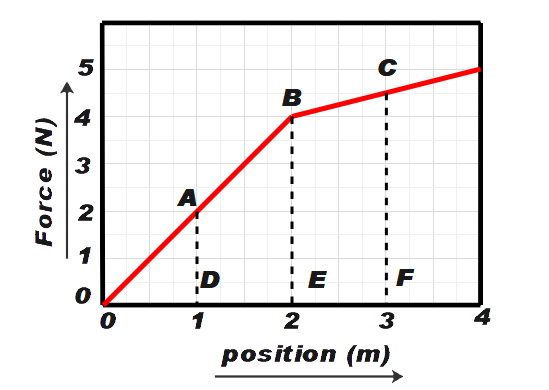
From the figure above we can say that,
AD = 2N, BE = 4N, CF = 4.5N and DE = EF = 1m
Therefore,
We can say that,
Area of trapezium, (DABE) i.e. \[{{A}_{1}}\] can be given by,
\[{{A}_{1}}=\dfrac{1}{2}\left[ AD+BE \right]\times DE\]
After substituting values,
\[{{A}_{1}}=\dfrac{1}{2}\left[ 2+4 \right]\times 1\]
Therefore,
\[{{A}_{1}}=3J\] ………….. (1)
Similarly, area of trapezium, (EBCF) \[{{A}_{2}}\] can be given by,
\[{{A}_{2}}=\dfrac{1}{2}\left[ CF+BE \right]\times EF\]
After substituting given values
\[{{A}_{2}}=\dfrac{1}{2}\left[ 4.5+4 \right]\times 1\]
Therefore
\[{{A}_{2}}=4.25J\] ………….. (2)
Now, we know that for graph of F-x the area under F-x is known as work done
Therefore, work done from x = 1m to x = 3m is given by,
\[W={{A}_{1}}+{{A}_{2}}\]
From (1) and (2)
We get,
\[W=3+4.25\]
Therefore,
\[W=7.25J\]
So, the correct answer is “Option B”.
Note:
When an object is moved or displaced from its initial position to a distance d independent of the path after application of force F, the work done can be given as product of F and distance d. The displacement is caused by the force, therefore, it can be said that work done is the amount of energy required to move an object at distance d.
Complete answer:
We know that area under the Force-position graph gives us the work done on the particle. Therefore, we shall calculate the area under the given graph from x = 1 to x = 3 meters.
From the figure above we can say that,
AD = 2N, BE = 4N, CF = 4.5N and DE = EF = 1m
Therefore,
We can say that,
Area of trapezium, (DABE) i.e. \[{{A}_{1}}\] can be given by,
\[{{A}_{1}}=\dfrac{1}{2}\left[ AD+BE \right]\times DE\]
After substituting values,
\[{{A}_{1}}=\dfrac{1}{2}\left[ 2+4 \right]\times 1\]
Therefore,
\[{{A}_{1}}=3J\] ………….. (1)
Similarly, area of trapezium, (EBCF) \[{{A}_{2}}\] can be given by,
\[{{A}_{2}}=\dfrac{1}{2}\left[ CF+BE \right]\times EF\]
After substituting given values
\[{{A}_{2}}=\dfrac{1}{2}\left[ 4.5+4 \right]\times 1\]
Therefore
\[{{A}_{2}}=4.25J\] ………….. (2)
Now, we know that for graph of F-x the area under F-x is known as work done
Therefore, work done from x = 1m to x = 3m is given by,
\[W={{A}_{1}}+{{A}_{2}}\]
From (1) and (2)
We get,
\[W=3+4.25\]
Therefore,
\[W=7.25J\]
So, the correct answer is “Option B”.
Note:
When an object is moved or displaced from its initial position to a distance d independent of the path after application of force F, the work done can be given as product of F and distance d. The displacement is caused by the force, therefore, it can be said that work done is the amount of energy required to move an object at distance d.
Recently Updated Pages
Master Class 11 Computer Science: Engaging Questions & Answers for Success

Master Class 11 Business Studies: Engaging Questions & Answers for Success
Master Class 11 Economics: Engaging Questions & Answers for Success
Master Class 11 English: Engaging Questions & Answers for Success
Master Class 11 Maths: Engaging Questions & Answers for Success
Master Class 11 Biology: Engaging Questions & Answers for Success
Trending doubts
One Metric ton is equal to kg A 10000 B 1000 C 100 class 11 physics CBSE
There are 720 permutations of the digits 1 2 3 4 5 class 11 maths CBSE
Discuss the various forms of bacteria class 11 biology CBSE
Draw a diagram of a plant cell and label at least eight class 11 biology CBSE
State the laws of reflection of light
Explain zero factorial class 11 maths CBSE