




\[\Delta ABC ~ \Delta PQR\], the ratio of their corresponding altitudes AD and PS are in\[2:3\], then \[\Delta ABC:\Delta PQR = \]…………
A. \[9:4\]
B. \[16:81\]
C. \[4:9\]
D. \[2:3\]
Answer
 Verified
638.4k+ views
Hint: We know that the sum of the angles of a triangle is taken as \[180^\circ \]. We can say that two triangles are similar triangles only when the two triangles are equal in shape and different in sizes or it can be said that the two triangles are similar to each other whenever they are in the same proportion.
Complete step by step solution
Given:
The ratio of the altitudes of AD and PS is\[x:y = 2:3\].
The following are the schematic diagram of the triangles ABC and PQR.
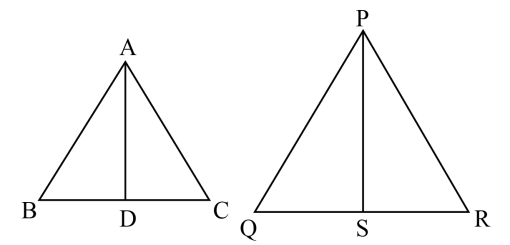
Given that \[\Delta ABC\]and\[\Delta PQR\] are similar to each other. Here we can observe that the two triangles are similar but ratios are different, it means these triangles are similar according to their proportion and shape.
The ratios of the two triangles can be found by the ratios of the squares of the two altitudes that are given. It can be written as:
\[\dfrac{{\Delta ABC}}{{\Delta PQR}} = \dfrac{{{x^2}}}{{{y^2}}}\]
On substituting the values of x and y in the above equation, we get,
\[\begin{array}{l}
\dfrac{{\Delta ABC}}{{\Delta PQR}} = \dfrac{{{x^2}}}{{{y^2}}}\\
\dfrac{{\Delta ABC}}{{\Delta PQR}} = \dfrac{{{2^2}}}{{{3^2}}}\\
\dfrac{{\Delta ABC}}{{\Delta PQR}} = \dfrac{4}{9}
\end{array}\]
Therefore, it is obtained that the ratio of \[\Delta ABC\] and \[\Delta PQR\] is \[4:9\], which means the option (c) is correct.
Note: Here, in this problem we have to be careful while taking the ratios, the question is asked as the ratio of triangle ABC and PQR, so the altitude of the triangle ABC should be in the numerator and the altitude of the triangle PQR should be in the denominator. The ratios of the \[\Delta ABC\] and \[\Delta PQR\] can also be written as the ratios of the area of the triangle \[\Delta ABC\] and the area of the triangle \[\Delta PQR\].
Complete step by step solution
Given:
The ratio of the altitudes of AD and PS is\[x:y = 2:3\].
The following are the schematic diagram of the triangles ABC and PQR.
Given that \[\Delta ABC\]and\[\Delta PQR\] are similar to each other. Here we can observe that the two triangles are similar but ratios are different, it means these triangles are similar according to their proportion and shape.
The ratios of the two triangles can be found by the ratios of the squares of the two altitudes that are given. It can be written as:
\[\dfrac{{\Delta ABC}}{{\Delta PQR}} = \dfrac{{{x^2}}}{{{y^2}}}\]
On substituting the values of x and y in the above equation, we get,
\[\begin{array}{l}
\dfrac{{\Delta ABC}}{{\Delta PQR}} = \dfrac{{{x^2}}}{{{y^2}}}\\
\dfrac{{\Delta ABC}}{{\Delta PQR}} = \dfrac{{{2^2}}}{{{3^2}}}\\
\dfrac{{\Delta ABC}}{{\Delta PQR}} = \dfrac{4}{9}
\end{array}\]
Therefore, it is obtained that the ratio of \[\Delta ABC\] and \[\Delta PQR\] is \[4:9\], which means the option (c) is correct.
Note: Here, in this problem we have to be careful while taking the ratios, the question is asked as the ratio of triangle ABC and PQR, so the altitude of the triangle ABC should be in the numerator and the altitude of the triangle PQR should be in the denominator. The ratios of the \[\Delta ABC\] and \[\Delta PQR\] can also be written as the ratios of the area of the triangle \[\Delta ABC\] and the area of the triangle \[\Delta PQR\].
Recently Updated Pages
Master Class 12 Economics: Engaging Questions & Answers for Success

Master Class 12 Biology: Engaging Questions & Answers for Success
Master Class 11 English: Engaging Questions & Answers for Success
Master Class 11 Physics: Engaging Questions & Answers for Success
Master Class 11 Computer Science: Engaging Questions & Answers for Success
Master Class 11 Chemistry: Engaging Questions & Answers for Success
Trending doubts
What is the Total Duration of Football Match?
Explain the Treaty of Vienna of 1815 class 10 social science CBSE
In football, which nation is called "La Roja"?
Why is there a time difference of about 5 hours between class 10 social science CBSE
10 examples of evaporation in daily life with explanations
What is the full form of POSCO class 10 social science CBSE