




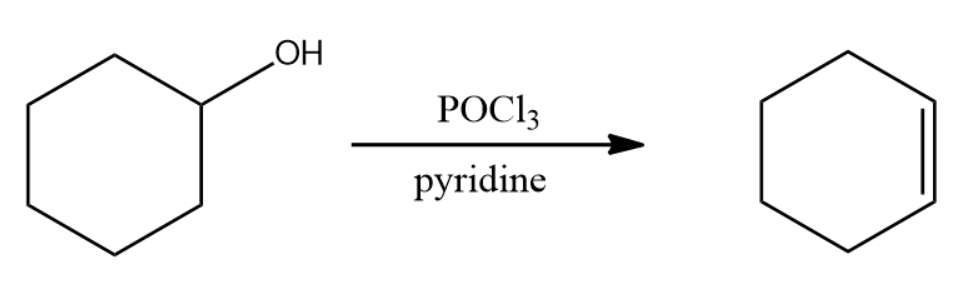
Dehydration of alcohols take place more rapidly with $POC{{l}_{3}}$ than with ${{H}_{2}}S{{O}_{4}}$.
Select the correct statement(s) about the above dehydration reaction:
This question has multiple correct options
Answer
 Verified
619.8k+ views
Hint: An attempt to this question can be made by determining the reaction mechanism for dehydration using both the reagents $POC{{l}_{3}}$ and${{H}_{2}}S{{O}_{4}}$. Now determine the difference in the mechanism. With this you can reason why $POC{{l}_{3}}$ is preferred over ${{H}_{2}}S{{O}_{4}}$ for dehydration.
Complete step by step answer:
So in the question it is asked that, we have to select
We will write the reaction mechanism for dehydration using $POC{{l}_{3}}$.
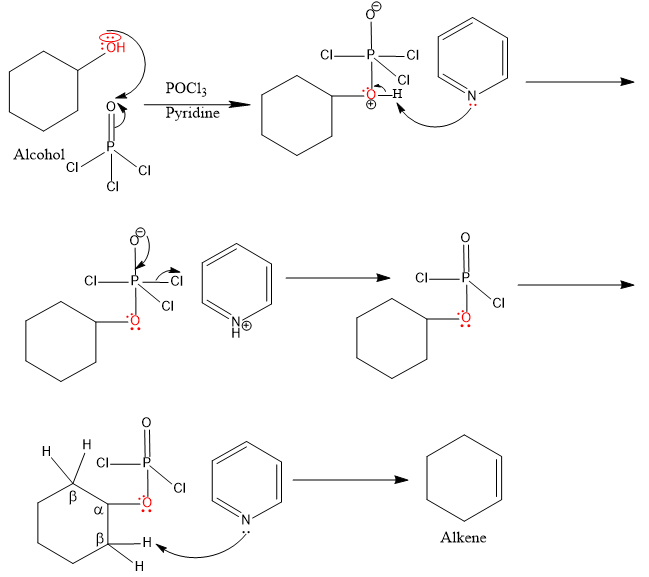
In the above reaction we observe,
- No carbocation formation
- Nucleophilic attack used for deprotonation
- involves E2 mechanism as pyridine base abstracts proton from the adjacent carbon as the same time at which $-\text{OPOC}{{\text{l}}_{2}}$ is leaving
- involves $\text{R}-\text{OPOC}{{\text{l}}_{2}}$ with $-\text{OPOC}{{\text{l}}_{2}}$ as a better leaving group
Based on the above statements we can conclude that the below given options stand correct.
(A) It does not involve carbocation.
(B) It involves the species $\text{R}-\text{OPOC}{{\text{l}}_{2}}$ with $-\text{OPOC}{{\text{l}}_{2}}$ as a better leaving group.
(C) It involves E2 mechanism as the pyridine base abstracts proton from the adjacent carbon as the same time at which $-\text{OPOC}{{\text{l}}_{2}}$ is leaving.
The correct answer is option “A, B and C” .
Note: The reaction with sulfuric acid on the other hand involves the formation of carbocation. This is a slow step. Along with that it uses the E1 mechanism for elimination unlike $POC{{l}_{3}}$ that uses the E2 mechanism for elimination.
Complete step by step answer:
So in the question it is asked that, we have to select
We will write the reaction mechanism for dehydration using $POC{{l}_{3}}$.
In the above reaction we observe,
- No carbocation formation
- Nucleophilic attack used for deprotonation
- involves E2 mechanism as pyridine base abstracts proton from the adjacent carbon as the same time at which $-\text{OPOC}{{\text{l}}_{2}}$ is leaving
- involves $\text{R}-\text{OPOC}{{\text{l}}_{2}}$ with $-\text{OPOC}{{\text{l}}_{2}}$ as a better leaving group
Based on the above statements we can conclude that the below given options stand correct.
(A) It does not involve carbocation.
(B) It involves the species $\text{R}-\text{OPOC}{{\text{l}}_{2}}$ with $-\text{OPOC}{{\text{l}}_{2}}$ as a better leaving group.
(C) It involves E2 mechanism as the pyridine base abstracts proton from the adjacent carbon as the same time at which $-\text{OPOC}{{\text{l}}_{2}}$ is leaving.
The correct answer is option “A, B and C” .
Note: The reaction with sulfuric acid on the other hand involves the formation of carbocation. This is a slow step. Along with that it uses the E1 mechanism for elimination unlike $POC{{l}_{3}}$ that uses the E2 mechanism for elimination.
Recently Updated Pages
Master Class 12 Economics: Engaging Questions & Answers for Success

Master Class 12 Social Science: Engaging Questions & Answers for Success
Master Class 12 English: Engaging Questions & Answers for Success
Master Class 12 Maths: Engaging Questions & Answers for Success
Master Class 12 Physics: Engaging Questions & Answers for Success
Master Class 12 Biology: Engaging Questions & Answers for Success
Trending doubts
Draw a labelled sketch of the human eye class 12 physics CBSE
Which are the Top 10 Largest Countries of the World?
Draw ray diagrams each showing i myopic eye and ii class 12 physics CBSE
Which is the correct genotypic ratio of mendel dihybrid class 12 biology CBSE
Differentiate between homogeneous and heterogeneous class 12 chemistry CBSE
Which animal never drinks water in its entire life class 12 biology CBSE