



How many degrees are in the sum of measures of complementary angles?
Answer
 Verified
546.6k+ views
Hint: As we know that the complementary angles are the two angles that are complement to one another means the sum of those angles are \[90{}^\circ \]. When a line divides a right angle then these two angles will be termed as the complementary angles. Let suppose the angle bisector of a right angle then the bisected angles will be of \[45{}^\circ \] each, then these two angles are complementary to another.
Complete step by step solution:
Since there are many special relations that can be formed using angles.
And one of the relation is complementary angles
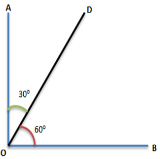
Given that, \[OA\bot OB\]
\[\Rightarrow \angle AOB=90{}^\circ \]
Also,
\[\begin{align}
& \angle AOD=30{}^\circ \\
& \angle DOB=60{}^\circ \\
\end{align}\]
Here, \[\angle AOD\] and \[\angle DOB\] are the complementary angles as the sum of these angles are \[90{}^\circ \].
Note:
The complementary angles are the angles which are complement to one another and the sum of these angles are \[90{}^\circ \]. Means when we say these two angles are complementary then their sum must be of \[90{}^\circ \]. In case of angle bisectors these two angles are equal and will be equal to \[45{}^\circ \] each as the angle bisector bisects the angle means divide the angle in two equal measures.
Complete step by step solution:
Since there are many special relations that can be formed using angles.
And one of the relation is complementary angles
Given that, \[OA\bot OB\]
\[\Rightarrow \angle AOB=90{}^\circ \]
Also,
\[\begin{align}
& \angle AOD=30{}^\circ \\
& \angle DOB=60{}^\circ \\
\end{align}\]
Here, \[\angle AOD\] and \[\angle DOB\] are the complementary angles as the sum of these angles are \[90{}^\circ \].
Note:
The complementary angles are the angles which are complement to one another and the sum of these angles are \[90{}^\circ \]. Means when we say these two angles are complementary then their sum must be of \[90{}^\circ \]. In case of angle bisectors these two angles are equal and will be equal to \[45{}^\circ \] each as the angle bisector bisects the angle means divide the angle in two equal measures.

Recently Updated Pages
Master Class 9 General Knowledge: Engaging Questions & Answers for Success

Master Class 9 Social Science: Engaging Questions & Answers for Success
Master Class 9 English: Engaging Questions & Answers for Success
Master Class 9 Maths: Engaging Questions & Answers for Success
Master Class 9 Science: Engaging Questions & Answers for Success
Class 9 Question and Answer - Your Ultimate Solutions Guide
Trending doubts
Difference Between Plant Cell and Animal Cell
Fill the blanks with the suitable prepositions 1 The class 9 english CBSE
Who is eligible for RTE class 9 social science CBSE
Which places in India experience sunrise first and class 9 social science CBSE
What is pollution? How many types of pollution? Define it
Name 10 Living and Non living things class 9 biology CBSE