




Define the term Displacement. Is it a vector or a scalar quantity?
Answer
 Verified
555k+ views
Hint: We should be clear about scalar and vector terms before proceeding to the answer. There is a minute difference between both terms and this difference brings about great change in various aspects of physics. These terms are based on two factors, magnitude and direction.
Complete answer:
Vector is the term used for quantities that have magnitude along with direction while scalar term defines the quantities that have only magnitude and no direction. Vector quantities include displacement, acceleration, force, weight and many more. While mass, speed, distance, temperature etc. are all scalar quantities.
Displacement can be defined as the shortest path between the starting point and the final destination point. It is generally shorter or equal to the distance covered by the object. it doesn’t tell us about the actual path on which our object travelled.
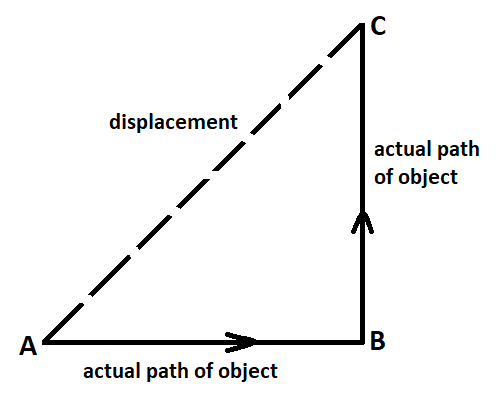
For example as in the above figure, the object travelled from A to B, then from B to C. ABC denotes the actual path travelled by the object but it is not the displacement of the object. It is the distance covered by an object. To calculate the displacement, we need to join the initial point with the final point (i.e. A to C). The path AC denotes the displacement of the object.
Displacement is a vector quantity i.e. dependent on magnitude as well as direction. With change in direction of motion or displacement its value also varies. As it is directional value hence it can have negative magnitude i.e. displacement will always be an integer number.
Note: Negative value of displacement defines the opposite direction of motion on the X and Y plane. Distance being a scalar can only be positive in magnitude. In the equations of motion, displacement is considered over distance.
Complete answer:
Vector is the term used for quantities that have magnitude along with direction while scalar term defines the quantities that have only magnitude and no direction. Vector quantities include displacement, acceleration, force, weight and many more. While mass, speed, distance, temperature etc. are all scalar quantities.
Displacement can be defined as the shortest path between the starting point and the final destination point. It is generally shorter or equal to the distance covered by the object. it doesn’t tell us about the actual path on which our object travelled.
For example as in the above figure, the object travelled from A to B, then from B to C. ABC denotes the actual path travelled by the object but it is not the displacement of the object. It is the distance covered by an object. To calculate the displacement, we need to join the initial point with the final point (i.e. A to C). The path AC denotes the displacement of the object.
Displacement is a vector quantity i.e. dependent on magnitude as well as direction. With change in direction of motion or displacement its value also varies. As it is directional value hence it can have negative magnitude i.e. displacement will always be an integer number.
Note: Negative value of displacement defines the opposite direction of motion on the X and Y plane. Distance being a scalar can only be positive in magnitude. In the equations of motion, displacement is considered over distance.
Recently Updated Pages
Master Class 11 Social Science: Engaging Questions & Answers for Success

Master Class 11 English: Engaging Questions & Answers for Success
Master Class 11 Accountancy: Engaging Questions & Answers for Success
Master Class 11 Physics: Engaging Questions & Answers for Success
Master Class 11 Computer Science: Engaging Questions & Answers for Success
Master Class 11 Business Studies: Engaging Questions & Answers for Success
Trending doubts
Find the value of the expression given below sin 30circ class 11 maths CBSE
One Metric ton is equal to kg A 10000 B 1000 C 100 class 11 physics CBSE
Draw a diagram of nephron and explain its structur class 11 biology CBSE
10 examples of friction in our daily life
Proton was discovered by A Thomson B Rutherford C Chadwick class 11 chemistry CBSE
The teeth used for biting and cutting food are called class 11 biology CBSE