



Define Supplementary Angles.
Answer
 Verified
644.4k+ views
Hint: We recall the definition of the supplementary angles which is a pair of angles whose sum of measures is equal to the measure of a straight angle or $180{}^\circ $. The two supplementary angles may be subtended on a straight line or may exist separately. \[\]
Complete step-by-step answer:
We know that the measure of an angle is the amount of rotation taken in an anti-clockwise direction . Let us take two lines $AB$ and $CD$ intersect each other at the point $O.$\[\]
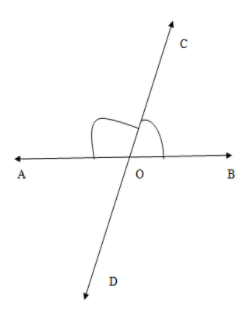
We observe that we have obtained four angles $\angle AOC,\angle BOC,\angle AOD,\angle BOD$ . We know that a straight angle is an angle on a straight line. A straight angle is always measured as ${{180}^{\circ }}$. We have a pair of straight angles above and below the line $AB$ which is $\angle AOB={{180}^{\circ }}$. Similarly we have two straight angles on both left and right side of the straight line $CD$ which is $\angle COD={{180}^{\circ }}$.
We observe angles subtended by ray $\overrightarrow{OC}$ above the line $AB$ whose sum is $\angle AOB$ and angles subtended by the ray $\overrightarrow{OD}$ below the line $AB$ whose sum is also $\angle AOB$. We have
\[\begin{align}
& \angle AOC+\angle BOC=\angle AOB={{180}^{\circ }} \\
& \angle AOD+\angle BOD=\angle AOB={{180}^{\circ }} \\
\end{align}\]
So the pair of angles $\angle AOC,\angle BOC$ and the pair of angles $\angle AOD,\angle BOD$ are supplementary angles. We also have angles subtended by ray $\overrightarrow{OA}$ on the left side of the line $CD$ whose sum is $\angle COD$ and angles subtended by the ray $\overrightarrow{OB}$ on the right side of the line $CD$ whose sum is also $\angle COD$. We have
\[\begin{align}
& \angle AOC+\angle AOD=\angle COD={{180}^{\circ }} \\
& \angle BOC+\angle BOD=\angle COD={{180}^{\circ }} \\
\end{align}\]
So the pair of angles $\angle AOC,\angle AOD $ and the pair of angles $\angle BOC,\angle BOD$ are supplementary angles. The supplementary angles can also exist not subtended on a straight line. \[\]
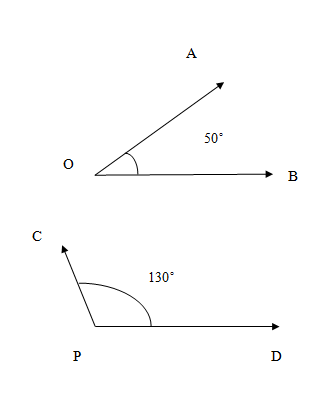
The above angles $\angle AOB,\angle CPD$ are not subtended on straight line but they are supplementary angles because $\angle AOB+\angle CPD={{30}^{\circ }}+{{150}^{\circ }}={{180}^{\circ }}$\[\]
Note: We note that supplementary angles are different from complementary angles which are a pair of angles whose sum of measure is a measurement of a right angle which is ${{90}^{\circ }}$. The sum of two supplementary angles in radian in $\pi .$ Some well known examples of supplementary angles are the adjacent angles of a parallelogram, co-interior angles, the opposite angles of a quadrilateral inscribed in a circle etc.
Complete step-by-step answer:
We know that the measure of an angle is the amount of rotation taken in an anti-clockwise direction . Let us take two lines $AB$ and $CD$ intersect each other at the point $O.$\[\]
We observe that we have obtained four angles $\angle AOC,\angle BOC,\angle AOD,\angle BOD$ . We know that a straight angle is an angle on a straight line. A straight angle is always measured as ${{180}^{\circ }}$. We have a pair of straight angles above and below the line $AB$ which is $\angle AOB={{180}^{\circ }}$. Similarly we have two straight angles on both left and right side of the straight line $CD$ which is $\angle COD={{180}^{\circ }}$.
We observe angles subtended by ray $\overrightarrow{OC}$ above the line $AB$ whose sum is $\angle AOB$ and angles subtended by the ray $\overrightarrow{OD}$ below the line $AB$ whose sum is also $\angle AOB$. We have
\[\begin{align}
& \angle AOC+\angle BOC=\angle AOB={{180}^{\circ }} \\
& \angle AOD+\angle BOD=\angle AOB={{180}^{\circ }} \\
\end{align}\]
So the pair of angles $\angle AOC,\angle BOC$ and the pair of angles $\angle AOD,\angle BOD$ are supplementary angles. We also have angles subtended by ray $\overrightarrow{OA}$ on the left side of the line $CD$ whose sum is $\angle COD$ and angles subtended by the ray $\overrightarrow{OB}$ on the right side of the line $CD$ whose sum is also $\angle COD$. We have
\[\begin{align}
& \angle AOC+\angle AOD=\angle COD={{180}^{\circ }} \\
& \angle BOC+\angle BOD=\angle COD={{180}^{\circ }} \\
\end{align}\]
So the pair of angles $\angle AOC,\angle AOD $ and the pair of angles $\angle BOC,\angle BOD$ are supplementary angles. The supplementary angles can also exist not subtended on a straight line. \[\]
The above angles $\angle AOB,\angle CPD$ are not subtended on straight line but they are supplementary angles because $\angle AOB+\angle CPD={{30}^{\circ }}+{{150}^{\circ }}={{180}^{\circ }}$\[\]
Note: We note that supplementary angles are different from complementary angles which are a pair of angles whose sum of measure is a measurement of a right angle which is ${{90}^{\circ }}$. The sum of two supplementary angles in radian in $\pi .$ Some well known examples of supplementary angles are the adjacent angles of a parallelogram, co-interior angles, the opposite angles of a quadrilateral inscribed in a circle etc.
Recently Updated Pages
Which will be the least stable resonating structure class 11 chemistry CBSE

Explain the structure of megasporangium class 12 biology CBSE
Differentiate between voluntary action and reflex class 10 biology CBSE
How many 5 digit telephone numbers can be construc-class-11-maths-CBSE
How do you find the angle of the resultant vector class 11 physics CBSE
Why is chloroform kept in dark coloured bottles class 12 chemistry CBSE
Trending doubts
The common name of Rheo leaf is A Oyster plant B Boat class 9 biology CBSE
Difference Between Plant Cell and Animal Cell
Fill the blanks with the suitable prepositions 1 The class 9 english CBSE
What is the full form of pH?
Any five important events between the years 1930 to class 9 social science CBSE
On an outline map of India show its neighbouring c class 9 social science CBSE