




Define resistivity of a material. Give its units.
Answer
 Verified
680.1k+ views
Hint: Resistance per unit length and cross-sectional area is called resistivity. It depends on the length and area of the cross–section of the conductor. Its unit is ohm-meter (\[\Omega m\]).
Complete step by step answer:
When an electric current is allowed to pass through a material, it experiences some opposition in its motion. This may be due to friction or some other reasons. This opposition is together known as the resistance of the conductor. Like you, we are aware that conductors are materials that allow the electric current to pass through it. Due to this resistance, the material starts to get heated up, which leads to energy loss.
Insulators have higher resistance compared to that of semiconductors and conductors. Thus conductors allow current to pass through it, due to low resistance. The resistance depends on the length and cross-sectional area of the conductor. It is directly proportional to the length and inversely proportional to the area of cross-section. Let us consider a material of length l and area of cross-section a.
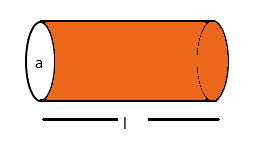
So we can write it in the equation from as
\[R=k\dfrac{l}{A}\]where k is a proportionality constant.
This indicates as length increases, resistance increases, and as the area of cross-section increases, resistance decreases.
Now substituting the value of k, we get
\[R=\rho \dfrac{l}{A}\]……………………….(1)
Here \[\rho \] is the constant called resistivity. The resistance per unit length and cross-sectional area is called resistivity. It is constant for each material. The resistivity changes from material to material.
Or in terms of \[\rho \], wee a write the equation(1) as
\[\rho =R\dfrac{A}{l}\]……………………….(2)
Which means it is proportional to the area of cross-section and inversely proportional to the length of the conductor.
If the area of cross-section and length of the conductor is one, then we get
\[\rho =R\]…………………………(3)
Then the resistance is equal to resistivity. Resistivity is also known as specific resistance.
The unit of resistance is ohm (\[\Omega \]). Then for resistivity, it is ohm meter
(\[\Omega m\]).
The resistivity of the alloy is high compared to that of their constituent metals.
Note: The dimensional formula of resistivity is \[\left[ M{{L}^{3}}{{T}^{-3}}{{A}^{-2}} \right]\]. And for resistance, the dimensional formula is\[\left[ M{{L}^{2}}{{T}^{-3}}{{I}^{-2}} \right]\]. Resistance is the property of a material and depends on temperature.
Complete step by step answer:
When an electric current is allowed to pass through a material, it experiences some opposition in its motion. This may be due to friction or some other reasons. This opposition is together known as the resistance of the conductor. Like you, we are aware that conductors are materials that allow the electric current to pass through it. Due to this resistance, the material starts to get heated up, which leads to energy loss.
Insulators have higher resistance compared to that of semiconductors and conductors. Thus conductors allow current to pass through it, due to low resistance. The resistance depends on the length and cross-sectional area of the conductor. It is directly proportional to the length and inversely proportional to the area of cross-section. Let us consider a material of length l and area of cross-section a.
So we can write it in the equation from as
\[R=k\dfrac{l}{A}\]where k is a proportionality constant.
This indicates as length increases, resistance increases, and as the area of cross-section increases, resistance decreases.
Now substituting the value of k, we get
\[R=\rho \dfrac{l}{A}\]……………………….(1)
Here \[\rho \] is the constant called resistivity. The resistance per unit length and cross-sectional area is called resistivity. It is constant for each material. The resistivity changes from material to material.
Or in terms of \[\rho \], wee a write the equation(1) as
\[\rho =R\dfrac{A}{l}\]……………………….(2)
Which means it is proportional to the area of cross-section and inversely proportional to the length of the conductor.
If the area of cross-section and length of the conductor is one, then we get
\[\rho =R\]…………………………(3)
Then the resistance is equal to resistivity. Resistivity is also known as specific resistance.
The unit of resistance is ohm (\[\Omega \]). Then for resistivity, it is ohm meter
(\[\Omega m\]).
The resistivity of the alloy is high compared to that of their constituent metals.
Note: The dimensional formula of resistivity is \[\left[ M{{L}^{3}}{{T}^{-3}}{{A}^{-2}} \right]\]. And for resistance, the dimensional formula is\[\left[ M{{L}^{2}}{{T}^{-3}}{{I}^{-2}} \right]\]. Resistance is the property of a material and depends on temperature.
Recently Updated Pages
Master Class 12 Physics: Engaging Questions & Answers for Success

Master Class 12 Social Science: Engaging Questions & Answers for Success
Master Class 12 English: Engaging Questions & Answers for Success
Master Class 12 Maths: Engaging Questions & Answers for Success
Master Class 12 Business Studies: Engaging Questions & Answers for Success
Master Class 12 Chemistry: Engaging Questions & Answers for Success
Trending doubts
Draw a labelled sketch of the human eye class 12 physics CBSE
Which are the Top 10 Largest Countries of the World?
Draw ray diagrams each showing i myopic eye and ii class 12 physics CBSE
One megawatt is equal to how many units of electri class 12 physics CBSE
Which is the correct genotypic ratio of mendel dihybrid class 12 biology CBSE
Give 10 examples of unisexual and bisexual flowers