



Define Raoult’s Law for the elevation of boiling point of a solution.
Answer
 Verified
591.9k+ views
Hint:According to Raoult's law, elevation of boiling point of a solution is directly proportional to the lowering in vapour pressure caused by the number of particles of solute present in the solution.
\[\Delta {T_b} = \dfrac{{{K_b} \times {w_B} \times 1000}}{{{M_B} \times {w_A}}}\]
$\Delta {T_b} = {K_b} \times m$
Where,
$\Delta {T_b}$= Boiling point elevation
${K_b}$= Molal boiling point elevation constant ( also called ebullioscopic constant )
${w_b}$= given weight of solute
${M_b}$= Molecular mass of solute
${w_A}$= Given weight of solvent
$m$= molarity of solution
Complete step by step answer:
Elevation in boiling point:
The boiling point of a liquid is the temperature at which the vapour pressure of the liquid becomes equal to the atmospheric pressure.
For Example, vapour pressure of water is $1atm$ at $373K$. Therefore, water boils at $373K$ because its vapour pressure at this temperature becomes equal to one atmospheric pressure which is $1.013bar$. The vapour pressure of an aqueous solution of sucrose is less than $1.013bar$ at $373K$ and therefore the solution will not boil at $373K$.
In order to make the solution boil, its temperature must be increased so that its vapour pressure becomes equal to $1atm$. Thus, boiling point of a solution is always higher than the boiling point of the pure solvent in which the solvent is prepared.
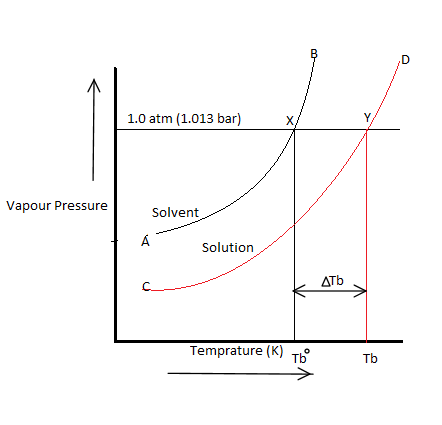
The elevation in boiling point on the addition of a non-volatile solute to a solvent can be easily illustrated graphically as shown above.
It is clear from the figure that the vapour pressure of the pure solvent becomes equal to atmospheric pressure at $X$ ( corresponding to temperature ${T_b}^0$) while the vapour pressure of the solution becomes equal to atmospheric pressure at $Y$( corresponding to the temperature ${T_b}$).
$\Delta {T_b} = {T_b} - {T_b}^0$
Note:
For a solution of two liquids A and B, Raoult's law predicts that if no other gases are present, then the total vapor pressure $p$ above the solution is equal to the weighted sum of the "pure" vapor pressures ${p_A}$ and ${p_B}$ of the two components. Hence, the total pressure above the solution of A and B would be:
$p = {p_A}{\chi _A} + {p_B}{\chi _B}$
\[\Delta {T_b} = \dfrac{{{K_b} \times {w_B} \times 1000}}{{{M_B} \times {w_A}}}\]
$\Delta {T_b} = {K_b} \times m$
Where,
$\Delta {T_b}$= Boiling point elevation
${K_b}$= Molal boiling point elevation constant ( also called ebullioscopic constant )
${w_b}$= given weight of solute
${M_b}$= Molecular mass of solute
${w_A}$= Given weight of solvent
$m$= molarity of solution
Complete step by step answer:
Elevation in boiling point:
The boiling point of a liquid is the temperature at which the vapour pressure of the liquid becomes equal to the atmospheric pressure.
For Example, vapour pressure of water is $1atm$ at $373K$. Therefore, water boils at $373K$ because its vapour pressure at this temperature becomes equal to one atmospheric pressure which is $1.013bar$. The vapour pressure of an aqueous solution of sucrose is less than $1.013bar$ at $373K$ and therefore the solution will not boil at $373K$.
In order to make the solution boil, its temperature must be increased so that its vapour pressure becomes equal to $1atm$. Thus, boiling point of a solution is always higher than the boiling point of the pure solvent in which the solvent is prepared.
The elevation in boiling point on the addition of a non-volatile solute to a solvent can be easily illustrated graphically as shown above.
It is clear from the figure that the vapour pressure of the pure solvent becomes equal to atmospheric pressure at $X$ ( corresponding to temperature ${T_b}^0$) while the vapour pressure of the solution becomes equal to atmospheric pressure at $Y$( corresponding to the temperature ${T_b}$).
$\Delta {T_b} = {T_b} - {T_b}^0$
Note:
For a solution of two liquids A and B, Raoult's law predicts that if no other gases are present, then the total vapor pressure $p$ above the solution is equal to the weighted sum of the "pure" vapor pressures ${p_A}$ and ${p_B}$ of the two components. Hence, the total pressure above the solution of A and B would be:
$p = {p_A}{\chi _A} + {p_B}{\chi _B}$
Recently Updated Pages
Master Class 12 Business Studies: Engaging Questions & Answers for Success

Master Class 12 Chemistry: Engaging Questions & Answers for Success
Master Class 12 Biology: Engaging Questions & Answers for Success
Class 12 Question and Answer - Your Ultimate Solutions Guide
Master Class 11 English: Engaging Questions & Answers for Success
Master Class 11 Maths: Engaging Questions & Answers for Success
Trending doubts
Which is more stable and why class 12 chemistry CBSE
Which are the Top 10 Largest Countries of the World?
Draw a labelled sketch of the human eye class 12 physics CBSE
Differentiate between homogeneous and heterogeneous class 12 chemistry CBSE
What are the major means of transport Explain each class 12 social science CBSE
Sulphuric acid is known as the king of acids State class 12 chemistry CBSE