




Define magnetic ‘declination’ and ‘dip’ at a place.
Answer
 Verified
587.7k+ views
Hint: If you tie the centre of a permanent magnet with a string and let it rotate freely around the axis, we can determine the magnetic ‘declination’ and ‘dip’ at that place. The terminologies are self-explanatory.
Complete answer:
Both magnetic ‘declination’ and ‘dip’ can be observed if you let a permanent magnet move freely around its axis. Let's first look at the Magnetic Declination.
Magnetic Declination:
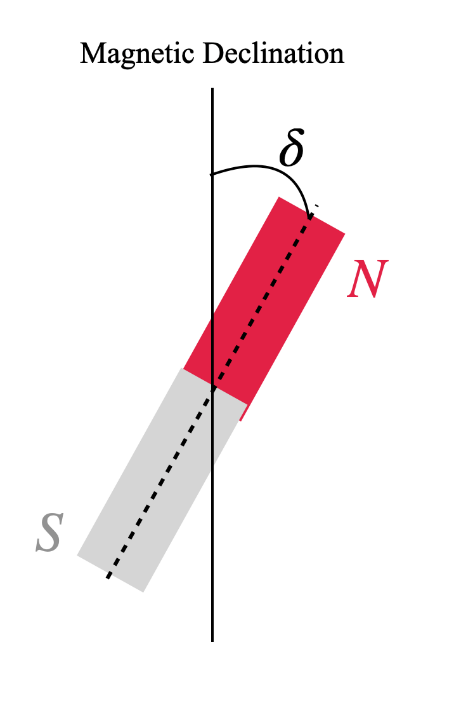
Magnetic Declination is the angle between the direction of the true geographical north pole and the magnetic north pole from that place. True North pole is the actual geographical north pole and Magnetic north pole is the north pole towards which the permanent magnet would point. There is a small difference in the direction and this deviation changes from place to place. It happens because the magnetic north pole never stays constant.
If the magnet points towards the east of the actual north pole, then the declination is positive. If the magnet towards the west, then the declination is negative.
The following figure clearly shows the declination of a magnet.
Magnetic Dip:
Now, let us look at the Magnetic Dip.
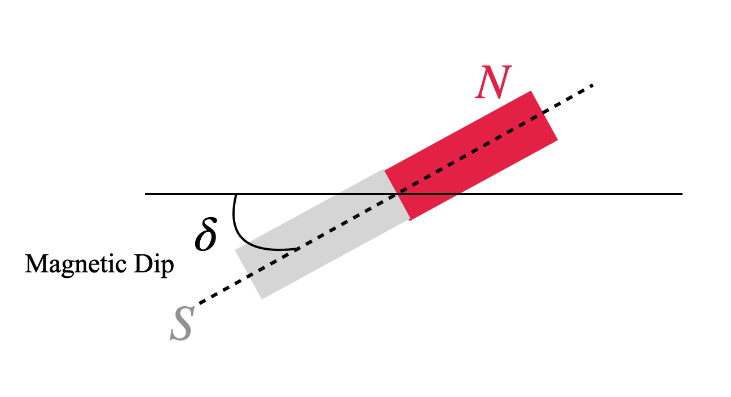
Magnetic dip is the angle the magnet would form with the horizontal. It is basically the angle between the magnetic fields at that place and the horizontal line. The dip angle or magnetic inclination is considered to be positive if the magnet is pointing downwards and negative if it is pointing upwards.
Note:
You can determine both of these quantities accurately if you have correct measuring tools. This gives us a clear idea about the magnetic fields of the earth. It changes continuously and follows a repeating pattern through the years. Solar flares can change the magnetic fields significantly and you can observe this using these two quantities.
Complete answer:
Both magnetic ‘declination’ and ‘dip’ can be observed if you let a permanent magnet move freely around its axis. Let's first look at the Magnetic Declination.
Magnetic Declination:
Magnetic Declination is the angle between the direction of the true geographical north pole and the magnetic north pole from that place. True North pole is the actual geographical north pole and Magnetic north pole is the north pole towards which the permanent magnet would point. There is a small difference in the direction and this deviation changes from place to place. It happens because the magnetic north pole never stays constant.
If the magnet points towards the east of the actual north pole, then the declination is positive. If the magnet towards the west, then the declination is negative.
The following figure clearly shows the declination of a magnet.
Magnetic Dip:
Now, let us look at the Magnetic Dip.
Magnetic dip is the angle the magnet would form with the horizontal. It is basically the angle between the magnetic fields at that place and the horizontal line. The dip angle or magnetic inclination is considered to be positive if the magnet is pointing downwards and negative if it is pointing upwards.
Note:
You can determine both of these quantities accurately if you have correct measuring tools. This gives us a clear idea about the magnetic fields of the earth. It changes continuously and follows a repeating pattern through the years. Solar flares can change the magnetic fields significantly and you can observe this using these two quantities.
Recently Updated Pages
Basicity of sulphurous acid and sulphuric acid are

Master Class 12 Economics: Engaging Questions & Answers for Success
Master Class 12 Biology: Engaging Questions & Answers for Success
Master Class 11 English: Engaging Questions & Answers for Success
Master Class 11 Physics: Engaging Questions & Answers for Success
Master Class 11 Computer Science: Engaging Questions & Answers for Success
Trending doubts
Draw a labelled sketch of the human eye class 12 physics CBSE
The chemical formula of tear gas is A CO Cl 2 B C 10 class 12 chemistry CBSE
Draw ray diagrams each showing i myopic eye and ii class 12 physics CBSE
Which are the Top 10 Largest Countries of the World?
Differentiate between homogeneous and heterogeneous class 12 chemistry CBSE
Which is the correct genotypic ratio of mendel dihybrid class 12 biology CBSE